
Happy Sunday, readers! I hope everyone has had a blessed day thus far. Today, I will be covering the fourth chapter of 1 Nephi, which is quite a chapter. As I’ve pointed out in previous posts, a common theme thus far is strange similarities to Old Testament stories. In fact, the accusation of plagiarism is a fairly common one. In his book, “The Kingdom of the Cults” author Walter Martin argues the reason sections of the Book of Mormon so closely resemble passages from the KJV is because he copied parts of the 1769 KJV. Another criticism offered is the Book of Mormon contains various translation errors and passages lifted from the New Testament. The obvious issue with this is that the events in the New Testament were written centuries after when the events of Book of Mormon were purported to take place. He also points out the idea of ancient Hebrews being ancestors of American Indigenous people was common in contemporary sources, such as “View of the Hebrews” by Ethan Smith (1823). This theory is also put forth by author Fawn M. Brodie in her book “No Man Knows My History: The Life of Joseph Smith.” I highly recommend these books for anyone wanting more information. Now, onto today’s reading.
1 Nephi Chapter 4
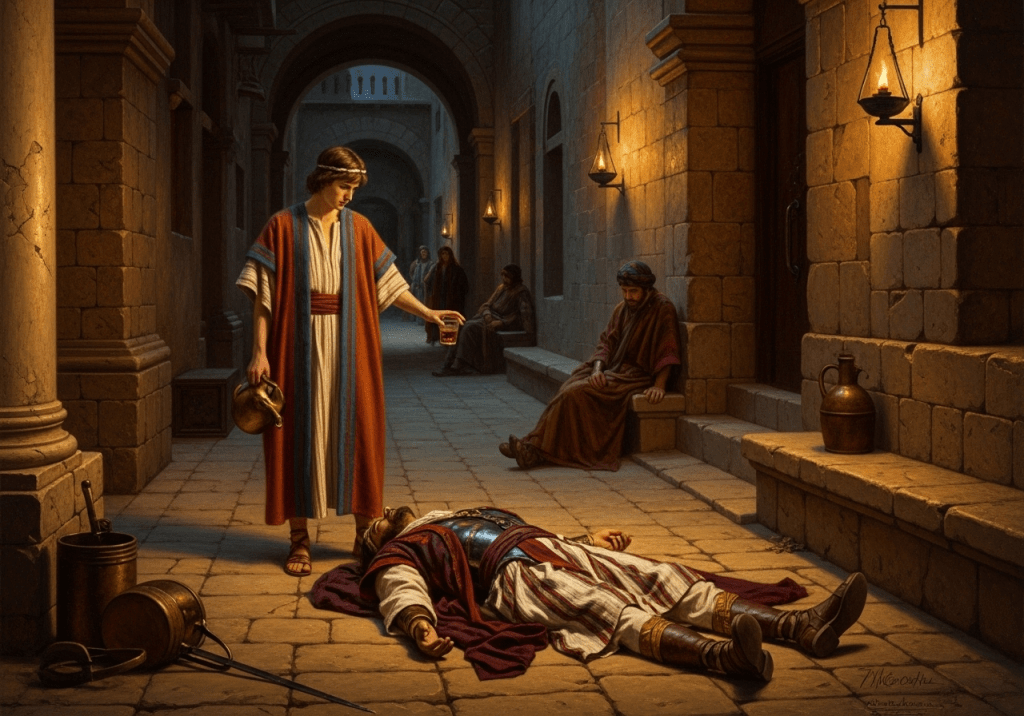
Nephi slays Laban at the Lord’s command and then secures the plates of brass by stratagem– Zoram chooses to join Lehi’s family in the wilderness. About 600-592 B.C.
2: Therefore, let us go up; let us be strong like unto Moses; for he truly spake unto the waters of the Red Sea and and they divided hither and thither, and our fathers came through, out of captivity, on dry ground, and the armies of Pharaoh did follow and were drowned in the waters of the Red Sea.
3: Now behold ye know that this is true; and ye also know that an angel hath spoken unto you; wherefore can ye doubt? Let us go up; the Lord is able to deliver us, even as our fathers, and to destroy Laban, even as the Egyptians.
See Joshua’s response to Israel regarding their doubt about being able to overthrow the Canaanites in Numbers 14: 6-9. This further confirms my theory that the stories put forth in the Book of Mormon are not original but borrowed from the Old Testament and repackaged as original and new.
7: Nevertheless I went forth, and as I came near the house of Laban I beheld a man, and he had fallen to the earth before me, for he was drunken with wine.
8: And when I came to him I found that it was Laban.
The next verses describe God convincing Nephi to kill Laban while he’s passed out drunk so he can take the plates. This is an odd series of events, because he could have simply taken them while Laban was so inebriated that he was rendered unconscious. Nephi hesitates, and God tells him more than once that he has delivered Laban into his hands. This reads like Joseph Smith wishes David would have killed Saul when he had more than one chance to do so. See 1 Samuel 24 and 26. It is important to note that there is not a single instance of God EVER ordering someone to kill another person in their sleep in the Bible. As much as I gleefully enjoy the story of Jael, God didn’t order her to drive a tent stake through Sisera’s head (See Judges 4).
13: Behold the Lord slayeth the wicked to bring forth his righteous purposes. It is better that one man should perish than that a nation should dwindle and perish in unbelief.
14: And now, when I, Nephi, had heard these words, I remembered the words of the Lord which he spake unto me in the wilderness, saying that: Inasmuch as thy seed shall keep my commandments, they shall prosper in the land of promise.
15: Yea, and I also thought that they could not keep the commandments of the Lord according to the law of Moses, save they should have the law.
16: And I also knew that the law was engraven upon the plates of brass.
At the risk of repeating myself, I will once again state that the laws and books Moses wrote were already available as well as the writings of Old Testament prophets. These supposed plates contained nothing new, so there would be no reason to act as if they were the last hope of preserving the laws, and there would certainly be no reason to decapitate a drunk man over them.
19: And after I had smitten off his head with his own sword, I took the garments of Laban and put them on mine own body; yea, even every whit; and I did gird on his armor about my loins.
Why was Laban drinking in town in his armor with his sword? And would anyone put on the bloody clothes of someone they just killed? Decapitations are messy. There was no way that clothing and armor weren’t covered in blood.
20: And after I had done this, I went forth unto the treasury of Laban. And as I went forth towards the treasury of Laban, behold, I saw the servant of Laban who had the keys of the treasury. And I commanded him in the voice of Laban, that he should go with me into the treasury.
21: And he supposed me to be his master, Laban, for he beheld the garments and also the sword girded about my loins.
So he didn’t notice the blood all over Nephi and didn’t see his face the whole time they were talking? Was Nephi really that good at impersonating the voice of a man he had only spoken to once or twice? Was he really so convincing that the servant willingly went with him?
24: And I also spake unto him that I should carry the engravings, which were upon the plates of brass, to my elder brethren, who were without the walls.
25: And I also bade him that he should follow me.
26: And he, supposing that I spake of the brethren of the church, and that I was truly that Laban whom I had slain, wherefore he did follow me.
In addition to the other problems that have already been discussed, there is a glaring issue in verse 26: the word “church.” That word did not exist during the Old Testament. When recording the Israelites gathering to offer sacrifices and to worship God, they were called a “congregation” or “assembly.” The word and the concept of “church” is specific to New Testament Christians. It was never used in regards to gatherings of Jews.
The next few verses describe the servant going with Nephi to reunite with his brothers and realizing that he is not Laban. Then this happens:
31: And now I, Nephi, being a man large in stature, and also having received much strength of the Lord, therefore I did seize upon the servant of Laban, and held him, that he should not flee.
32: And it came to pass that I spake with him, that if he would hearken unto my words, as the Lord liveth, and as I live, even so that if he would hearken unto our words, that we would spare his life.
33: And I spake unto him, that he need not fear; that he should be a free man like unto us if he would go down in the wilderness with us.
“Go with us or we’ll kill you” does not constitute an offer of freedom.
35: And it came to pass that Zoram did take courage at the words which I spake. Now Zoram was the name of the servant; and he promised he would go down into the wilderness unto our father. Yea, and he also made an oath unto us that he would tarry with us from that time forth.
Is an oath made under threat of death really sincere? This entire chapter is incredibly far-fetched and makes no theological sense. The God of the Book of Mormon already differs from the Biblical God in that He orders an unnecessary execution on someone who was black-out drunk. I have a sneaking suspicion I will be seeing more of this in subsequent passages. I will continue this journey tomorrow.
 The Inquisitive Christian
Leave a comment