
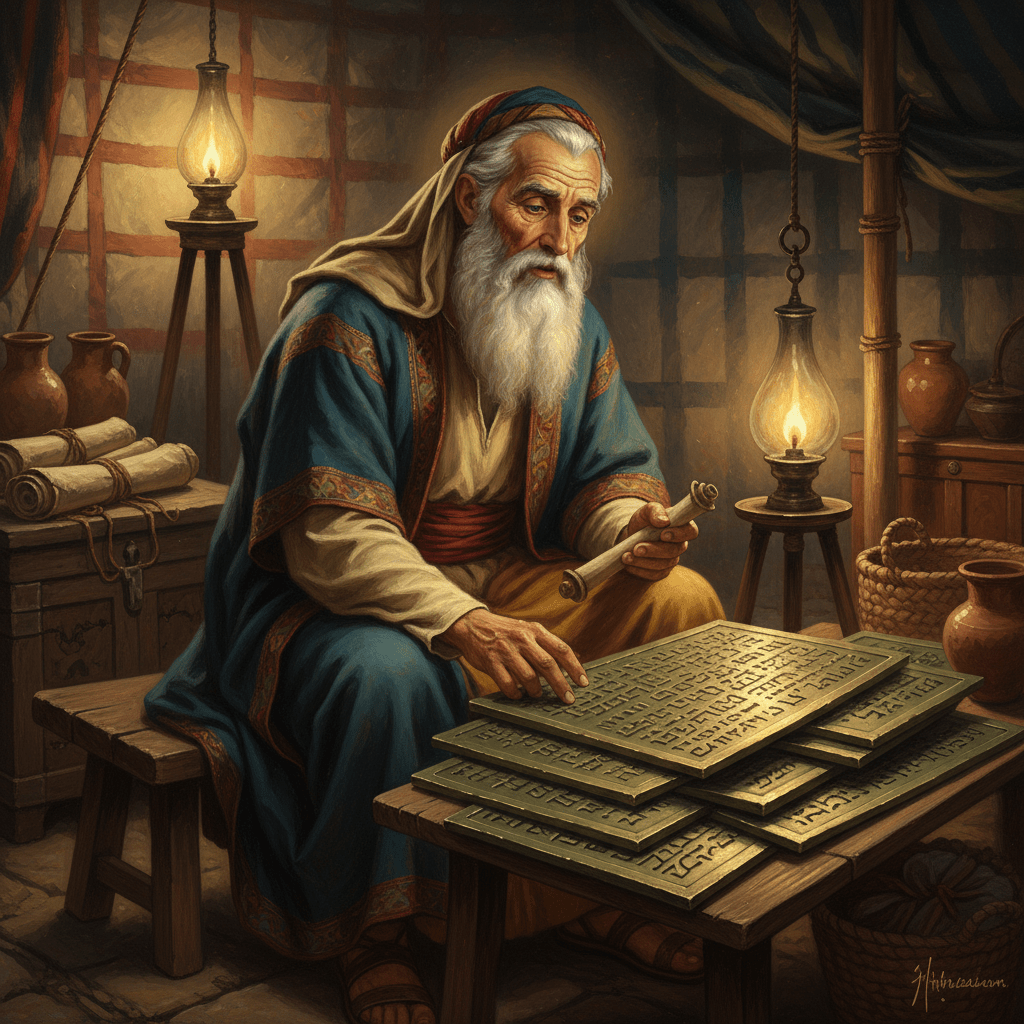
Nephi Chapter 5
Sariah complains against Lehi- both rejoice over the return of their sons– They offer sacrifices– the plates of brass contain the writings of Moses and the prophets– the plates identify Lehi as a descendent of Joseph. Lehi prophesies concerning his seed and the preservation of the plates. About 600-592 B.C.
5: But behold, I have obtained a land of promise, in the which things I do rejoice; yea, and I know that the Lord will deliver my sons out of the hands of Laban, and bring them down again unto us in the wilderness.
I would like to point out here the phrase “in the which things I do rejoice” makes no grammatical sense. It is not an error on my part. That is copied verbatim from the Book of Mormon mobile app. The main point of this verse I wish to address is the mention of “a land of promise.” Per the Old Testament, the “promised land” consisted of Canaan, which roughly corresponds to modern day Israel and Palestine. Genesis 12 is where God promises this land to Abraham. See Genesis 26:2-3; 28:12-13; 35:9-12; 48:3-4; and 50:24 for the repeating of these promises to Jacob and Joseph. See Genesis 15:18, Exodus 23:31, and Numbers 34:1-12 for a description of this land and its borders. Genesis 13:15 states,”All the land that you see I will give to you and to your offspring forever.” There is no other land of promise besides what is laid out in the Old Testament. When God states “forever,” He certainly means just that. He does not mean, “except for these descendants that aren’t documented in the Old Testament that I’ll send someplace else.”
6: And after this manner of language did my father, Lehi, comfort my mother, Sariah, concerning us, while we journeyed in the wilderness up to the land of Jerusalem, to obtain the record of the Jews.
This is simply another example of odd and repetitive phrasing in the Book of Mormon. “And after this manner of language did..” appears three times in this chapter; once in verse 3, another in verse 6, and a third time in verse 8. This phrase serves no grammatical or practical purpose. “After the manner of language” follows something that someone said. We already know the manner in which someone spoke because they were quoted. Nothing more needs to be written about the manner in which they spoke. It’s also strange that Lehi and Sariah keep being named as the supposed author’s parents when it has already been repeatedly established that’s what their names are. Therefore, it makes much more sense for the above quoted verse to say, “This is how my father comforted my mother.”
11: And he beheld that they did contain the five books of Moses, which gave an account of the creation of the world, and also of Adam and Eve, who were our first parents;
12: And also a record of the Jews from the beginning, even down to the commencement of the reign of King Zedekiah, king of Judah;
13: And also the prophecies of the holy prophets, from the beginning, even down to the commencement of the reign of Zedekiah; and also many prophecies which have been spoken by the mouth of Jeremiah.
As mentioned before, all of this was already well-documented amongst the Hebrews and available to be reviewed. This is not some novel rarity that had to be wrenched out of the hands of someone else in order to preserve their history. The entire premise of 1 Nephi is hinging upon the existence of plates made from material that didn’t exist with records that were already known.
14: And it came to pass that my father, Lehi, also found upon the pilates of brass a genealogy of his fathers; wherefore he knew that he was a descendent of Joseph; yea, even that Joseph who was the son of Jacob, who was sold into Egypt, and who was preserved by the hand of the Lord, that he might preserve his father, Jacob, and all his household from perishing with the famine.
15: And they were also led out of captivity and out of the land of Egypt, by that same God who had preserved them.
16: And thus my father, Lehi, did discover the genealogy of his fathers. And Laban also was a descendent of Joseph, wherefore he and his fathers had kept the records.
There was no “discovery” of unknown genealogies. The Hebrews kept meticulous family records. This is easily evidenced by the extensive genealogies seen in the Old Testament. Everyone knew who their ancestors were because of these records and the divisions of the Israelite tribes. Had these people in the Book of Mormon existed, they would have been mentioned in these genealogies, especially if they were direct descendants of Joseph. The notion that Lehi didn’t know who his forefathers were is simply not at all plausible.
17: And now when my father saw all these things, he was filled with the Spirit, and began to prophesy concerning his seed–
18: That these plates of brass should go forth unto all nations, kindreds, tongues, and people who were of his seed.
19: Wherefore, he said that these plates of brass should never perish; neither should they be dimmed any more by time. And he prophesied many things concerning his seed.
If these plates were to go forth unto all nations, kindreds, tongues, and people, then why did the Book of Mormon not exist until 1830? Why would something so foundational to knowing God not be known for at least another 2,000 years? If these plates of brass “should never perish,” then where are they? The idea that they even existed is based upon the word of one man, Joseph Smith, who claimed to have translated the Book of Mormon from gold plates, which no one else actually saw. The initial three witnesses to the plates (Martin Harris, Oliver Cowdery, and David Whitmore) never physically saw them, but claimed to have seen them in a vision when they went into the woods to pray with Joseph Smith. What’s particularly troublesome is that, according to local press at that time, the three men told different versions of their experience. When Harris was questioned by a lawyer, he was asked outright, “Did you see the plates and the engravings upon them with your bodily eyes?” His answer was, “I did not see them as I do that pencil-case, yet I saw them with the eye of faith; I saw them just as distinctly as I see anything around me– though at the time they were covered with a cloth.” So in other words, no. He didn’t see them. He changed his story again later in life and claimed he saw an angel turning the gold leaves so he could see the engravings. Whitmer claimed Smith had led them to an open field and they saw the plates lying on the ground. Not being satisfied with three witnesses, Smith made the decision to have eight more witnesses sign a statement claiming they also saw the plates. Four of these witnesses were Whitmores with one being related to them by marriage; three more witnesses were Joseph’s own family members. The theory for how he obtained these eight signatures came from Thomas Ford, the governor of Illinois, who was very well-acquainted with several of Joseph’s key men after they left the church. Ford was told the witnesses were “set to continual prayer, and other spiritual exercises.” Then, “he assembled them in a room, and produced a box, which he said contained the precious treasure. The lid was opened; the witnesses peeped into it but making no discovery, for the box was empty, they said, ‘Brother Joseph, we do not see the plates.’” The narrative goes on to detail how he then berated them for not having enough faith, demanded they pray more and then were persuaded they saw the plates after two hours of frantic praying. These witnesses would detail the size, weight, and metallic texture of the plates. Conveniently enough, these plates were later taken back to heaven by an angel, which begs the question of why God would demand people believe something then purposely remove all evidence for that belief, especially when He hasn’t done so with the Bible. For more details on the eleven witnesses, see “No Man Knows My History: The Life of Joseph Smith” by Fawn M. Brodie, chapter 5, “Witnesses for God.”
 The Inquisitive Christian
Leave a comment