
I remember a night in youth group at the tender age of 16 as we discussed the Bible and false teachings. Our youth pastor discussed how the U.S. Mint trained people to detect counterfeit bills: they studied legitimate ones so closely that they could spot a fake one immediately. That, he said, is what we as Christians should be doing with our beloved Bibles. We don’t need to spend endless hours dissecting unbiblical religions and false teachings in order to spot them. We should become so familiar with Scripture that heretical and false prophets are easy to spot. What has puzzled and frustrated me throughout this process is how easy the faults in the Book of Mormon are to spot, yet millions believe in its veracity. The LDS religion claims the Bible is one of its sacred texts, but how can this be when there are so many glaring contradictions? There’s only one answer to this: they don’t know the Bible. Christianity and Mormonism cannot both be true. Anyone with a decent grasp of Scripture should be able to see this with no difficulty.
1 Nephi chapter 9 is a very short chapter, consisting of just 6 verses. Skimming over it, I actually considered skipping a blog entry on it and simply proceeding to chapter 10. However, this little chapter is like a false claim sundae with a contradiction cherry on top, and in the interest of being thorough, I decided to cover it.
1 Nephi chapter 9
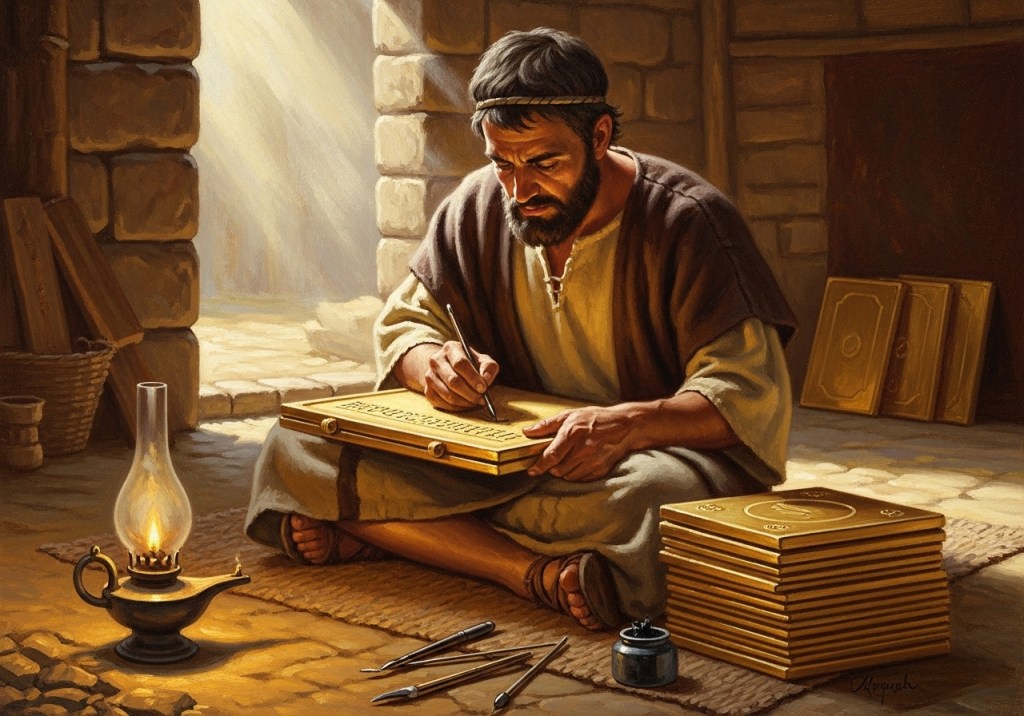
Nephi makes two sets of records. Each is called the plates of Nephi. The larger plates contain a secular history; the smaller ones deal primarily with sacred things. About 600-592 B.C.
1: “And all these things did my father see, and hear, and speak, as he dwelt in a tent, in the valley of Lemuel, and also a great many more things, which cannot be written upon these plates.”
This is perhaps the first concept I’ve run across that isn’t problematic. There are plenty of instances in the Bible that mention things that aren’t recorded in full.
2: “And now, as I have spoken concerning these plates, behold they are not the plates upon which I make a full account of the history of my people; for the plates upon which I make a full account of my people I have given the name of Nephi; wherefore, they are called the plates of Nephi, after mine own name; and these plates are also called the plates of Nephi.”
3: “Nevertheless, I have received a commandment of the Lord that I should make these plates, for the special purpose that there should be an account engraven of the ministry of my people.”
There is no ministry of Nephi’s people. In the Old Testament, the only people qualified for any ministry were the Levitical priests. They were charged with overseeing all worship, sacrifices, and temple proceedings. They were the only ones authorized to offer sacrifices, which presents a major issue in earlier Book of Mormon chapters, which report Lehi and his family making burnt offerings and sacrifices. The only exceptions to this, of course, are the Old Testament patriarchs that predated the establishment of the Levitical priesthood. This was established in Exodus 28 with Aaron and his sons.
There were instances of God punishing people for offering sacrifices and burning incense outside of the established priesthood. A prominent example of this took place Numbers 16, when Korah and a few others rebelled and said to Moses and Aaron, “You have gone far enough, for all the congregation are holy, every one of them, and the Lord is in their midst; so why do you exalt yourselves above the assembly of the Lord?” In other words, they were mad that they couldn’t also partake in ministering like the priesthood. To make a long story short, God caused the earth to open right beneath them, swallowing them alive. The earth then closed back over them. Then fire came from heaven and consumed 250 men who offered unauthorized incense to God. It concludes in verse 40 with “…no layman who is not of the descendants of Aaron should come near to burn incense before the Lord; that he might not become like Korah and his company– just as the Lord had spoken to him through Moses.” Lehi and his family were not priests, so they could not have offered sacrifices, and no one associated with them would have been permitted to do any sort of ministry.
4: “Upon the other plates should be engraven an account of the reign of the kings, and the wars and contentions of my people; wherefore these plates are for the more part of the ministry; and the other plates are for the more part of the reign of the kings and the wars and contentions of my people.”
This is yet another example of strange and needless repetition.
5: “Wherefore, the Lord hath commanded me to make these plates for a wise purpose in him, which purpose I know not.”
This contradicts verse 3, which lays out the purpose of these plates. The fact that I’m only 9 chapters in and have already found this many issues speaks to the daunting nature of this task that I’ve graciously assigned myself. I could give up and simply state this should be enough to call the entire religion into question, but I’m an incredibly stubborn woman, and such an unfinished project would gnaw at me for months. The unbiblical malarky persists, and so will I.
 The Inquisitive Christian
Leave a comment