
Do I have to? No. But am I going to so I can compare and contrast this with the Bible, so you all don’t have to do it yourselves? Absolutely. If you haven’t done so, I would encourage you to read my previous post, “New Testament Language in an Old Testament Era” because this one will build quite a lot off of the principles laid out there, and I don’t particularly enjoy repeating myself when it isn’t necessary. You might also check out “This Vision Seems Awfully Familiar…” because part of that is rehashed in this chapter. 1 Nephi 11 also contains several prophecies that you won’t find in the Old Testament and are simply descriptions of what took place in the New Testament, much like Lehi’s visions in 1 Nephi 10. I will skim over the verses here that mention John the Baptist, Jesus’s baptism, and the crucifixion because those were extensively addressed in my previous post. I also won’t be delving too deeply into the vision with the tree of life because that was also addressed previously.
1 Nephi Chapter 11
Nephi sees the Spirit of the Lord and is shown the tree of life. He sees the mother of the Son of God and learns of the condescension of God. He sees the baptism, ministry, and crucifixion of the Lamb of God. He sees also the call and ministry of the Twelve Apostles of the Lamb. About 600-592 B.C.
The first 11 verses consist of Nephi asking the Spirit of the Lord to see the visions that his father has seen and additional prophecies. He is then shown the tree of life and expresses his desire to know what it represents.
12: “And it came to pass that he said unto me: Look! And I looked as if to look upon him, and I saw him not; for he had gone from before my presence.”
13: “And it came to pass that I looked and beheld the great city of Jerusalem, and also other cities. And I beheld the city of Nazareth; and in the city of Nazareth I beheld a virgin, and she was exceedingly fair and white.”
14: “And it came to pass that I saw the heavens open; and an angel came down and stood before me; and he said to me: Nephi, what beholdest thou?”
15: “And I said unto him: A virgin, most beautiful and fair above all other virgins.”
The virgin birth was prophesied in Isaiah 7:14. That is the only time it is mentioned in the Old Testament. What’s bizarre about this particular passage is that Nephi knew immediately she was a virgin just by looking at her, and we have no descriptions at all in the Old or New Testaments of Mary’s physical appearance. The most obvious blunder here, of course, is that Mary was Middle Eastern. She would not have been “exceedingly fair and white.” We have no idea if she was “most beautiful and fair above all other virgins.” This begs the question of why Joseph Smith thought it necessary to describe her in this way. Was physical beauty a requirement for God to choose her to be the mother of Jesus? Is there a racist undertone of her whiteness being some sign of virtue and worthiness? God certainly doesn’t see it that way, as evidenced in 1 Samuel 16:7, when he was sent to anoint a new king over Israel and was certain one of David’s tall, handsome brothers was surely the one: “But the LORD said to Samuel, “Do not look at his appearance or at the height of his stature, because I have rejected him; for God sees not as man sees, for man looks at the outward appearance, but the Lord looks at the heart.” We see this principle again in John 7:24, when Jesus says, “Do not judge according to appearance, but judge with righteous judgment.”
16: “And he said unto me: Knowest thou the condescension of God?”
17: “And I said unto him: I know that he loveth his children; nevertheless, I do not know the meaning of all things.”
18: “And he said unto me: Behold, the virgin whom thou seest is the mother of the Son of God, after the manner of the flesh.”
“The mother of the Son of God” is a very interesting and telling turn of phrase. Since almost the beginning of Christianity, Mary was called “Theotokos,” which means “bearer or mother of God.” This stems, of course, from the belief in the Trinity, a doctrine so foundational to Christianity that one cannot claim to be a Christian while denying it. This term acknowledges the infant to which Mary gave birth was divine. There was some controversy in the 5th century over its use, namely from Nestorius, a monk with the church at Antioch. He was later appointed bishop of Constantinople in 428 AD but was removed in 431 AD after being accused of teaching heretical doctrines about Christ. Others who objected to the use of this term instead suggested “Anthropotokos,” which means “Bearer of Man.” This is naturally problematic because Mary did not give birth to a mere human. Nestorius preferred the term “Christotokos” which would mean “Bearer of Christ.” He believed this encompassed both the divine and human nature of Christ. Cyril of Alexandria, on the other hand, was completely baffled that this was even a point of discussion. In his Letter 1 to the Monks of Egypt, he stated, “I am amazed there are some who are extremely doubtful whether the holy Virgin should be called Mother of God or not. For if our Lord Jesus Christ is God, then surely the holy Virgin who gave him birth must be God’s mother.” He goes on to describe mothers as giving birth to both a human and a soul before concluding, “If anyone maintained that anyone’s mother was “mother of flesh” and not “mother of soul,” he would be talking nonsense. For what she has produced is one living being, a composite of two dissimilar elements, but a single human being, with each element retaining its own nature.” The debate raged on until an ecumenical council met at Chalcedon in 451 AD and settled the matter. She has been called Theotokos ever since. For more information, see chapter 8 in “Classical Christian Doctrine: Introducing the Essentials of the Ancient Faith” by Ronald E. Heine.
While the information I just presented may seem dry, it is necessary to point it out because it means Joseph Smith appears to be identifying with a term promoted by someone who was denounced as a heretic. He was going against not just the Bible, but also around 1,700 years of Christian theology and tradition. I will gladly explain the doctrine of the Trinity, but it will have to be a separate post. It is outside the scope of this particular discussion.
19: “And it came to pass that I beheld that she was carried away in the Spirit; and after she had been carried away in the Spirit for the space of a time the angel spake unto me, saying: Look!”
20: “And I looked and beheld the virgin again, bearing a child in her arms.”
21: “And the angel said unto me: Behold the Lamb of God, yea, even the Son of the Eternal Father! Knowest thou the meaning of the tree which thy father saw?”
Using the phrase “Eternal Father” contradicts Joseph Smith’s own teaching that God was once a man. In his “King Follet Discourse,” he states, “God himself was once as we are now, and is an exalted man, and sits enthroned in yonder heavens! That is the great secret…. It is the first principle of the Gospel to know for a certainty the Character of God, and to know… that he was once a man like us…. Here, then, is eternal life – to know the only wise and true God; and you have got to learn how to be Gods yourselves… the same as all Gods have done before you…” This is documented in multiple sources. The glaring problem, of course, is that nothing with a beginning can be called eternal.
Verses 22-25 discuss the meaning of the vision of the tree of life. Basically, the rod of iron was the word of God, and the waters and the tree represented God’s love. Verses 26 and 27 talk about John the Baptist and Jesus’s baptism, which have been previously discussed.
26: “And I beheld that he went forth ministering unto the people, in power and great glory; and the multitudes were gathered together to hear him; and I beheld they cast him out from among them.”
This doesn’t contradict necessarily contradict Biblical prophecies about Jesus. We read in Isaiah 53 he was “despised and forsaken by men,” and “He was oppressed and He was afflicted…” Unfortunately for LDS followers, this one instance of not being problematic does not cancel out the flaming dumpster fire of other problems in the Book of Mormon.
29: And I also beheld twelve others following him. And it came to pass that they were carried away in the Spirit from before my face, and I saw them not.”
There are no Old Testament prophecies concerning the Twelve Apostles. I suspect this is simply another effort on Smith’s part to make his scriptures appear as giving accurate prophecy.
30: “And it came to pass that the angel spake unto me again, saying: Look! And I looked, and I beheld the heavens open again, and I saw angels descending upon the children of men; and they did minister unto them.”
No.
31: “And he spake unto me again, saying: Look! And I looked, and I beheld the Lamb of God going forth among the children of men. And I beheld multitudes of people who were sick, and who were afflicted with all manner of diseases, and with devils and unclean spirits; and the angel spake and showed all these things unto me. And they were healed by the power of the Lamb of God; and the devils and the unclean spirits were cast out.”
Isaiah 61:1-2 is a foreshadowing of Jesus’s ministry. More descriptions of his ministry in a spiritual sense can be found in Isaiah 9. Isaiah 35:4-6 speaks of the miracles he would perform. There is nothing regarding casting out demons, but that could be inferred by all other prophecies concerning Jesus. Verses 32 and 33 are about the crucifixion.
34: “And after he was slain I saw the multitudes of the earth, that they were gathered together to fight against the apostles of the Lamb; for thus were the twelve called by the angel of the Lord.”
Nowhere in Scripture are the Twelve Apostles called the apostles of the Lamb.
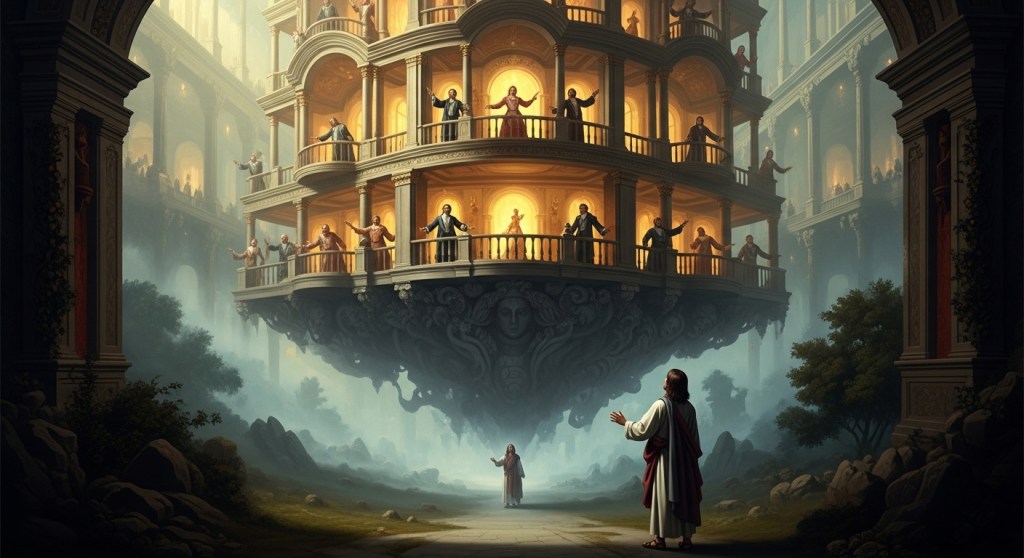
35: “And the multitude of the earth was gathered together; and I beheld that they were in a large and spacious building, like unto the building my father saw. And the angel of the Lord spake unto me again, saying: Behold the world and the wisdom thereof; yea, behold the house of Israel hath gathered together to fight against the twelve apostles of the Lamb.”
36: “And it came to pass that I saw and bear record, that the great and spacious building was the pride of the world; and it fell, and the fall thereof was exceedingly great. And the angel of the Lord spake unto me again, saying: Thus shall be the destruction of all nations, kindreds, tongues, and people, that shall fight against the twelve apostles of the Lamb.”
There is nothing even closely resembling these last two verses anywhere in the Bible. They were all horribly persecuted and died terrible deaths, but nothing about verses 35 and 36 make any sense. The world does not fight against the Twelve Apostles. It fights against God and his principles. It mocks Jesus and everything he stood for. It twists Scripture to try to force it to align with whatever sin it wants to affirm. Its anger is not ultimately directed at us. John 15:18 states, “If the world hates you, remember that it hated me first.”
 The Inquisitive Christian
Leave a comment