
You should all be grateful that the wind where I live is out of control today, because if it wasn’t, I’d be at the gun range gleefully destroying targets and not trudging through the Book of Mormon, so you all don’t have to. So here I am instead, taking a different kind of aim at a different kind of target: 1 Nephi Chapter 13. There is quite a lot to unpack within the 42 verses that make up this chapter. We will see Smith’s clear hatred of Catholics. We will see more of his white supremacist sentiments. We will also see a woefully common and completely ignorant claim that continues to rear its obnoxious head on a regular basis: that the Catholic church removed books from the Bible. As you can tell from that sentence, I have quite a lot to say on that topic. I will be citing “How We Got the Bible” by Neil R. Lightfoot throughout this post, as it’s an excellent source on the origins of Scripture and its canonization. It was first recommended to me by my oldest brother, Dr. Jonathan Morgan of Indiana Wesleyan University, and I’ve since read it and built upon the foundation of knowledge it laid. I would highly recommend it for anyone curious about that topic. And now, without further delay, let’s delve into today’s reading.
1 Nephi Chapter 13
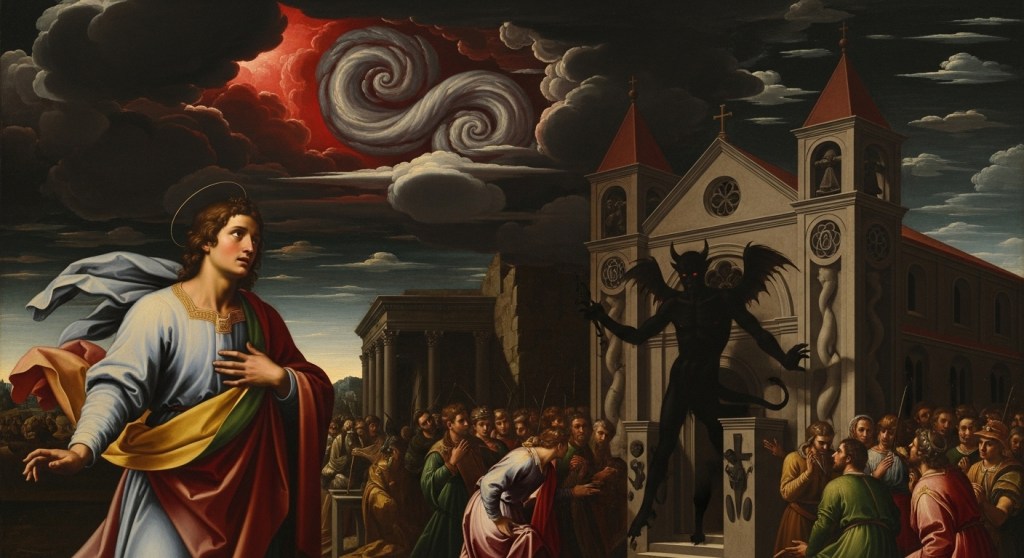
Nephi sees in a vision the church of the devil set up among the Gentiles, the discovery and colonizing of America, the loss of many plain and precious parts of the Bible, the resultant state of gentile apostasy, the restoration of the gospel, the coming forth of latter-day scripture, and the building up of Zion. About 600-592 B.C.
1: “And it came to pass that the angel spake unto me, saying: Look! And I looked and beheld many nations and kingdoms.
2: “And the angel said unto me: What beholdest thou? And I said: I behold many nations and kingdoms.”
3: “And he said unto me: These are the nations and kingdoms of the Gentiles.”
4: “And it came to pass that I saw among the Gentiles the formation of a great church.”
5: “And the angel said unto me: Behold the formation of a church which is most abominable above all other churches, which slayeth the saints of God, yea, and tortureth them and bindeth them down, and yoketh them with a yoke of iron, and bringeth them down into captivity.”
6: “And it came to pass that I beheld this great and abominable church; and I saw the devil that he was the founder of it.”
This passage is very clearly talking about the Catholic Church, as that is the oldest church founded. There is some debate over this idea, as Catholics believe their church began immediately at the Day of Pentecost and Peter was the first Pope. Others would say these early churches at Christianity’s inception were simply Christian and not necessarily Catholic. None of this really matters, however, in the context of this chapter in 1 Nephi; no matter what stance one takes, it’s sill obvious the Catholic Church is being discussed here because it was the first association of Christian churches that officially organized themselves with uniform doctrine, teachings, and practices.
While it’s incredibly well-documented that the Catholic Church became corrupt over time (hello, Protestant Reformation!), it’s quite the leap to assert the devil founded the church. The first four centuries of the Catholic Church, known as the Classical period of Christianity, produced all the foundational doctrines that are so essential to Christianity that one cannot claim to be one without affirming these beliefs. These include the doctrine of the Trinity (this is a major one), the atonement, and baptism, just to name a few. The Nicene Creed (which Mormons do not affirm) is an excellent summary of Christian beliefs and came during those first four centuries. While the early church fathers were by no means perfect, every Christian alive owes them a certain amount of respect for grappling with these issues, digging into Scripture for clarity, and laying the foundations for all who came after them. I’m unapologetically Protestant to my core, and even I find the idea that Satan started the Catholic Church to be an abhorrent declaration. Read “Classical Christian Doctrine: Introducing the Essentials of the Ancient Faith” by Ronald E. Heine for more information on this interesting topic.
7: “And I also saw gold, and silver, and silks, and scarlets, and fine-twisted linen, and all manner of precious clothing; and I saw many harlots.”
8: “And the angel spake unto me, saying: Behold the gold, and the silver, and the silks, and the scarlets, and the fine-twined linen, and the precious clothing, and the harlots, are the desires of this great and abominable church.”
9: “And also for the praise of the world do they destroy the saints of God, and bring them down into captivity.”
As stated before, it’s well-known how corrupt the powers of the Catholic Church became. It was that very corruption that necessitated the Protestant Reformation. It is true they punished and executed dissenters. William Tyndale, who translated much of the Bible into English, was charged with heresy and executed in 1536. Martin Luther had to go into hiding due to threats from the Church. These are just two of many examples. Again, though, insisting the devil founded a church because its later leaders became corrupt is nonsensical. If that were true, then we would also have to say that every single other institution on earth was founded by him.
10: “And it came to pass that I looked and beheld many waters; and they divided the Gentiles from the seed of my brethren.”
11: “And it came to pass that the angel said unto me: Behold the wrath of God is upon the seed of thy brethren.”
12: “And I looked and beheld a man among the Gentiles, who was separated from the seed of my brethren by the many waters; and I beheld the Spirit of God, that it came down and wrought upon the man; and he went forth upon the many waters, even unto the seed of my brethren, who were in the promised land.”
13: “And it came to pass that I beheld the Spirit of God, that it wrought upon other Gentiles; and they went forth out of captivity, upon the many waters.”
14: “And it came to pass that I beheld many multitudes of the Gentiles upon the land of promise; and I beheld the wrath of God, that it was upon the seed of my brethren; and they were scattered before the Gentiles and were smitten.”
15: “And I beheld the Spirit of the Lord, that it was upon the Gentiles, and they did prosper and obtain the land for their inheritance; and I beheld that they were white, and exceedingly fair and beautiful, like unto my people before they were slain.”
This should go completely without saying, but Middle Eastern people were not “white, and exceedingly fair.” We see yet again Smith’s attitude that whiteness is automatically associated with virtue and God’s favor. There is absolutely zero reason to bring up skin color. There’s only one instance I can think of in the Bible where skin color is mentioned (Song of Solomon 1:5), and that’s a love poem in which Solomon gushes about the beauty of his lover. Yet only 13 chapters into the Book of Mormon, skin color has been mentioned at least three times I can recall off the top of my head.
Some time ago, when I first became interested in investigating Mormonism, I stumbled across an incredibly fascinating article in the LDS publication “Dialogue.” It’s a journal for LDS academics to discuss evidence (or lack thereof) for the Book of Mormon. The article, titled “Simply Implausible: DNA and a Mesoamerican Setting for the Book of Mormon,” delves deeply into the lack of Middle Eastern DNA in indigenous populations in the Americas. This is a significant finding because if the Book of Mormon narrative is true and ancient Hebrews migrated to the Americas, then there would be DNA evidence in Native American populations. Since there is absolutely none, the only reasonable conclusion to draw is what’s described here simply didn’t happen. The author, Thomas Murphy, also details the intellectual bullying that took place as a result of his findings. He was even threatened with church discipline over it.
I have heard it said by some that God must have removed the evidence because He wants people to have faith in Him and not physical findings. Now, I will confess here that I’m not sure how prominent that line of thinking is in LDS circles, as I’ve not discussed this at great length with a large number of them. So, if this is more of a fringe idea, forgive me. However, I think it needs to be said that the God of the Bible, who says, “Come, let us REASON together” in Isaiah 1:18 (emphasis mine) is not going to demand we believe in something then purposely remove every single piece of evidence that would enable that belief. We are rational, logical beings created in the image of God, so it goes to follow that He is those things as well. While a few theological concepts may be beyond our grasp (the Trinity, for example), we step out in faith and believe them because there is so much evidence for so many other things. Faith with no evidence isn’t faith at all; it’s blind belief fueled by indoctrination.
Verses 16 through 19 describes battling between the different people in the Americas. Verses 20 through 25 introduce the Book of Mormon.
26: “And they go forth by the hand of the twelve apostles of the Lamb, from the Jews unto the Gentiles, thou seest the formation of that great and abominable church, which is most abominable above all other churches; for behold, they have taken away from the gospel of the Lamb many parts which are plain and most precious; and also many covenants of the Lord have they taken away.”
27: “And all this have they done that they might pervert the right ways of the Lord, that they might blind the eyes and harden the hearts of the children of men.”
No, this absolutely did not happen. This is a very common claim based upon willful ignorance and a disdain for Christianity in general, smugly said as some sort of “gotcha” while they throw their shoulders out from repeatedly patting themselves on the back for being so much smarter than us silly Christians. The canonization of Scripture is very well explained in the book I mentioned earlier, “How We Got the Bible.”
When we’re talking about the Bible, “canon” refers to the books written with divine authority. A book’s canonicity depends on its authority. Paul’s letters, for example, had authority right away due to his status as an apostle. They did not become considered canon until it was included in a list of writings recognized as having divine authority.
By the time of Jesus, the Old Testament canon was already fixed and recognized. We know this because Jesus and his apostles often quoted from the Old Testament, usually prefixing the quotes with “it is written.” The books of the Hebrew Bible are the same as the Christian Bible’s Old Testament. Jesus even alluded to this arrangement and what books are contained in it. He spoke of the time “from the blood of Abel to the blood of Zechariah between the altar and the sanctuary.” (Luke 11:51, Matt 23:35). The first martyr of the OT was Abel; the last was Zechariah in Chronicles. The Hebrew Bible places Chronicles as the last book, so Jesus was referring to everything in between.
Further evidence for Old Testament canon comes from Josephus, a 1st century Jewish historian. He wrote a defense of the Hebrew Bible in 95 A.D. titled, “Against Apion.” In it, he points out the number of books recognized as having divine authority are 22. They combined their books, arranged them, and enumerated them differently than we do. But all that material is the same as the 39 OT books that we have today. Furthermore, the time covered in these books is expressly limited. Josephus believed the canon extended from Moses to Artaxerxes (464-424 B.C.) This corresponds to the Jewish belief that prophetic inspiration ended with Malachi, a contemporary of Ezra and Nehemiah. The Jews took their sacred text very seriously, to the point where none of them would even dream of adding or taking away from it. It is reasonable to believe, then, that what we have now as the Old Testament is exactly as the ancient Hebrews intended and recognized as divine.
As far as the New Testament canon goes, we know that the earliest Christians didn’t have one. We do know Old Testament writings and letters from Apostles were read in church initially. Divinely inspired men, such as Paul, wrote letters to the different churches containing regulations and teachings. These letters were then gathered into collections. The collections of letters between the different churches varied slightly, but only because they were collected at different times and places. Lists of accepted New Testament books began to appear in the 2nd century.
The earliest example we have is the Muratorian Fragment, named after the man who discovered it and published it in the 18th century. Part of it has been lost. It starts with Luke but lists that as the 3rd Gospel, so it’s assumed the first 2 were the missing piece. John, Acts, 13 letters of Paul, Jude, two letters of John, and Revelation were then listed. Not included were Hebrews, James, 1 and 2 Peter, and perhaps 3 John. Included are the Wisdom of Solomon and the Apocalypse of Peter. Of the latter, it was written “some of our people” didn’t want it read in church. At the end were listed books that were considered heretical.
In the 3rd century, Origen, an early Christian scholar and writer, added his input. He listed the Four Gospels, Acts, 13 letters of Paul, 1 Peter, 1 John, and Revelation. He wasn’t entirely sure about Hebrews, James, 2 Peter, 2 and 3 John. He did often quote from Hebrews but acknowledged that not all churches accepted it. He did list the canon differently in his “Homilies of Joshua,” but later went on to list the 27 books of the New Testament we have today.
The canonization of the New Testament came to a close in the 4th century, as recorded by early church historian Eusebius. He distinguished 3 categories of books: those universally acknowledged, those disputed, and those universally rejected. Books acknowledged by all included the Four Gospels, Acts, 14 letters of Paul, 1 John, 1 Peter, and Revelation. Disputed books included James, Jude, 2 Peter, 2 and 3 John, but he noted they were “recognized by the majority.” The rejected books included Shepherd of Hermas, The Epistle of Barnabas, and The Teachings of the Apostles. In A.D. 367, Athanasius of Alexandria published a list of the 27 books of the NT that we have today, noting, “These are the springs of salvation… Let no one add anything to them or take anything away from them.”
As the Author of “How We Got the Bible” states at the end of chapter 14, “No church or council made the canon of Scripture. No church by its decrees gave to or pronounced on the Books of the Bible their infallibility. The Bible owes its authority to no individual or group. The church does not control the canon, but the canon controls the church. The authority is inherent in Scripture itself and was simply recognized.”
I told you all I had quite a lot to say about this topic! As you can see from history, no books were removed from the canon. Books were rejected for good reason. Early Christians were not naive or ignorant regarding what constituted Scripture. There are repeated warnings in the New Testament about false teachers, so it’s clear the early Christians were expected to use discernment.
Verses 28 through 29 basically repeat the same things in verses 26 and 27. 30 through 34 discusses the goings on of his descendants in America.
35: “For behold, saith the Lamb: I will manifest myself unto thy seed, that they shall write many things which I shall minister unto them, which shall be plain and precious (What in the world is the obsession with that phrase? It’s occurred in this chapter 9 times); and after thy seed shall be destroyed, and dwindle in unbelief, and also the seed of thy brethren, behold, these things shall be hid up, to come forth unto the Gentiles, by the gift and power of the Lamb.”
36: “And in them shall be written my gospel, saith the Lamb, and my rock and my salvation.:
No. Absolutely not. Galatians 1:8 states, “But even if we, or an angel from heaven, should preach to you a gospel contrary to what we have preached to you, let him be accursed!” We have the Four Gospels. That’s it. Do not pass go. Do not collect $200. Go to jail, for good measure.
The rest of this chapter basically prophesies the spreading of the Book of Mormon and uses its characteristic repetitive language to describe how everyone who believes in it will be saved. I don’t feel the need to expound upon any of that at this juncture, because 1) I’ve made my points pretty clear and addressed the major issues in this chapter, and 2) I’m doggedly tired and want nothing more than to make some tea and do something that doesn’t require any critical thinking. “For of making many books there is no end, and much study is a weariness to the flesh” (Ecclesiastes 12:12). Stay tuned, ladies and gents! I’ll be back in a day or two.
 The Inquisitive Christian
Leave a comment