
I procrastinated today. I promised myself I’d get this post done earlier this afternoon. I swore I would manage my time wisely today so I could relax and either do some reading or get cozy on the couch and watch some Mr. Ballen on YouTube. But life happened differently today. I went to church, wandered on over to the range with some friends, happily destroyed several targets, then we all decided we needed to buy more ammo. Then, we decided we were all hungry so we stuffed our faces at Perkins and took up space in the booth for probably 2 hours (don’t worry, the waitress was tipped well). My friend and her husband are the sorts of people who are very easy to talk to for hours on end. She’s a history nerd. History is to her as theology is to me. Over coffee and iced tea, we excitedly discussed history and religion. Our discussion meandered over to the Book of Mormon with its historical inaccuracies. Indeed, Smith had an affinity for distorting facts, plagiarizing ideas, and outright making things up. We will continue to see this in today’s reading.
1 Nephi Chapter 16
The wicked take the truth to be hard. Lehi’s sons marry the daughters of Ishmael. The Liahona guides their course in the wilderness. Messages from the Lord are written on the Liahona from time to time. Ishmael dies; his family murmurs because of afflictions. About 600-592 B.C.
Verses 1-6 report that Nephi’s brothers are distressed at the things he has prophesied. Nephi tells them if they heed the commands of God, then truth and prophecies won’t be difficult for them to hear. His brothers humble themselves and agree to walk in righteousness. The entourage that accompanied them is mentioned again in verse 7 when Lehi’s sons and the servant Zoram marry Ishmael’s daughters.
8: “And thus my father had fulfilled all the commandments of the Lord which had been given unto him. And also, I, Nephi, had been blessed of the Lord exceedingly.”
9: “And it came to pass that the voice of the Lord spake unto my father by night, and commanded him that on the morrow he should take his journey into the wilderness.”
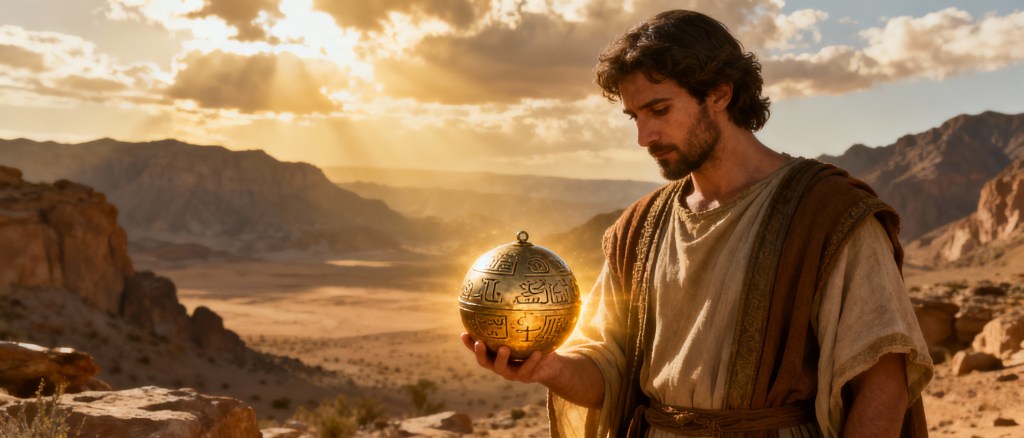
10: “And it came to pass that as my father arose in the morning, and went forth the tent door, to his great astonishment he beheld upon the ground a round ball of curious workmanship; and it was of fine brass. And within the ball were two spindles; and the one pointed the way wither we should go into the wilderness.”
First of all, what shape is a ball other than round? Why is it necessary to declare this brass ball as round? This redundancy is something I would expect from children who are learning how to navigate and describe the world around them. The second, and more important issue is the material this supposed ball was made of: brass. As I have mentioned in a much earlier post, the alloy that makes up brass was not known to the ancient Hebrews. The word used there is more accurately translated to “bronze.” Earlier English translations only used the word “brass” because “bronze” did not exist in the English language until the 18th century. See Ancient Brass or Bronze – Bible History Online – Bible History for more information. So, we basically have a compass that appeared out of nowhere made from a material that didn’t exist back then.
Verses 11-17 repetitively describe how they packed up all their belongings, plus seeds for crops, and traveled in the wilderness, following the directions given by the brass ball. They hunt for food with “our bows and our arrows and our stones and our slings.”
18: “And it came to pass that as I, Nephi, went forth to slay food, behold, I did break my bow, which was made of fine steel; and after I did break my bow, behold, my brethren were angry with me because of the loss of my bow, for we did obtain no food.”
I’m shocked there are so many issues contained in just one verse. What happened to all the other implements of hunting for food? More bows, arrows, slings, and stones were mentioned in verse 15. We also have another issue with an inappropriate material: a bow made of steel. While steel existed during this time, it was absolutely not used in making bows. Ancient bows were typically made of flexible wood and were often mounted with bronze. Other ancients made bows out of horn. The strings were most commonly ox-gut, and the arrows were either reed or a light wood tipped with either bronze, iron, or flint. Steel was not used in any part of any ancient bow or arrow (see Archery in the Bible Encyclopedia – ISBE (Bible History Online). In fact, bows made of metal were not made until the 15th century. There are ornate, decorative metal reflex bows that were manufactured during the Indo-Persian Mughal empire, but those were ceremonial and not used for battle. European crossbow makers began to include steel in their designs, but a longbow made of steel was out of the question because it would be too strong for anyone to pull back by hand. You can read about the history of bow-making here: The history of metal bows – Bow International.
In addition to that glaring issue, I have another question: how in the world would he manage to break a bow made of steel? What on earth would he have had to do to exert enough force to break steel? Anyone capable of rational thinking should take issue with this.
19: “And it came to pass that we did return without food to our families, and being much fatigued, because of their journeying, they did suffer much for the want of food.”
20: “And it came to pass that Laman and Lemuel and the sons of Ishmael did begin to murmur exceedingly, because of their sufferings and afflictions in the wilderness; and also my father began to murmur against the Lord his God; yea, and they were exceedingly sorrowful, even that they did murmur against the Lord.”
I’m beginning to murmur against myself for deciding to undertake this project.
21: “Now it came to pass that I, Nephi, having been afflicted with my brethren because of the loss of my bow, and their bows having lost their springs, it began to be exceedingly difficult, yea, insomuch that we could obtain no food.”
So everyone else’s bow was also out of service? What happened to the slings and stones? And why were they mad at Nephi over his bow breaking but not everyone else’s being out of commission?
22: “And it came to pass that I, Nephi, did speak much unto my brethren, because they had hardened their hearts again, even unto complaining against the Lord their God.”
23: “And it came to pass that I, Nephi, did make out of wood a bow, and out of a straight stick, an arrow; wherefore, I did arm myself with a bow and an arrow, with a sling and with stones. And I said to my father: Whither shall I go to obtain food?”
Making a bow out of wood is the only non-problematic element in this chapter.
24: “And it came to pass that he did inquire of the Lord, for they had humbled themselves because of my words; for I did say many things unto them in the energy of my soul.”
25: “And it came to pass that the voice of the Lord came unto my father; and he was truly chastened because of his murmuring against the Lord, insomuch that he was brought down into the depths of sorrow.”
26: “And it came to pass that the voice of the Lord said unto him: Look upon the ball, and behold the things which are written.”
27: “And it came to pass that when my father beheld the things which were written upon the ball, he did fear and tremble exceedingly, and also my brethren and the sons of Ishmael and our wives.”
What was so terrifying that everyone was trembling? What did it say?
28: “And it came to pass that I, Nephi, beheld the pointers which were in the ball, that they did work according to the faith and diligence and heed which we did give unto them.”
So, you’re not going to tell us what it said. But also, how can you put “faith and diligence and heed” unto inanimate objects? I think there’s a word for that.
29: “And there was also written upon them a new writing, which was plain to be read, which did give us understanding concerning the ways of the Lord; and it was written and changed from time to time, according to the faith and diligence which we gave unto it. And thus we see that by small means the Lord can bring about great things.”
Putting faith and diligence unto inanimate objects is what pagans did. It’s called idolatry. We have faith in God, not objects. I’m reminded of the ephod Gideon made that people started worshipping. That happens in Judges 8:24-28. It’s possible that Gideon didn’t make it intending for people to worship it, but that’s what happened. An interesting commentary on this can be found here: Why did Gideon make an ephod from the gold in Judges 8:27?. While Joseph Smith certainly wanted this sphere to be viewed positively by his followers, he goofed with this seemingly small detail. We are to trust in God and God only. See Psalm 115.
Verses 30-33 describe Nephi successfully hunting for food and bringing it back to camp, much to the joy of everyone else. They continue traveling.
34: “And it came to pass that Ishmael died, and was buried in the place which was called Nahom.”
35: “And it came to pass that the daughters of Ishmael did mourn exceedingly, because of the loss of their father, and because of their afflictions in the wilderness; and they did murmur against my father, because he had brought them out of the land of Jerusalem, saying: Our father is dead; yea, and we have wandered much in the wilderness, and we have suffered much affliction, hunger, thirst, and fatigue; and after all these sufferings we must perish in the wilderness with hunger.”
36: “And thus they did murmur against my father, and also against me; and they were desirous to return again to Jerusalem.”
I have pointed out in previous posts that stories in the Book of Mormon are reminiscent of ones in the Old Testament of the Bible. The Pentateuch is full of the Israelites complaining bitterly against Moses and Aaron, insisting they brought them to the wilderness to starve them all and kill them. They even demand, at some point, to be taken back to Egypt. I think it’s a safe bet to believe Smith drew his inspiration for 1 Nephi from those events in the Bible. He appears to be trying to set up Nephi as some sort of Moses figure. The brass ball, leading them to where they’re supposed to go, is similar to God traveling as a pillar of cloud by day and of fire by night. The Israelites followed the pillar wherever it went and stopped when it stopped. See Exodus 13:21. Another recognizable pattern is Nephi’s brothers getting angry, conspiring against him, then repenting. This, too, follows the pattern of the Israelite’s behavior, which we will see in the next few verses.
37: “And Laman said unto Lemuel and also the sons of Ishmael: Behold, let us slay our father, and also our brother Nephi, who has taken it upon him to be our ruler and our teacher, who are his eldest brethren.”
38: “Now, he says that the Lord has talked with him, and also that angels have ministered unto him. But behold, we know that he lies unto us; and he tells us these things, and he worketh many things by his cunning arts, that he may deceive our eyes, thinking, perhaps, that he may lead us away into some strange wilderness; and after he has led us away, he has thought to make himself a king and a ruler over us, that he may do with us according to his will and pleasure. And after this manner did my brother Laman stir up their hearts to anger.”
39: “And it came to pass that the Lord was with us, yea, even the voice of the Lord came and did speak many words unto them, and did chasten them exceedingly; and after they were chastened by the voice of the Lord they did turn away their anger, and did repent of their sins, insomuch that they Lord did bless us again with food, that we did not perish.”
See what I mean? Tune in this week for more. The next chapter is going to require copious amounts of coffee, pacing around the room periodically, and occasional snuggles from my cat. It has 55 verses. God help me.
 The Inquisitive Christian
Leave a comment