
When my older brother was trying to learn multiplication, my mother would dutifully hold up flash cards at the kitchen table, expecting him to answer as quickly as possible. Only he wouldn’t. In fact, he made sure to pour himself a big glass of milk beforehand so he could conveniently “take a drink of milk” if our mom held up a particularly difficult card. We all knew perfectly well what he was doing (well, probably not me because I was still quite young), which led to teasing him about it when he got older. He was procrastinating. He was using his apparent thirst for milk as a way of postponing his answer to those pesky multiplications. He took a swig of milk to give him time to think. I feel like that’s what I’ve been doing with this post. For the past week, I have told myself that I will get this done only to open my laptop and go to YouTube instead. I have a headache. I’m tired. I should make tea first. I should shower, then I’ll definitely get it done. So here I sit with my still wet hair from my shower, a cup of tea, no headache or fatigue, and no more excuses. Let’s dive into 1 Nephi chapter 17… all 55 verses of it.
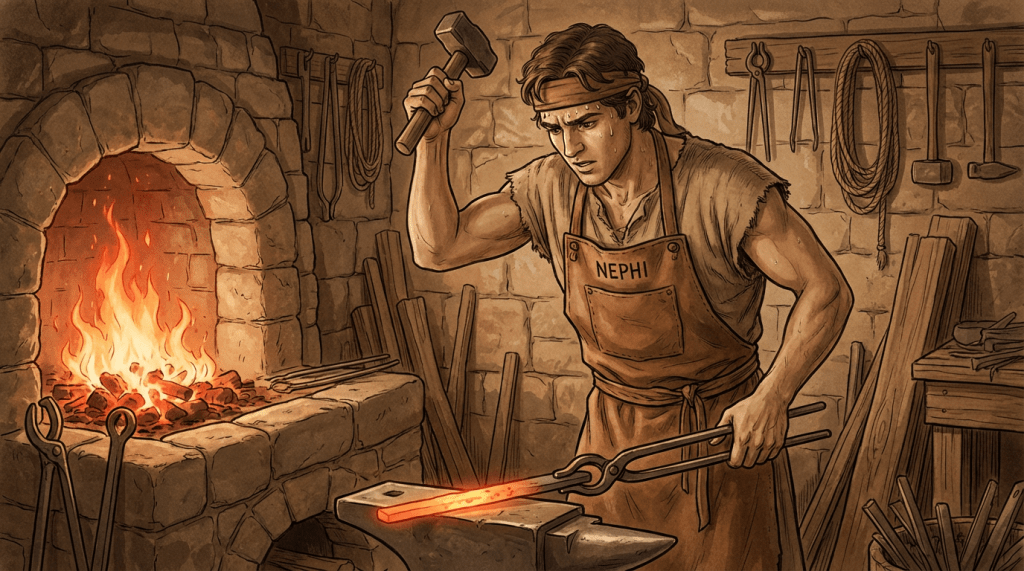
1 Nephi chapter 17
Nephi is commanded to build a ship. His brethren oppose him. He exhorts them by recounting the history of God’s dealings with Isreal. Nephi is filled with the power of God. His brethren are forbidden to touch him, lest they whither as a dried reed. About 592-591 B.C.
1: “And it came to pass that we did again take our journey in the wilderness; and we did travel nearly eastward from that time forth. And we did travel and wade through much affliction in the wilderness; and our women did bear children in the wilderness.”
2: “And so great were the blessings of the Lord upon us, that while we did live upon raw meat in the wilderness, our women did give plenty of suck for their children, and were strong, yea, even like unto men; and they began to bear their journeyings without murmurings.”
Laying aside the obvious food-borne illnesses relating to regularly eating raw meat, this would have violated Old Testament laws regarding meat consumption. Genesis 9:4 states, “But you must not eat meat that still has its lifeblood in it.” Leviticus 7:26-27 in the NASB reads, “And you are not to eat any blood, either of bird or animal, in any of your dwellings. Any person who eats any blood, even that person shall be cut off from his people.” Leviticus 17:10-11 reinforces this: “And any man from the house of Isreal, or from the aliens who sojourn among them, who eats any blood, I will set my face against that person who eats blood, and will cut him off from among his people. For the life of the flesh is in the blood, and I have given it to you on the altar to make atonement for your souls; for it is the blood by reason of the life that makes atonement.” While these verses and others like them don’t explicitly say “raw meat,” raw meat in the Old Testament would have had blood in it. Ezekiel 24 contains a parable of a boiling pot that meat is cooked in to illustrate purification. The description in that parable reflects the cultural norm of cooking meat. Even if not explicitly condemned, eating raw meat certainly would have been out of the ordinary, as the Old Testament contains no passages describing someone eating it and many passages talking about how to cook it.
3: “And thus we see that the commandments of God must be fulfilled. And if it so be that the children of men keep the commandments of God he doth nourish them, and strengthen them, and provide means whereby they can accomplish the thing which he has commanded them; wherefore, he did provide means for us while we did sojourn in the wilderness.”
4: “And we did sojourn for the space of many years, yea, even eight years in the wilderness.”
So the children who were “strong, yea, like even like unto men” couldn’t have been more than about 7 years old.
5: “And we did come to the land which we called Bountiful, because of its much fruit and also wild honey; and all these things were prepared of the Lord that we might not perish. And we beheld the sea, which we called Irreantum, which, being interpreted, is many waters.”
There are a couple of strange things about this verse. The first one is the name “Bountiful.” In the Bible, and even here in the Book of Mormon, names for places are transliterated, not directly translated. Yet Smith has done both of those things in the same verse. In other words, whatever the Hebrew (or, in the case of the Book of Mormon, Egyptian) word for “Bountiful” was, that is what we would be reading because it would be transliterated from that word into similar sounding syllables in English. We wouldn’t be reading the word Bountiful.
I’d also like to point out the oddity of the word “Irreantum,” which doesn’t appear in any other ancient extant text anywhere. The sources I looked up to understand this word were all pro-LDS sites, save for one letter to an academic journal in 1985 refuting the Mormon claims about that word. The LDS scholars believe it has roots in some ancient South Semitic language they believe would have been spoken by local tribes to the area that Lehi and his family traveled to. You can read that study here for more information: What’s in a Name? Irreantum. That article was easily the most cited one in all the LDS sources I read. In fact, I couldn’t find any other academic papers besides that one on the subject. While it’s certainly possible more exist and I simply didn’t find them, it’s strange that one prominent paper was what all sources cited. Shouldn’t there be other scholars chiming in? Speaking of which, you can read the dissenting opinion here: Science in Christian Perspective.
The only conclusion I can draw regarding the lack of sources countering the claims about the origins of Irreantum is that non-LDS scholars don’t take the Book of Mormon seriously enough to delve into a study of its linguistics. This phenomenon can be observed in other topics such as archeology, biology, and theology. If the ONLY academics studying these topics through the lens of the Book of Mormon are LDS scholars and no one else from any other institution, that should probably tell us something.
6: “And it came to pass that we did pitch our tents by the seashore; and notwithstanding we had suffered many afflictions and much difficulty, yea, even so much that we cannot write them all, we were exceedingly rejoiced when we came to the seashore; and we called the place Bountiful, because of its much fruit.”
7: “And it came to pass that I, Nephi, (Yes, yes. We already know it’s you, Nephi) had been in the land of Bountiful for the space of many days, the voice of the Lord came unto me, saying: Arise, and get thee into the mountain. And it came to pass that I arose and went up into the mountain, and cried unto the Lord.”
8: “And it came to pass that the Lord spake unto me, saying: Thou shalt construct a ship, after the manner which I shall show thee, that I may carry thy people across these waters.”
A common complaint I hear with remakes of movies nowadays is that no one is coming up with original material. They take beloved characters and change them. They add in their own nonsensical plots and take away vital plot points in the source material. I now see that practice is definitely nothing new. Here we see Smith taking yet another Bible story, changing it, and trying to pass it off as true. If this Nephi person really wanted to build a big boat, all he had to do was consult the Pentateuch. I’m sure there’s an “I Noah guy” joke in there somewhere.
9: “And I said: Lord, whither shall I go that I may find ore to molten, that I may make tools to construct the ship after the manner which thou has shown unto me?”
10: “And it came to pass that the Lord told me whither I should go to find ore, that I might make tools.”
So they had a small mining operation in Bountiful, too.
11: “And it came to pass that I, Nephi, did make a bellows wherewith to blow the fire, of the skins of beasts; and after I had made a bellows, that I might have wherewith to blow the fire, I did smite two stones together that I might make fire.”
12: “For the Lord had not hitherto suffered that we should make much fire, as we journeyed in the wilderness; for he said: I will make thy food become sweet, that ye cook it not;”
This just read like Joseph Smith added it in as an afterthought when he realized how implausible eating raw meat consistently was. This still doesn’t solve the problem of Old Testament food laws, though.
13: “And I will also be your light in the wilderness; and I will prepare the way before you, if it so be that ye shall keep my commandments; wherefore, inasmuch as ye shall keep my commandments ye shall be led towards the promised land; and ye shall know that it is by me that ye are led.”
14: “Yea, and the Lord said also that: After ye have arrived in the promised land, ye shall know that I, the Lord, am God; and that I, the Lord, did deliver you from destruction; yea, that I did bring you out of the land of Jerusalem.”
I cannot find a single instance in the Old Testament of the phrase “land of Jerusalem.” Ancient Hebrews didn’t use that phrase to describe Isreal as a whole, saying instead, “land of Israel.” If they were referring to Jerusalem, they simply said that and left out the prefix “land of.” There is no reason for Nephi, then, to consistently use this phrase.
Verses 15-22 can be summarized thus: Nephi makes the tools to build the ship. His brothers want nothing to do with any of it and openly mock him for it. In verse 20, they say he is foolish just like their father, who led them out of Jerusalem. They proceed to insist they would have been better off had they stayed there and not wandered in the wilderness for 8 years and even go far enough to call the people of Jerusalem righteous.
In verses 23-25, Nephi reminds them of God bringing the Israelites out of Egypt through Moses.
26: “Now ye know that Moses was commanded of the Lord to do that great work; and ye know that by his word the waters of the Red Sea were divided hither and thither, and they passed through on dry ground.”
27: “But ye know that the Egyptians were drowned by the Red Sea, who were the armies of Pharoah.”
This is documented in Exodus 14:13-31. It matches the Biblical account to try to seem legitimate.
28: “And ye also know that they were fed with manna in the wilderness.”
This correlates with Exodus 16.
29: “Yea, and ye also know that Moses, by his word according to the power of God which was in him, smote the rock, and there came forth water, that the children of Israel might quench their thirst.”
This took place in Exodus 17.
30: “And notwithstanding they being led, the Lord their God, their Redeemer, going before them, leading them by day and giving light to them by night, and doing all things for them which were expedient for man to receive, they hardened their hearts and blinded their minds, and reviled against Moses and against the true and living God.”
31: “And it came to pass that according to his word he did destroy them; and according to his word he did lead them; and according to his word he did do all things for them; and there was not any thing done save it were by his word.”
Exodus 13:21 describes the way God led the Israelites: a pillar of cloud by day and a pillar of fire by night. It’s also very well-documented that Israel was incredibly fickle in their devotion to God and regularly complained to Moses and Aaron.
Verses 32-38 involve Nephi describing the Israelites defeating the unrighteous pagan nations that inhabited the land before them.
39: “He ruleth high in the heavens, for it is his throne, and this earth is his footstool.”
This is taken from Isaiah 66:1, which says, “Thus says the Lord, ‘Heaven is My throne, and the earth is My footstool.”
40: “And he loveth those who will have him to be their God. Behold, he loved our fathers, and he covenanted with them, yea, even Abraham, Isaac, and Jacob; and he remembered the covenants which he had made; wherefore, he did bring them out of the land of Egypt.”
41: “And he did straiten them in the wilderness with his rod; for they hardened their hearts, even as ye have; and the Lord straitened them because of their iniquity. He sent fiery flying serpents among them; and after they were bitten he prepared a way that they might be healed; and the labor which they had to perform was to look; and because of the simpleness of the way, or the easiness of it, there were many who perished.”
Verse 41 is referencing Numbers 21:6-9. The serpents are described as fiery, but certainly not flying, so I’m not sure why Smith decided it was necessary to add something so obviously false. The passage in Numbers also reports that many people died from being bitten, not because of “the easiness” of looking at the bronze serpent. That’s an incredibly strange and nonsensical claim to make. The simplicity would have saved many lives, not hampered their healing.
Verses 42-47 consist of Nephi continuing to rebuke his brothers, describing the hardening of the Israelites’ hearts and coming captivity. He calls his brothers murderers for wanting to kill their father and him. He talks about how powerful God is and wonders why they continue to be stubborn and not obey God. He tells them how anguished he is because of their stubbornness then announces he is “full of the Spirit of God, insomuch that my frame has no strength.”
In verse 48, his brothers want to kill him (for the umpteenth time), but Nephi calls on the power of God and tells them that if they touch him, they’ll wither up and die. He tells them in verse 49 to quit complaining and help him build his ship. Verses 50-51 consist of Nephi describing how powerful God is and that power will enable him to complete the task of building a ship. He makes sure to inform us in 52 that his brothers kept their hands to themselves. They didn’t want to wither away, after all.
53: “And it came to pass that the Lord said unto me: Stretch forth thine hand again unto thy brethren, and they shall not wither before thee, but I will shock them, saith the Lord, and this will I do, that they may know that I am the Lord their God.”
Shock them? In what sense? Are we talking some nasty shock from static electricity or something else?
54: “And it came to pass that I stretched forth my hand unto my brethren, and they did not wither before me; but the Lord did shake them, even according to the word which he had spoken.”
So, God scared them in some way. That’s not near as fun as the idea of Nephi reaching out and shocking them out of their sandals with some holy static electricity from heaven. Oh, well.
55: “And now, they said: We know of a surety that the Lord is with thee, for we know that it is the power of the Lord that has shaken us. And they fell down before me, and were about to worship me, but I would not suffer them, saying: I am they brother, yea, even they younger brother; wherefore, worship our Lord thy God, and honor they father and thy mother, that thy days may be long in the land with the Lord thy God shall give thee.
This seems like it was taken from Acts 14, where people started calling Paul and Barnabas Hermes and Zeus, respectively, and were going to offer sacrifices to them. Paul stopped them, of course, and told them to worship God instead.
And that’s a wrap. Finally. But being the little contrarian I am, I’ll be back in not too long with more commentary on the rest of the Book of Mormon. But for now, it’s time to sign off for the night. Stay tuned, ladies and gents.
 The Inquisitive Christian
Leave a comment