The Inquisitive Christian

Questioning everything since 1984

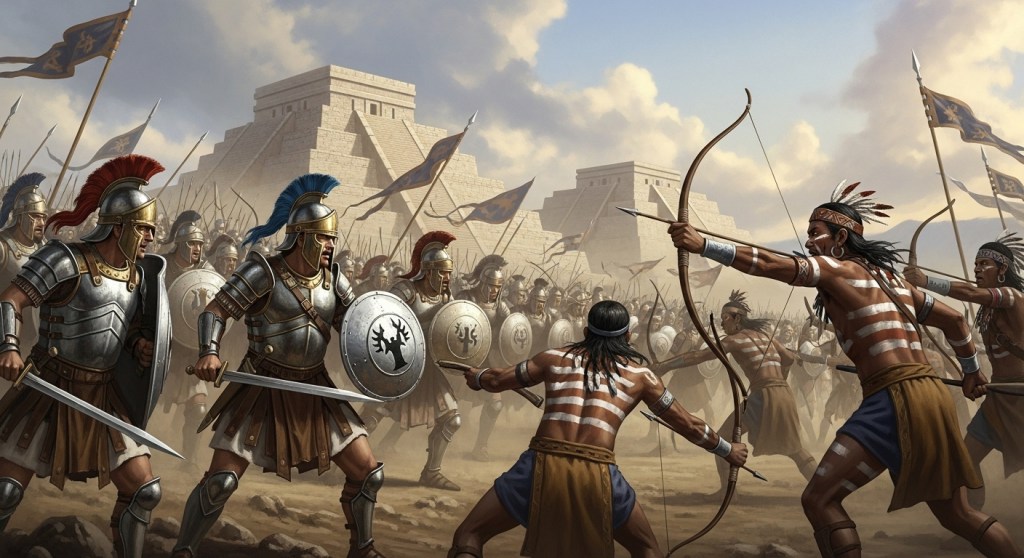
  • The charge of racism in LDS theology and history has long been a topic of discussion. Based upon my previous post on 1 Nephi chapter 11 and now chapter 12, I think it’s fair to say the Book of Mormon reflects the racism of Joseph Smith’s time by associating whiteness with virtue and darkness with depravity, and there’s nothing subtle about this message. This will become more evident in this chapter and others. In addition to this, we will also see the Book of Mormon make claims that are not only not supported by evidence but contradict it outright. I could go down the rabbit hole with genetics and archeological findings in the Americas, but that will have to wait, as it is somewhat out of the scope of this particular chapter. Here we see Nephi record prophecies that involve his descendants and those of his brothers.
    1 Nephi Chapter 12

    Nephi sees in vision the land of promise; the righteousness, iniquity, and downfall of its inhabitants; the coming of the Lamb of God among them; how the Twelve Disciples and the Twelve Apostles will judge Israel; and the loathsome and filthy state of those who dwindle in unbelief. About 600-592 B.C.

    1: “And it came to pass that the angel said unto me: Look, and behold thy seed, and the seed of thy brethren. And I looked and beheld the land of promise; and I beheld the multitudes of people, yea, even as it were in number as many as the sand of the sea.”

    In a previous post of mine, “An Implausible Discovery,” I point out that there was only one promised land in the Bible, and Nephi and his family would have already been living in it when this was purported to have been written. The “land of promise” mentioned here, of course, turns out to be America. Also, the phrase “as many as the sand of the sea” appears in the Old Testament when God promises Abraham of how numerous his descendants will be. See Genesis 22:17. So, it appears that’s another phrase taken from the Bible.

    2: “And it came to pass that I beheld multitudes gathered together to battle, one against the other; and I beheld wars, and rumors of wars, and great slaughters with the sword among my people.”

    The phrase “rumors of wars” is used by Jesus in discussing the end times (Matthew 24:6 and Mark 13:7), so it’s very strange that it’s used here in an Old Testament era.

    3: “And it came to pass that I beheld many generations pass away, after the manner of wars and contentions in the land; and I beheld many cities, yea, even that I did not number them.”

    4: “And it came to pass that I saw a mist of darkness on the face of the land of promise; and I saw lightnings, and I heard thunderings, and earthquakes, and all manner of tumultuous noises; and I saw the earth and the rocks, that they rent; and I saw mountains tumbling into pieces; and I saw the plains of the earth, that they were broken up; and I saw many cities that were sunk; and I saw many that were burned with fire; and I saw many that did tumble to the earth, because of the quaking thereof.”

    If these things were true, there would be archeological evidence of these events. There is none. Anywhere. At all. I will happily delve more into this when these settlements and wars are discussed in much greater detail later on in the Book of Mormon.

    5: “And it came to pass after I saw these things, I saw the vapor of darkness, that it passed from off the face of the earth; and behold, I saw multitudes who had not fallen because of the great and terrible judgment of the Lord.”

    6: “And I saw the heavens open, and the Lamb of God descending out of heaven; and he came down and showed himself unto them.”

    So, it’s being claimed that Jesus visited the USA. Ok, then.

    7: “And I also saw and bear record that the Holy Ghost fell upon twelve others; and they were ordained of God, and chosen.”

    8: “And the angel spake unto me, saying: Behold the twelve disciples of the Lamb, who are chosen to minister unto they seed.”

    The claim here seems to be that God chose 12 additional disciples for a different continent. Even if one were to believe the Book of Mormon, what sense does this make? The Twelve Apostles in the New Testament accompanied Jesus during his ministry then continued preaching after his death and resurrection. If he really did appear to people on this continent, why would he need 12 more disciples, and why would he choose people who weren’t even a part of his original ministry? If any of this had actually happened, then the Book of Mormon would complement the Bible perfectly. There would be no inconsistencies, contradictions, or obvious plagiarisms. There would be many different manuscripts that would bear witness to the Book of Mormon and what it claims. But as we have seen thus far and will continue to see, there are problems galore. LDS theology is rife with unbiblical teachings.

    9: “And he said unto me: Thou rememberest the twelve apostles of the Lamb? Behold they are they who shall judge the twelve tribes of Israel; wherefore, the twelve ministers of thy seed shall be judged of them; for ye are the house of Israel.”

    There is no judgment by the Twelve Apostles in Scripture. The only reference we have of anyone besides God passing judgment is 1 Corinthians 6:23, when Paul asks, “Do you not know that the saints will judge the world? And do you not know that we are to judge angels?” This passage is cryptic, and there are several possible interpretations. However, the Bible makes it clear the God is the ultimate judge. See Romans 14:10-12, Hebrews 12:23, James 4:12, 2 Corinthians 5:10, and John 5:22. If all we have is a single, odd, cryptic verse in the New Testament implying Christians may play a role in judgement, it’s inconsistent with the Bible to claim the Apostles will judge Israel.

    10: “And these twelve ministers who thou beholdest shall judge thy seed. And, behold, they are righteous forever; for because of their faith in the Lamb of God their garments are made white in his blood.”

    11: “And the angel said unto me: Look! And I looked, and beheld three generations pass away in righteousness; and their garments were white even like unto the Lamb of God. And the angel said unto me: These are made white in the blood of the Lamb, because of their faith in him.”

    12: “And I, Nephi, also saw many of the fourth generation who passed away in righteousness.”

    Using whiteness to illustrate the purification from sins is often used in the Bible. It is used in a spiritual sense. See Isaiah 1:18, and Psalm 51:7. When used as a physical description, God is the subject. Daniel 7:9 describes the Ancient of Days and His “vesture was like white snow, and the hair of His head like pure wool.” Revelation 1:14 describes the hair of Jesus as “white like wool, as white as snow.” It is not used to describe skin color unless it’s talking about leprosy. It is never used to describe skin tone as a sign of virtue. This is an important concept for the end of this chapter.

    Verses 13-19 describe the descendants of Nephi fighting against the descendants of his brothers.

    20: “And it came to pass that I beheld, and saw the people of the seed of my brethren that they had overcome my seed; and they went forth in multitudes upon the face of the land.”

    21: “And I saw them gathered together in multitudes; and I saw wars and rumors of wars among them; and in the wars and rumors of wars I saw many generations pass away.”

    22: “And the angel said unto me: Behold these shall dwindle in unbelief.”

    23: “And it came to pass that I beheld, after they had dwindled in unbelief they became a dark, and loathsome, and a filthy people, full of idleness and all manner of abominations.”

    And with that, we Joseph Smith’s thoughts on Indigenous people. There is no other way to read this. If he believed that ancient Jews migrated to the Americas, then he believed they were the ancestors of Native Americans, which he is describing here. This absolutely reflects the attitudes of white people towards Native Americans at that time, who were widely known as “savages.” Charming.

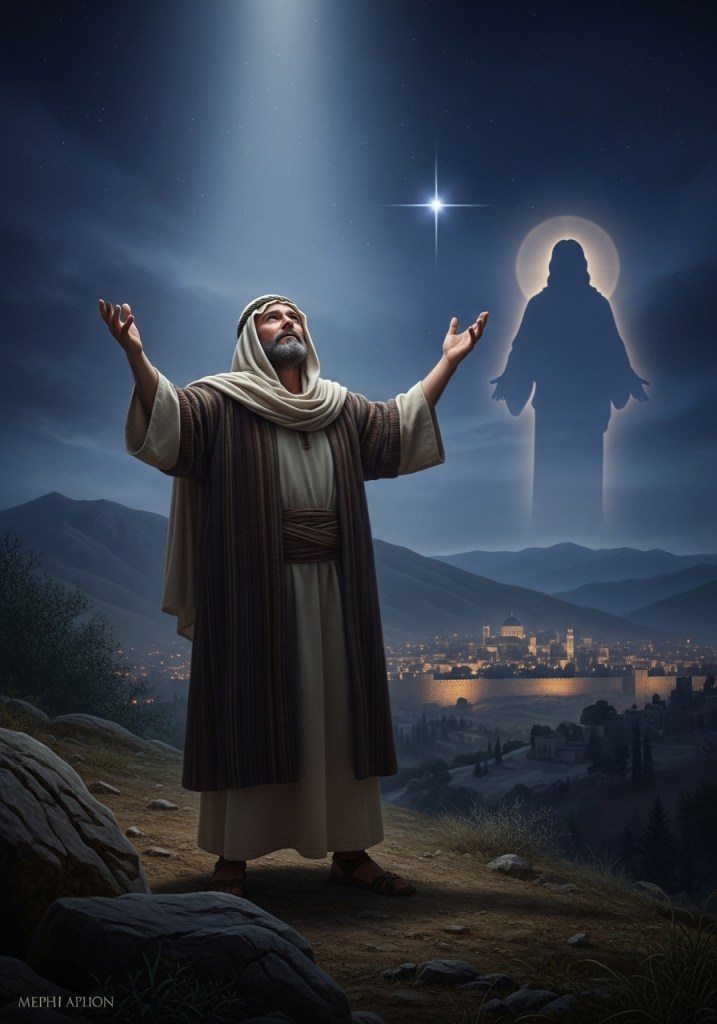
  • Do I have to? No. But am I going to so I can compare and contrast this with the Bible, so you all don’t have to do it yourselves? Absolutely. If you haven’t done so, I would encourage you to read my previous post, “New Testament Language in an Old Testament Era” because this one will build quite a lot off of the principles laid out there, and I don’t particularly enjoy repeating myself when it isn’t necessary. You might also check out “This Vision Seems Awfully Familiar…” because part of that is rehashed in this chapter. 1 Nephi 11 also contains several prophecies that you won’t find in the Old Testament and are simply descriptions of what took place in the New Testament, much like Lehi’s visions in 1 Nephi 10. I will skim over the verses here that mention John the Baptist, Jesus’s baptism, and the crucifixion because those were extensively addressed in my previous post. I also won’t be delving too deeply into the vision with the tree of life because that was also addressed previously.

    1 Nephi Chapter 11

    Nephi sees the Spirit of the Lord and is shown the tree of life. He sees the mother of the Son of God and learns of the condescension of God. He sees the baptism, ministry, and crucifixion of the Lamb of God. He sees also the call and ministry of the Twelve Apostles of the Lamb. About 600-592 B.C.

    The first 11 verses consist of Nephi asking the Spirit of the Lord to see the visions that his father has seen and additional prophecies. He is then shown the tree of life and expresses his desire to know what it represents.

    12: “And it came to pass that he said unto me: Look! And I looked as if to look upon him, and I saw him not; for he had gone from before my presence.”

    13: “And it came to pass that I looked and beheld the great city of Jerusalem, and also other cities. And I beheld the city of Nazareth; and in the city of Nazareth I beheld a virgin, and she was exceedingly fair and white.”

    14: “And it came to pass that I saw the heavens open; and an angel came down and stood before me; and he said to me: Nephi, what beholdest thou?”

    15: “And I said unto him: A virgin, most beautiful and fair above all other virgins.”

    The virgin birth was prophesied in Isaiah 7:14. That is the only time it is mentioned in the Old Testament. What’s bizarre about this particular passage is that Nephi knew immediately she was a virgin just by looking at her, and we have no descriptions at all in the Old or New Testaments of Mary’s physical appearance. The most obvious blunder here, of course, is that Mary was Middle Eastern. She would not have been “exceedingly fair and white.” We have no idea if she was “most beautiful and fair above all other virgins.” This begs the question of why Joseph Smith thought it necessary to describe her in this way. Was physical beauty a requirement for God to choose her to be the mother of Jesus? Is there a racist undertone of her whiteness being some sign of virtue and worthiness? God certainly doesn’t see it that way, as evidenced in 1 Samuel 16:7, when he was sent to anoint a new king over Israel and was certain one of David’s tall, handsome brothers was surely the one: “But the LORD said to Samuel, “Do not look at his appearance or at the height of his stature, because I have rejected him; for God sees not as man sees, for man looks at the outward appearance, but the Lord looks at the heart.” We see this principle again in John 7:24, when Jesus says, “Do not judge according to appearance, but judge with righteous judgment.”

    16: “And he said unto me: Knowest thou the condescension of God?”

    17: “And I said unto him: I know that he loveth his children; nevertheless, I do not know the meaning of all things.”

    18: “And he said unto me: Behold, the virgin whom thou seest is the mother of the Son of God, after the manner of the flesh.”

    “The mother of the Son of God” is a very interesting and telling turn of phrase. Since almost the beginning of Christianity, Mary was called “Theotokos,” which means “bearer or mother of God.” This stems, of course, from the belief in the Trinity, a doctrine so foundational to Christianity that one cannot claim to be a Christian while denying it. This term acknowledges the infant to which Mary gave birth was divine. There was some controversy in the 5th century over its use, namely from Nestorius, a monk with the church at Antioch. He was later appointed bishop of Constantinople in 428 AD but was removed in 431 AD after being accused of teaching heretical doctrines about Christ. Others who objected to the use of this term instead suggested “Anthropotokos,” which means “Bearer of Man.” This is naturally problematic because Mary did not give birth to a mere human. Nestorius preferred the term “Christotokos” which would mean “Bearer of Christ.” He believed this encompassed both the divine and human nature of Christ. Cyril of Alexandria, on the other hand, was completely baffled that this was even a point of discussion. In his Letter 1 to the Monks of Egypt, he stated, “I am amazed there are some who are extremely doubtful whether the holy Virgin should be called Mother of God or not. For if our Lord Jesus Christ is God, then surely the holy Virgin who gave him birth must be God’s mother.” He goes on to describe mothers as giving birth to both a human and a soul before concluding, “If anyone maintained that anyone’s mother was “mother of flesh” and not “mother of soul,” he would be talking nonsense. For what she has produced is one living being, a composite of two dissimilar elements, but a single human being, with each element retaining its own nature.” The debate raged on until an ecumenical council met at Chalcedon in 451 AD and settled the matter. She has been called Theotokos ever since. For more information, see chapter 8 in “Classical Christian Doctrine: Introducing the Essentials of the Ancient Faith” by Ronald E. Heine.

    While the information I just presented may seem dry, it is necessary to point it out because it means Joseph Smith appears to be identifying with a term promoted by someone who was denounced as a heretic. He was going against not just the Bible, but also around 1,700 years of Christian theology and tradition. I will gladly explain the doctrine of the Trinity, but it will have to be a separate post. It is outside the scope of this particular discussion.

    19: “And it came to pass that I beheld that she was carried away in the Spirit; and after she had been carried away in the Spirit for the space of a time the angel spake unto me, saying: Look!”

    20: “And I looked and beheld the virgin again, bearing a child in her arms.”

    21: “And the angel said unto me: Behold the Lamb of God, yea, even the Son of the Eternal Father! Knowest thou the meaning of the tree which thy father saw?”

    Using the phrase “Eternal Father” contradicts Joseph Smith’s own teaching that God was once a man. In his “King Follet Discourse,” he states, “God himself was once as we are now, and is an exalted man, and sits enthroned in yonder heavens! That is the great secret…. It is the first principle of the Gospel to know for a certainty the Character of God, and to know… that he was once a man like us…. Here, then, is eternal life – to know the only wise and true God; and you have got to learn how to be Gods yourselves… the same as all Gods have done before you…” This is documented in multiple sources. The glaring problem, of course, is that nothing with a beginning can be called eternal.

    Verses 22-25 discuss the meaning of the vision of the tree of life. Basically, the rod of iron was the word of God, and the waters and the tree represented God’s love. Verses 26 and 27 talk about John the Baptist and Jesus’s baptism, which have been previously discussed.

    26: “And I beheld that he went forth ministering unto the people, in power and great glory; and the multitudes were gathered together to hear him; and I beheld they cast him out from among them.”

    This doesn’t contradict necessarily contradict Biblical prophecies about Jesus. We read in Isaiah 53 he was “despised and forsaken by men,” and “He was oppressed and He was afflicted…” Unfortunately for LDS followers, this one instance of not being problematic does not cancel out the flaming dumpster fire of other problems in the Book of Mormon.

    29: And I also beheld twelve others following him. And it came to pass that they were carried away in the Spirit from before my face, and I saw them not.”

    There are no Old Testament prophecies concerning the Twelve Apostles. I suspect this is simply another effort on Smith’s part to make his scriptures appear as giving accurate prophecy.

    30: “And it came to pass that the angel spake unto me again, saying: Look! And I looked, and I beheld the heavens open again, and I saw angels descending upon the children of men; and they did minister unto them.”

    No.

    31: “And he spake unto me again, saying: Look! And I looked, and I beheld the Lamb of God going forth among the children of men. And I beheld multitudes of people who were sick, and who were afflicted with all manner of diseases, and with devils and unclean spirits; and the angel spake and showed all these things unto me. And they were healed by the power of the Lamb of God; and the devils and the unclean spirits were cast out.”

    Isaiah 61:1-2 is a foreshadowing of Jesus’s ministry. More descriptions of his ministry in a spiritual sense can be found in Isaiah 9. Isaiah 35:4-6 speaks of the miracles he would perform. There is nothing regarding casting out demons, but that could be inferred by all other prophecies concerning Jesus. Verses 32 and 33 are about the crucifixion.

    34: “And after he was slain I saw the multitudes of the earth, that they were gathered together to fight against the apostles of the Lamb; for thus were the twelve called by the angel of the Lord.”

    Nowhere in Scripture are the Twelve Apostles called the apostles of the Lamb.

    35: “And the multitude of the earth was gathered together; and I beheld that they were in a large and spacious building, like unto the building my father saw. And the angel of the Lord spake unto me again, saying: Behold the world and the wisdom thereof; yea, behold the house of Israel hath gathered together to fight against the twelve apostles of the Lamb.”

    36: “And it came to pass that I saw and bear record, that the great and spacious building was the pride of the world; and it fell, and the fall thereof was exceedingly great. And the angel of the Lord spake unto me again, saying: Thus shall be the destruction of all nations, kindreds, tongues, and people, that shall fight against the twelve apostles of the Lamb.”

    There is nothing even closely resembling these last two verses anywhere in the Bible. They were all horribly persecuted and died terrible deaths, but nothing about verses 35 and 36 make any sense. The world does not fight against the Twelve Apostles. It fights against God and his principles. It mocks Jesus and everything he stood for. It twists Scripture to try to force it to align with whatever sin it wants to affirm. Its anger is not ultimately directed at us. John 15:18 states, “If the world hates you, remember that it hated me first.”

  • Various insights come to me at the most random times. This evening, I was relishing the aroma of the apple pie syrup I was making while the rain fell softly on my kitchen windowpanes. Between the occasional stirs of the simmering amber concoction, I perused chapter 10 of 1 Nephi. Besides the seeming plagiarism of New Testament passages, something else jumped out at me: the use of the phrase “Holy Ghost.” Some translations use the phrase “Holy Spirit,” but the observation remains the same. While the Holy Spirit is absolutely present and active in the Old Testament, that particular phrase is only used three times: once in Psalm 51:11, and twice in Isaiah 63:10-11. In all other parts of the Old Testament, he is called “the Spirit of the Lord,” “the Spirit of God,” or simply “Spirit.” Thus far in the Book of Mormon, that phrase has appeared numerous times, which is a very peculiar difference from the Bible. Given the evidence I’ve presented in my post “This Vision Seems Awfully Familiar” of Smith’s plagiarism, I think it is perfectly reasonable to conclude that phrase and other passages that match the Bible are because he was attempting to make his book appear as if the prophecies it contains are accurate. However, I’m not here to tell you what to think. Review the evidence, then decide for yourself.

    1 Nephi, chapter 10

    Lehi predicts that the Jews will be taken captive by the Babylonians. He tells of the coming among the Jews of a Messiah, a Savior, a Redeemer. Lehi also tells of the coming of the one who should baptize the Lamb of God. Lehi tells of the death and resurrection of the Messiah. He compares the scattering and gathering of Israel to an olive tree. Nephi speaks of the Son of God, of the gift of the Holy Ghost, and of the need for righteousness. About 600-592 B.C.

    1: “And now I, Nephi, proceed to give an account upon the plates of my proceedings, and my reign and ministry; wherefore, to proceed with mine account, I must speak somewhat of the things of my father, and also of my brethren.”

    2: “For behold, it came to pass after my father had made an end of speaking the words of his dream, and also of exhorting them to all diligence, he spake unto them concerning the Jews–“

    3: “That they should be destroyed, even that great city Jerusalem, and many be carried away captive into Babylon, according to the own due time of the Lord, they should return again, yeah, even be brought back out of captivity; and after they should be brought back out of captivity they should possess again the land of their inheritance.”

    Isaiah 39:6-7 predicts “all that is in hour house…shall be carried to Babylon; nothing shall be left” and “… some of your sons… shall be taken away; and they shall become officials in the palace of the king of Babylon.” Jeremiah 25:11-12 is more specific, saying they would be exiled for 70 years. The prophesy of their return was fulfilled when King Cyrus of Persia allowed the exiled Judeans to return to Jerusalem and build the second temple.

    4: “Yea, even six hundred years from the time that my father left Jerusalem, a prophet would the Lord God raise up among the Jews– even a Messiah, or, in other words, a Savior of the world.”

    5: “And he also spake concerning the prophets, how great a number had testified of these things, concerning this Messiah, of whom he had spoken, or the Redeemer of the world.”

    6: “Wherefore, all mankind were in a lost and in a fallen state, and ever would they be save they should rely on this Redeemer.”

    Isaiah 7:14 predicts the Virgin Birth and his name would be Immanuel, which means “God with us.” Isaiah 11:1 and Jeremiah 23:5-6 both prophesied that Christ would be a descendant of David. Micah 5:2 tells us his birth will be in Bethlehem. The whole chapter of Isaiah 53 describes Christ as a suffering servant who was “pierced through for our transgressions.” It goes into great detail describing the weight of everyone’s sins and the atonement. Psalm 22 also predicts his suffering, opening with the well-known phrase Jesus said on the cross, “My God, my God, why hast Thou forsaken me?” The chapter goes on to describe the suffering: “They pierced my hands and my feet… They divide my garments among them, and for my clothing they cast lots.” See Matthew 27:35 and John 19:23-24 to see the fulfillment of that prediction. His resurrection is also foretold in Psalm 16:10, Isaiah 53, and Hosea 6:1-2. These are only a few of MANY prophecies concerning Christ. Listing them all would require more time than I have, but you should get the idea. What’s strange to note here are the terms the Book of Mormon uses to prophesy concerning Jesus. “Redeemer” is not used in any Old Testament predictions of his coming. Neither is “savior.” While these words are used to describe God, they are not applied specifically to Jesus until the New Testament.

    7: “And he spake also concerning a prophet who should come before the Messiah, to prepare the way of the Lord–“

    8: “Yea, even he should go forth and cry in the wilderness: Prepare ye the way of the Lord, and make his paths straight; for there standeth one among you whom ye know not; and he is mightier than I, whose shoe’s latchet I am not worthy to unloose. And much spake my father concerning this thing.”

    Isaiah 40:3-4 alludes to John the Baptist as a voice calling out to prepare the way for the Lord. Malachi 3:1 also speaks of a messenger coming before the Messiah. However, it is not prophesied that he will refer to him as someone “whose shoe’s latchet I am not worthy to unloose.” That does not appear until the New Testament. See John 1:27, Matthew 3:11, and Mark 1:7.

    9: “And my father said he should baptize in Bethabara, beyond the Jordan; and he also said he should baptize with water; even that he should baptize the Messiah with water.”

    10: “And after he had baptized the Messiah with water, he should behold and bear record that he had just baptized the Lamb of God, who should take away the sins of the world.”

    Jesus’ baptism was not explicitly foretold in any Old Testament prophecies. It was not described as a physical baptism of water, but as a pouring out of the Spirit. This can be seen in Isaiah 11:2 and again in 42:1. It is also described in Psalm 2:7. No baptism appears in any of these descriptions, much less the geographical location where it would take place. It’s also important to note that while a sacrificial lamb was a theme throughout the Old Testament and is mentioned in Isaiah 53:7, he is not once referred to as “Lamb of God” at any time in any of these verses. That is another phrase that is not used until the New Testament.

    11: “And it came to pass after my father had spoken these words he spake unto my brethren concerning the gospel which should be preached among the Jews, and also concerning the dwindling of the Jews in unbelief. And after they had slain the Messiah, who should come, and after he had been slain he should rise from the dead, and should make himself manifest, by the Holy Ghost, unto the Gentiles.”

    The death and resurrection are the only things prophesied here in the Old Testament. Everything else is simply a description of what took place in the New Testament.

    12: “Yea, even my father spake much concerning the Gentiles, and also concerning the house of Israel, that they should be compared like unto an olive tree, whose branches should be broken off and should be scattered upon all the face of the earth.”

    13: “Wherefore, he said it must needs be that we should be led with one accord into the land of promise, unto the fulfilling of the word of the Lord, that we should be scattered upon all the face of the earth.”

    14: “And after the house of Israel should be scattered they should be gathered together again; or, in fine, after the Gentiles had received the fulness of the Gospel, the natural branches of the olive tree, or the remnants of the house of Israel, should be grafted in, or come to the knowledge of the true Messiah, their Lord and their Redeemer.”

    This analogy never appears in the Old Testament. See Romans 11. It is true that the Jews are compared to an olive tree, and some branches are broken off due to unbelief. Unlike this passage in the Book of Mormon, however, it is the Gentiles who are grafted in, NOT the remnants of Israel. While it does later say they can be grafted back in if they turn from their unbelief, it isn’t a guarantee just because they’re Jews. So, not only does it appear that Smith plagiarized Romans 11, he plagiarized it incorrectly. The rest of 1 Nephi Chapter 10 goes on to describe how Nephi is desirous to know prophecies like his father. I’d like to point out verse 18, however.

    18: “For he is the same yesterday, today, and forever; and the way is prepared for all men from the foundation of the world, if it so be that they repent and come unto him.”

    Malachi 3:6 declares, “For I, the Lord, do not change…” Hebrews 13:8 also states Jesus’ unchanging nature. This is important because in order for the Book of Mormon to be from God, He would have had to make exceptions to His laws and nature that are well-documented in the Bible. You can see my previous posts for examples of this. Also, Ephesians 1:4 states we were chosen before the foundation of the world, not “at the foundation of the world” as verse 18 states.

    I am unsure of how all of these inconsistencies can be justified in a person’s mind. I’m assuming LDS members would simply brush all of these aside or explain them all away through sloppy hermeneutics. But how much is too much? I’m only ten chapters in. How much is a book allowed to contradict the Bible before someone decides that it’s worth truly examining their own beliefs and presuppositions about the Bible?

  • I remember a night in youth group at the tender age of 16 as we discussed the Bible and false teachings. Our youth pastor discussed how the U.S. Mint trained people to detect counterfeit bills: they studied legitimate ones so closely that they could spot a fake one immediately. That, he said, is what we as Christians should be doing with our beloved Bibles. We don’t need to spend endless hours dissecting unbiblical religions and false teachings in order to spot them. We should become so familiar with Scripture that heretical and false prophets are easy to spot. What has puzzled and frustrated me throughout this process is how easy the faults in the Book of Mormon are to spot, yet millions believe in its veracity. The LDS religion claims the Bible is one of its sacred texts, but how can this be when there are so many glaring contradictions? There’s only one answer to this: they don’t know the Bible. Christianity and Mormonism cannot both be true. Anyone with a decent grasp of Scripture should be able to see this with no difficulty.

    1 Nephi chapter 9 is a very short chapter, consisting of just 6 verses. Skimming over it, I actually considered skipping a blog entry on it and simply proceeding to chapter 10. However, this little chapter is like a false claim sundae with a contradiction cherry on top, and in the interest of being thorough, I decided to cover it.

    1 Nephi chapter 9

    Nephi makes two sets of records. Each is called the plates of Nephi. The larger plates contain a secular history; the smaller ones deal primarily with sacred things. About 600-592 B.C.

    1: “And all these things did my father see, and hear, and speak, as he dwelt in a tent, in the valley of Lemuel, and also a great many more things, which cannot be written upon these plates.”

    This is perhaps the first concept I’ve run across that isn’t problematic. There are plenty of instances in the Bible that mention things that aren’t recorded in full.

    2: “And now, as I have spoken concerning these plates, behold they are not the plates upon which I make a full account of the history of my people; for the plates upon which I make a full account of my people I have given the name of Nephi; wherefore, they are called the plates of Nephi, after mine own name; and these plates are also called the plates of Nephi.”

    3: “Nevertheless, I have received a commandment of the Lord that I should make these plates, for the special purpose that there should be an account engraven of the ministry of my people.”

    There is no ministry of Nephi’s people. In the Old Testament, the only people qualified for any ministry were the Levitical priests. They were charged with overseeing all worship, sacrifices, and temple proceedings. They were the only ones authorized to offer sacrifices, which presents a major issue in earlier Book of Mormon chapters, which report Lehi and his family making burnt offerings and sacrifices. The only exceptions to this, of course, are the Old Testament patriarchs that predated the establishment of the Levitical priesthood. This was established in Exodus 28 with Aaron and his sons.

    There were instances of God punishing people for offering sacrifices and burning incense outside of the established priesthood. A prominent example of this took place Numbers 16, when Korah and a few others rebelled and said to Moses and Aaron, “You have gone far enough, for all the congregation are holy, every one of them, and the Lord is in their midst; so why do you exalt yourselves above the assembly of the Lord?” In other words, they were mad that they couldn’t also partake in ministering like the priesthood. To make a long story short, God caused the earth to open right beneath them, swallowing them alive. The earth then closed back over them. Then fire came from heaven and consumed 250 men who offered unauthorized incense to God. It concludes in verse 40 with “…no layman who is not of the descendants of Aaron should come near to burn incense before the Lord; that he might not become like Korah and his company– just as the Lord had spoken to him through Moses.” Lehi and his family were not priests, so they could not have offered sacrifices, and no one associated with them would have been permitted to do any sort of ministry.

    4: “Upon the other plates should be engraven an account of the reign of the kings, and the wars and contentions of my people; wherefore these plates are for the more part of the ministry; and the other plates are for the more part of the reign of the kings and the wars and contentions of my people.”

    This is yet another example of strange and needless repetition.

    5: “Wherefore, the Lord hath commanded me to make these plates for a wise purpose in him, which purpose I know not.”

    This contradicts verse 3, which lays out the purpose of these plates. The fact that I’m only 9 chapters in and have already found this many issues speaks to the daunting nature of this task that I’ve graciously assigned myself. I could give up and simply state this should be enough to call the entire religion into question, but I’m an incredibly stubborn woman, and such an unfinished project would gnaw at me for months. The unbiblical malarky persists, and so will I.

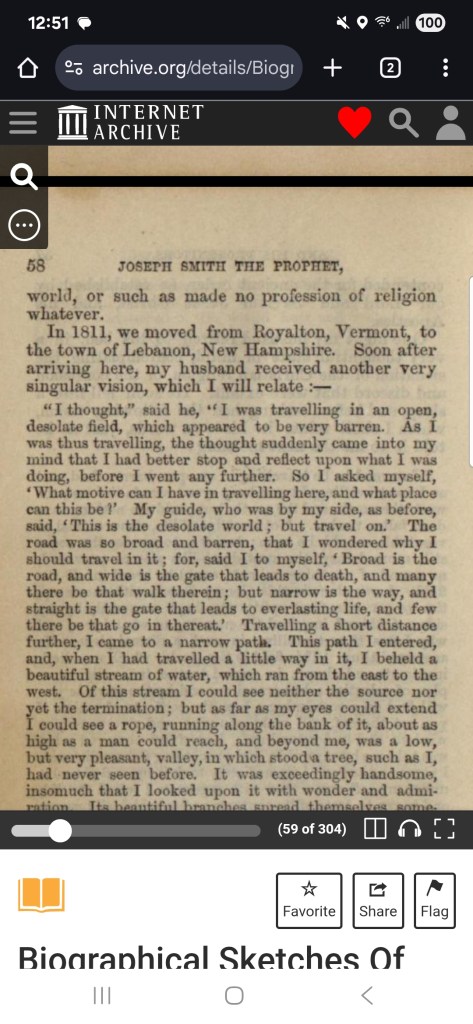
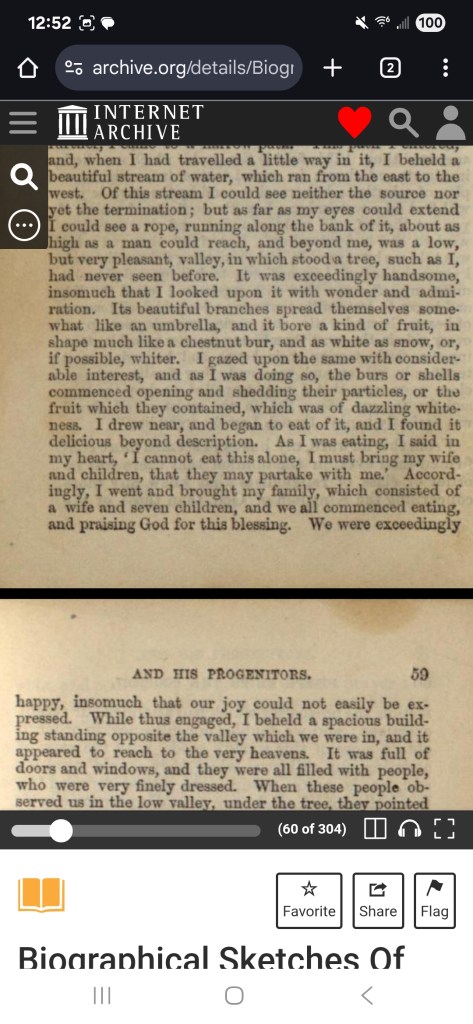
  • I’ve been looking forward to this particular dissection ever since I read chapter 4 in Fawn M. Brodie’s “No Man Knows My History: The Life of Joseph Smith.” In it, she points out the uncanny resemblance between Lehi’s vision in 1 Nephi 8 and a dream Joseph Smith Sr. had earlier in life. As you will see, this is more solid evidence of Joseph’s plagiarism when composing the Book of Mormon. Brodie points out this vivid dream was recorded in Lucy Smith’s “Biographical Sketches” on pages 58 and 59. My endless curiosity piqued; I made the decision to proceed with no caution down a rabbit hole to find this excerpt myself. Much to my delight, the website https://archive.org exists and happens to have this book in its entirety available for the perpetually inquisitive. I proceeded forth like a treasure hunter, peering at a map and making my way towards this fascinating paragraph. Sure enough, as cited, pages 58 and 59 held the key to what clearly fueled Lehi’s vision. Since I’m the sort of person who loves receipts, I will be including those screenshots for your examination. Now, onto today’s reading.

    1 Nephi, Chapter 8

    Lehi sees a vision of the tree of life. He partakes of its fruit and desires his family to do likewise. He sees a rod of iron, a straight and narrow path, and the mists of darkness that enshroud men. Sariah, Nephi, and Sam partake of the fruit, but Laman and Lemuel refuse. About 600-592 B.C.

    1: “And it came to pass that we had gathered together all manner of seeds of every kind, both of grain of every kind, and also of the seeds of the fruit of every kind.”

    2: “And it came to pass that while my father tarried in the wilderness he spake unto us, saying: Behold, I have dreamed a dream; or, in other words, I have seen a vision.”

    3: “And behold, because of the thing which I have seen, I have reason to rejoice in the Lord because of Nephi and also of Sam; for I have reason to suppose that they, and also many of their seed, will be saved.”

    4: “But behold, Laman and Lemuel, I fear exceedingly because of you; for behold, methought I saw in my dream, a dark and dreary wilderness.”

    Lucy’s recollection of Joseph Sr.’s dream reads, “I thought I was thus traveling in an open and desolate field, which appeared very barren…” This may not seem like much at first but keep reading. It gets stranger.

    5: “And it came to pass that I saw a man, and he was dressed in a white robe; and he came and stood before me.”

    6: “And it came to pass that he spake unto me, and bade me follow him.”

    7: “And it came to pass that as I followed him I beheld myself that I was in a dark and dreary waste.”

    While the guide in Joseph Sr.’s dream is not described, we know he had one: “My guide, who was by my side, as before, said, “This is a desolate world; but travel on.”

    8: “And after I had traveled for the space of many hours in darkness, I began to pray unto the Lord that he would have mercy on me, according to the multitude of his tender mercies.”

    9: “And it came to pass after I had prayed unto the Lord I beheld a large and spacious field.”

    10: “And it came to pass that I beheld a tree, whose fruit was desirable to make one happy.”

    11: “And it came to pass that I did go forth and partake of the fruit thereof; and I beheld that it was most sweet, above all that I ever before tasted. Yea, and I beheld that the fruit thereof was white, to exceed all whiteness that I had ever seen.”

    “… and beyond me was a low, but very pleasant, valley in which stood a tree, such as I had never seen before. It was exceedingly handsome, insomuch that I looked upon it with wonder and admiration…. and it bore a kind of fruit, in shape much like a chestnut bur, and as white as snow, or, if possible, whiter… I drew near, and began to eat of it, and I found it delicious beyond description.”

    12: “And as I partook of the fruit thereof it filled my soul with exceedingly great joy; wherefor, I began to be desirous that my family should partake of it also; for I knew that it was desirable above all other fruit.”

    “As I was eating, I said in my heart, ‘I cannot eat this alone. I must bring my wife and children, that they may partake with me.’”

    13: “And as I cast my eyes round about, that perhaps I might discover my family also, I beheld a river of water; and it ran along, and it was near the tree of which I was partaking the fruit.”

    “… I beheld a beautiful stream of water, which ran from the east and to the west.”

    14: “And I looked to behold from whence it came; and I saw at the head thereof a little way off; and at the head thereof I beheld your mother Sariah, and Sam, and Nephi; and they stood as if they knew not whither they should go.”

    15: “And it came to pass that I beckoned unto them; and I also did say unto them with a loud voice that they should come unto me, and partake of the fruit, which was desirable above all other fruit.”

    16: “And it came to pass that they did come unto me and partake of the fruit also.”

    “Accordingly, I went and brought my family, which consisted of a wife and seven children, and we all commenced eating, and praising God for this blessing.”

    17: “And it came to pass that I was desirous that Laman and Lemuel should come and partake of the fruit also; wherefore, I cast mine eyes towards the head of the river, that perhaps I might see them.”

    18: “And it came to pass that I saw them, but they would not come unto me and partake of the fruit.”

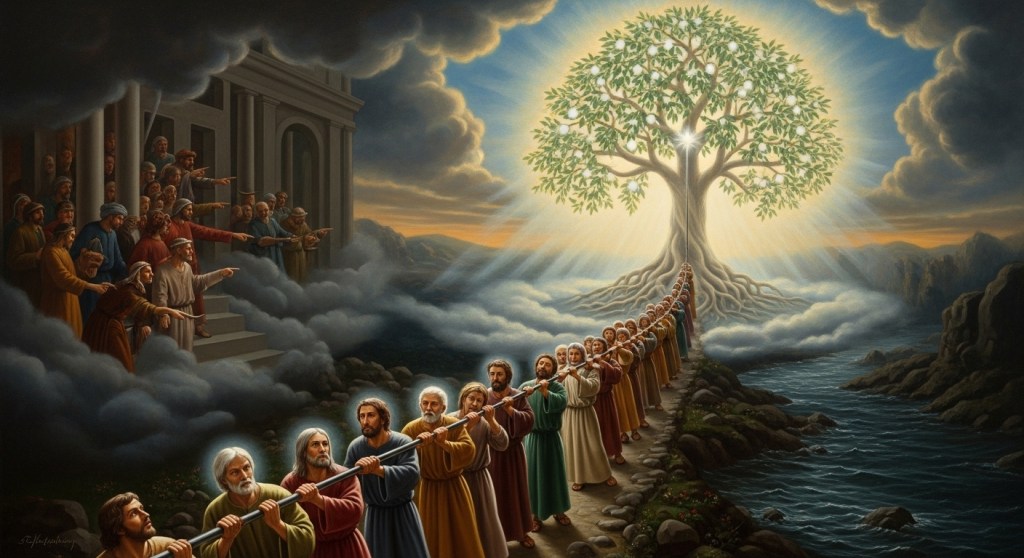
    19: “And I beheld a rod of iron, and it extended along the bank of the river, and led to the tree by which I stood.”

    20: “And I also beheld a straight and narrow path, which came along by the rod of iron, even to the tree by which I stood; and it also led by the head of the fountain, unto a large and spacious field, as if it had been a world.”

    “Traveling a short distance further, I came to a narrow path. This path I entered, and, when I had traveled a little way in it, I beheld a beautiful stream of water, which ran from the east to the west. Of this stream I could see neither the source nor yet the termination; but as far as my eyes could extend I could see a rope, running along the bank of it…”

    The next several verses describe a multitude of people trying to find their way down the path and grasping the rod of iron. Those who made it to the tree also ate the fruit. Then there’s this:

    26: “And I also cast my eyes round about, and beheld, on the other side of the river of water, a great and spacious building; and it stood as it were in the air, high above the earth.”

    27: “And it was filled with people, both old and young, both male and female; and their manner of dress was exceedingly fine; and they were in the attitude of mocking and pointing their fingers towards those who had come at and were partaking of the fruit.”

    “While thus engaged, I beheld a spacious building standing opposite the valley which we were in, and it appeared to reach to the very heavens. It was full of doors and windows, and they were filled with people, who were very finely dressed. When these people observed us in the low valley, under the tree, they pointed the finger of scorn at us, and treated us with all manner of disrespect and contempt.”

    In the next few verses, more people eat the fruit, and they also get scorned. They then feel shame from the scorn and follow other paths.

    33: “And great was the multitude that did enter into that strange building. And after they did enter into that building they did point the finger of scorn at me and those that were partaking of the fruit also; but we heeded them not.”

    “But their contumely we utterly disregarded.”

    While Lucy Smith’s “Biographical Sketches” was not published until after Joseph’s Smith’s death, I think it is safe and perfectly reasonable to assume that if she appreciated her husband’s dream enough to record it in such detail and publish it, she would have told it and retold it to her children and others. This vision of Lehi’s is suspiciously similar to it, and I am left to conclude that Joseph simply copied it and changed a few details around because he probably never thought his mother would publish a biography with the dream in it. He could not have been a true prophet of God, and this is one of many reasons why. I will be expounding upon those reasons as I get further into the Book of Mormon and examine the Doctrine and Covenants. As promised, behold my screenshots!

  • The title is a phrase I keep muttering to myself while reading the Book of Mormon. Read on to see why.

    1 Nephi Chapter 7

    Lehi’s sons return to Jerusalem and invite Ishmael and his household to join them in their journey. Laman and others rebel. Nephi exhorts his brethren to have faith in the Lord. They bind him with cords and plan his destruction. He is freed by the power of faith. His brethren ask forgiveness. Lehi and his company offer sacrifice and burnt offerings. About 600-592 B.C. 

    1: “And now I would that ye might know, that after my father, Lehi, had made an end of prophesying concerning his seed, it came to pass that the Lord spake unto him again, saying that was not meet for him, Lehi, that he should take his family into the wilderness alone; but that his sons should take daughters to wife, that they might raise up seed unto the Lord in the land of promise.”

    2: “And it came to pass that the Lord commanded him that I, Nephi, and my brethren, should again return unto the land of Jerusalem, and bring down Ishmael and his family into the wilderness.”

    Who is Ishmael? If you read the Old Testament, you’ll notice when someone is named, “son of…” is somehow attached to who is being named. This does not always occur when the person being spoken about is well-known already to the narrative. For example, King David is not always written as “David, son of Jesse,” but his father was named at the start of and throughout the record of his life in the Old Testament. So, it’s strange and differs from the Bible to simply bring some seemingly random person into the story without clarifying who they are in relation to their tribe and others. 

    4: “And it came to pass that we went up into the house of Ishmael, and we did gain favor in the sight of Ishmael, insomuch that we did speak unto him the words of the Lord.”

    What were those words? What was said to him and his household to convince them to leave their home and go into the wilderness? It’s strange that nothing that was said at this meeting made it into this record. 

    5: “And it came to pass that the Lord did soften the heart of Ishmael, and also his household, insomuch that they took their journey with us down into the wilderness to the tent of our father.”

    This verse makes the aforementioned missing information more bizarre. In what way did Ishmael’s heart need softening? Against what was it hardened? Against God, or against leaving? 

    6: “And it came to pass that as we journeyed in the wilderness, behold Laman and Lemuel, and two of the daughters of Ishmael, and two of the sons of Ishmael and their families, did rebel against us; yea, against me, Nephi, and Sam, and their father, Ishmael, and his wife, and his three other daughters.”

    7: “And it came to pass in the which rebellion, they were desirous to return unto the land of Jerusalem.”

    I’ll mention again that I am typing these verses out exactly as they’re printed in the Book of Mormon. So, grammatically incorrect phrasing is not an error on my part. Now, onto the main point here: why did the rebellious members of this party want to return to Jerusalem? What was stopping them from splitting from the group and going back? They weren’t being held captive. This is an odd, needless conflict that has no real purpose or explanation. It’s as if it’s written simply for the sake of having conflict. 

    The next several verses consist of Nephi admonishing his brothers for hardening their hearts against what God has supposedly told them to do. He talks about the land of promise and needing to obey God. This further irritates Laman and Lemuel, who take matters into their own hands. 

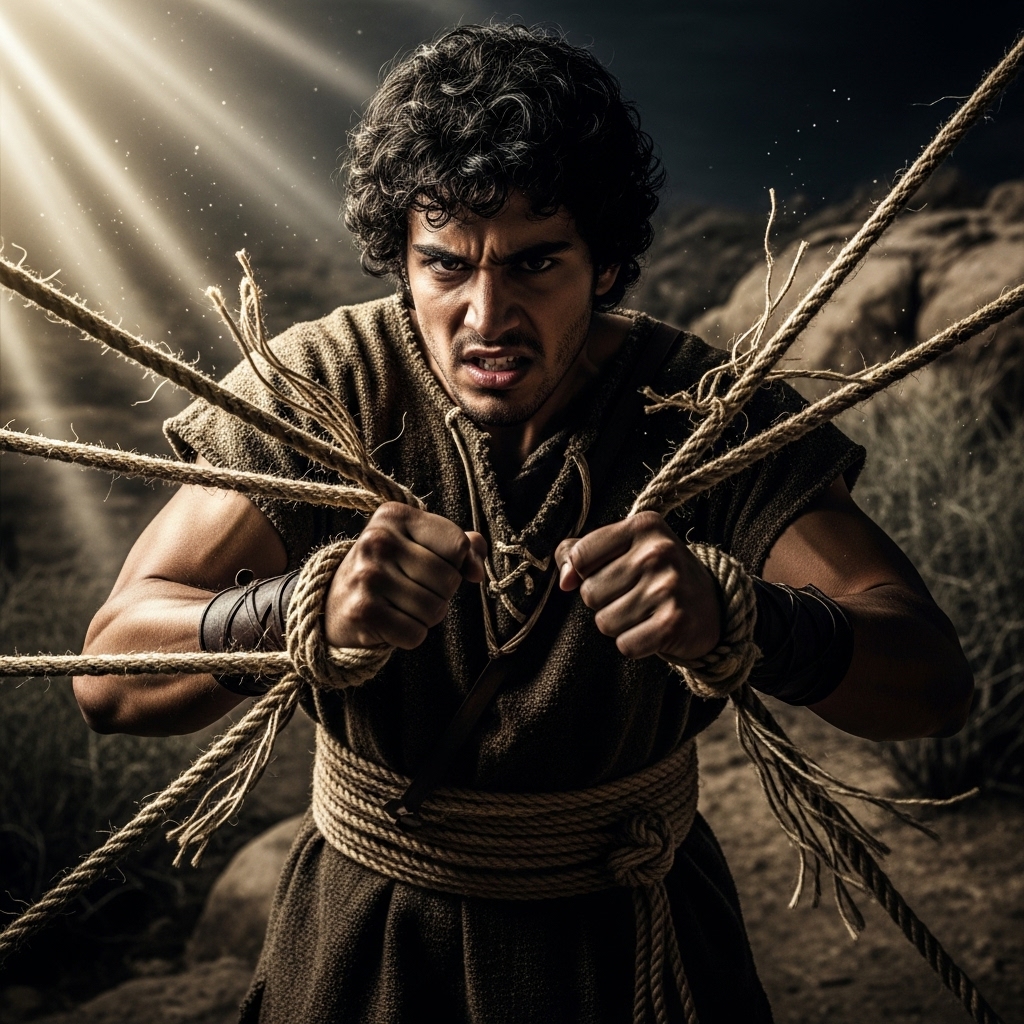
    16: “And it came to pass that when I, Nephi, had spoken these words unto my brethren, they were angry with me. And it came to pass that they did lay their hands on me, for behold, they were exceedingly wroth, and they did bind me with cords, for they sought to take away my life, that they might leave me in the wilderness to be devoured by wild beasts.” 

    This bears a strange resemblance to the incident in the Bible when Joseph’s brothers, in a fit of jealous rage, throw him into a pit and discuss what they’re going to do with him over lunch. While they didn’t kill him and sold him to a passing caravan instead, they did allow their father to believe he had been killed by a wild animal. See Genesis 37:18-36 for more details. Also, it may be a minor point, but where was everyone else when this was taking place? Were they simply watching Nephi being bound by his brothers?

    17: “And it came to pass that I prayed unto the Lord, saying: O Lord, according to my faith which is in thee, wilt thou deliver me from the hands of my brethren; yea, even give me strength that I may burst from these bands with which I am bound.”

    18: “And it came to pass that when I had said these words, behold, the bands were loosed from off my hands and feet, and I stood before my brethren, and I spake to them again.”

    I read these verses and thought of Samson’s last prayer to God to grant him strength one last time to avenge the loss of his eyes. I was also reminded of the instance when the Philistines bound him with cords and he broke them easily because of the strength God gave him (as long as he didn’t cut his hair, of course). Read Judges 16 for more information on Samson. It’s as if Joseph Smith took bits and pieces of Old Testament stories and scrambled them around just enough to make it not seem like he was taking his ideas from other sources. 

    This chapter continues with Ishmael’s wife and one of his daughters convincing Laman and Lemuel to cease their aggression against Nephi. Not another word is mentioned of Ishmael’s sons and daughters who joined Laman and Lemuel in their rebellion, so it’s impossible to say what they were doing when all of this was taking place or what their responses were to Nephi. That’s another strange, small plot hole. 

    Laman and Lemuel ask Nephi’s forgiveness, which he grants. Then they all hold hands and sing Kumbaya by a campfire. Just kidding. They all go down to where Lehi has settled and offer sacrifices and burnt offerings.  

  • 1 Nephi Chapter 6

    Nephi writes of the things of God–Nephi’s purpose is to persuade men to come unto the God of Abraham and be saved. About 600-592 B.C.

    1: “And now I, Nephi, do not give the genealogy of my fathers in this part of my record; neither at any time shall I give it after upon these plates which I am writing; for it is given in the record which has been kept by my father; wherefore, I do not write it in this work.

    2: For it sufficeth me to say that we are descendants of Joseph.” 

    It does not suffice. Listing the genealogy would give evidence to back this claim. The refusal to list it gives the impression that it’s a bogus claim that can’t be verified. 

    3: “And it mattereth not to me that I am particular to give a full account of all the things of my father, for they cannot be written upon these plates, for I desire the room that I may write of the things of God.”

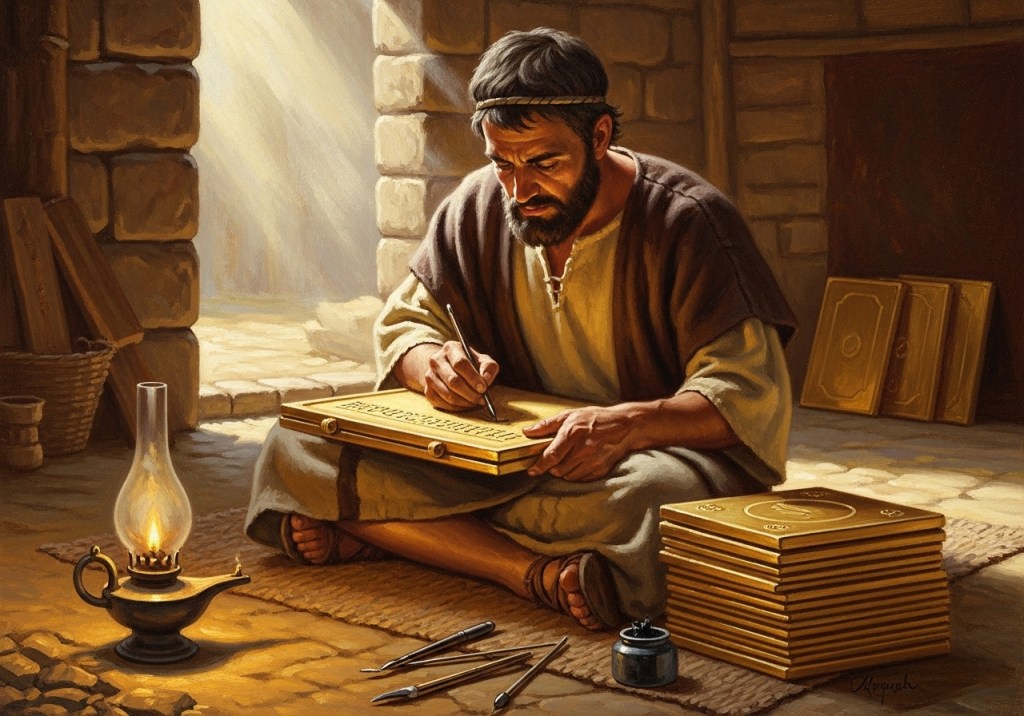
    This is yet one more reason recording all of this on metal plates makes no sense. Engraving all of this would be labor-intensive, and there is a space limitation. This would be easily remedied by using leather as a writing material, which was common in the Old Testament.

    4: “For the fulness of mine intent is that I may persuade men to come unto the God of Abraham, and the God of Isaac, and the God of Jacob, and be saved.”

    This deviates significantly from the Old Testament in that the purpose of prophets was to speak God’s word to the Israelites specifically. We see this all throughout the Bible when God’s prophets chastise Israel, advise various kings in matters of war, and prophesy the destruction of Israel as well as the coming of the Messiah. In the Old Testament, they were God’s chosen people. Proselytizing to make converts was not done. This is not to say that foreigners did not reside with the Hebrew people and assimilate to their culture and worship of God. Rahab and her family are an example of this. Not only was she permitted to live with them, she was also in the lineage of Christ. See Joshua 2:1-6 and 6:17-25 for more details on her. We also know foreigners lived among them because there were laws governing them and how they were to be treated (Exodus 22:21, Exodus 12:48, Numbers 9:14, Leviticus 12:48, Leviticus 19:33-34, Leviticus 24:22). So, we see others were certainly permitted to follow God along with the Israelites, but nowhere do we see where anyone actively sought out non-Hebrews to come follow God.  

  • Nephi Chapter 5

    Sariah complains against Lehi- both rejoice over the return of their sons– They offer sacrifices– the plates of brass contain the writings of Moses and the prophets– the plates identify Lehi as a descendent of Joseph. Lehi prophesies concerning his seed and the preservation of the plates. About 600-592 B.C. 

    5: But behold, I have obtained a land of promise, in the which things I do rejoice; yea, and I know that the Lord will deliver my sons out of the hands of Laban, and bring them down again unto us in the wilderness. 

    I would like to point out here the phrase “in the which things I do rejoice” makes no grammatical sense. It is not an error on my part. That is copied verbatim from the Book of Mormon mobile app. The main point of this verse I wish to address is the mention of “a land of promise.” Per the Old Testament, the “promised land” consisted of Canaan, which roughly corresponds to modern day Israel and Palestine. Genesis 12 is where God promises this land to Abraham. See Genesis 26:2-3; 28:12-13; 35:9-12; 48:3-4; and 50:24 for the repeating of these promises to Jacob and Joseph. See Genesis 15:18, Exodus 23:31, and Numbers 34:1-12 for a description of this land and its borders. Genesis 13:15 states,”All the land that you see I will give to you and to your offspring forever.” There is no other land of promise besides what is laid out in the Old Testament. When God states “forever,” He certainly means just that. He does not mean, “except for these descendants that aren’t documented in the Old Testament  that I’ll send someplace else.” 

    6: And after this manner of language did my father, Lehi, comfort my mother, Sariah, concerning us, while we journeyed in the wilderness up to the land of Jerusalem, to obtain the record of the Jews. 

    This is simply another example of odd and repetitive phrasing in the Book of Mormon. “And after this manner of language did..” appears three times in this chapter; once in verse 3, another in verse 6, and a third time in verse 8. This phrase serves no grammatical or practical purpose. “After the manner of language” follows something that someone said. We already know the manner in which someone spoke because they were quoted. Nothing more needs to be written about the manner in which they spoke. It’s also strange that Lehi and Sariah keep being named as the supposed author’s parents when it has already been repeatedly established that’s what their names are. Therefore, it makes much more sense for the above quoted verse to say, “This is how my father comforted my mother.” 

     11: And he beheld that they did contain the five books of Moses, which gave an account of the creation of the world, and also of Adam and Eve, who were our first parents;

    12: And also a record of the Jews from the beginning, even down to the commencement of the reign of King Zedekiah, king of Judah;

    13: And also the prophecies of the holy prophets, from the beginning, even down to the commencement of the reign of Zedekiah; and also many prophecies which have been spoken by the mouth of Jeremiah. 

    As mentioned before, all of this was already well-documented amongst the Hebrews and available to be reviewed. This is not some novel rarity that had to be wrenched out of the hands of someone else in order to preserve their history. The entire premise of 1 Nephi is hinging upon the existence of plates made from material that didn’t exist with records that were already known. 

    14: And it came to pass that my father, Lehi, also found upon the pilates of brass a genealogy of his fathers; wherefore he knew that he was a descendent of Joseph; yea, even that Joseph who was the son of Jacob, who was sold into Egypt, and who was preserved by the hand of the Lord, that he might preserve his father, Jacob, and all his household from perishing with the famine.

    15: And they were also led out of captivity and out of the land of Egypt, by that same God who had preserved them.

    16: And thus my father, Lehi, did discover the genealogy of his fathers. And Laban also was a descendent of Joseph, wherefore he and his fathers had kept the records. 

    There was no “discovery” of unknown genealogies. The Hebrews kept meticulous family records. This is easily evidenced by the extensive genealogies seen in the Old Testament. Everyone knew who their ancestors were because of these records and the divisions of the Israelite tribes. Had these people in the Book of Mormon existed, they would have been mentioned in these genealogies, especially if they were direct descendants of Joseph. The notion that Lehi didn’t know who his forefathers were is simply not at all plausible. 

    17: And now when my father saw all these things, he was filled with the Spirit, and began to prophesy concerning his seed–

    18: That these plates of brass should go forth unto all nations, kindreds, tongues, and people who were of his seed.

    19: Wherefore, he said that these plates of brass should never perish; neither should they be dimmed any more by time. And he prophesied many things concerning his seed.

    If these plates were to go forth unto all nations, kindreds, tongues, and people, then why did the Book of Mormon not exist until 1830? Why would something so foundational to knowing God not be known for at least another 2,000 years? If these plates of brass “should never perish,” then where are they? The idea that they even existed is based upon the word of one man, Joseph Smith, who claimed to have translated the Book of Mormon from gold plates, which no one else actually saw. The initial three witnesses to the plates (Martin Harris, Oliver Cowdery, and David Whitmore) never physically saw them, but claimed to have seen them in a vision when they went into the woods to pray with Joseph Smith. What’s particularly troublesome is that, according to local press at that time, the three men told different versions of their experience. When Harris was questioned by a lawyer, he was asked outright, “Did you see the plates and the engravings upon them with your bodily eyes?” His answer was, “I did not see them as I do that pencil-case, yet I saw them with the eye of faith; I saw them just as distinctly as I see anything around me– though at the time they were covered with a cloth.” So in other words, no. He didn’t see them. He changed his story again later in life and claimed he saw an angel turning the gold leaves so he could see the engravings. Whitmer claimed Smith had led them to an open field and they saw the plates lying on the ground. Not being satisfied with three witnesses, Smith made the decision to have eight more witnesses sign a statement claiming they also saw the plates. Four of these witnesses were Whitmores with one being related to them by marriage; three more witnesses were Joseph’s own family members. The theory for how he obtained these eight signatures came from Thomas Ford, the governor of Illinois, who was very well-acquainted with several of Joseph’s key men after they left the church. Ford was told the witnesses were “set to continual prayer, and other spiritual exercises.” Then, “he assembled them in a room, and produced a box, which he said contained the precious treasure. The lid was opened; the witnesses peeped into it but making no discovery, for the box was empty, they said, ‘Brother Joseph, we do not see the plates.’” The narrative goes on to detail how he then berated them for not having enough faith, demanded they pray more and then were persuaded they saw the plates after two hours of frantic praying. These witnesses would detail the size, weight, and metallic texture of the plates. Conveniently enough, these plates were later taken back to heaven by an angel, which begs the question of why God would demand people believe something then purposely remove all evidence for that belief, especially when He hasn’t done so with the Bible. For more details on the eleven witnesses, see “No Man Knows My History: The Life of Joseph Smith” by Fawn M. Brodie, chapter 5, “Witnesses for God.” 

  • Happy Sunday, readers! I hope everyone has had a blessed day thus far. Today, I will be covering the fourth chapter of 1 Nephi, which is quite a chapter. As I’ve pointed out in previous posts, a common theme thus far is strange similarities to Old Testament stories. In fact, the accusation of plagiarism is a fairly common one. In his book, “The Kingdom of the Cults” author Walter Martin argues the reason sections of the Book of Mormon so closely resemble passages from the KJV is because he copied parts of the 1769 KJV. Another criticism offered is the Book of Mormon contains various translation errors and passages lifted from the New Testament. The obvious issue with this is that the events in the New Testament were written centuries after when the events of Book of Mormon were purported to take place. He also points out the idea of ancient Hebrews being ancestors of American Indigenous people was common in contemporary sources, such as “View of the Hebrews” by Ethan Smith (1823). This theory is also put forth by author Fawn M. Brodie in her book “No Man Knows My History: The Life of Joseph Smith.” I highly recommend these books for anyone wanting more information. Now, onto today’s reading.

    1 Nephi Chapter 4

    Nephi slays Laban at the Lord’s command and then secures the plates of brass by stratagem– Zoram chooses to join Lehi’s family in the wilderness. About 600-592 B.C. 

    2: Therefore, let us go up; let us be strong like unto Moses; for he truly spake unto the waters of the Red Sea and and they divided hither and thither, and our fathers came through, out of captivity, on dry ground, and the armies of Pharaoh did follow and were drowned in the waters of the Red Sea.

    3: Now behold ye know that this is true; and ye also know that an angel hath spoken unto you; wherefore can ye doubt? Let us go up; the Lord is able to deliver us, even as our fathers, and to destroy Laban, even as the Egyptians.

    See Joshua’s response to Israel regarding their doubt about being able to overthrow the Canaanites in Numbers 14: 6-9. This further confirms my theory that the stories put forth in the Book of Mormon are not original but borrowed from the Old Testament and repackaged as original and new. 

    7: Nevertheless I went forth, and as I came near the house of Laban I beheld a man, and he had fallen to the earth before me, for he was drunken with wine.

    8: And when I came to him I found that it was Laban.

    The next verses describe God convincing Nephi to kill Laban while he’s passed out drunk so he can take the plates. This is an odd series of events, because he could have simply taken them while Laban was so inebriated that he was rendered unconscious. Nephi hesitates, and God tells him more than once that he has delivered Laban into his hands. This reads like Joseph Smith wishes David would have killed Saul when he had more than one chance to do so. See 1 Samuel 24 and 26. It is important to note that there is not a single instance of God EVER ordering someone to kill another person in their sleep in the Bible. As much as I gleefully enjoy the story of Jael, God didn’t order her to drive a tent stake through Sisera’s head (See Judges 4). 

    13: Behold the Lord slayeth the wicked to bring forth his righteous purposes. It is better that one man should perish than that a nation should dwindle and perish in unbelief.

    14: And now, when I, Nephi, had heard these words, I remembered the words of the Lord which he spake unto me in the wilderness, saying that: Inasmuch as thy seed shall keep my commandments, they shall prosper in the land of promise.

    15: Yea, and I also thought that they could not keep the commandments of the Lord according to the law of Moses, save they should have the law.

    16: And I also knew that the law was engraven upon the plates of brass.

    At the risk of repeating myself, I will once again state that the laws and books Moses wrote were already available as well as the writings of Old Testament prophets. These supposed plates contained nothing new, so there would be no reason to act as if they were the last hope of preserving the laws, and there would certainly be no reason to decapitate a drunk man over them. 

    19: And after I had smitten off his head with his own sword, I took the garments of Laban and put them on mine own body; yea, even every whit; and I did gird on his armor about my loins.

    Why was Laban drinking in town in his armor with his sword? And would anyone put on the bloody clothes of someone they just killed? Decapitations are messy. There was no way that clothing and armor weren’t covered in blood. 

    20: And after I had done this, I went forth unto the treasury of Laban. And as I went forth towards the treasury of Laban, behold, I saw the servant of Laban who had the keys of the treasury. And I commanded him in the voice of Laban, that he should go with me into the treasury. 

    21: And he supposed me to be his master, Laban, for he beheld the garments and also the sword girded about my loins. 

    So he didn’t notice the blood all over Nephi and didn’t see his face the whole time they were talking? Was Nephi really that good at impersonating the voice of a man he had only spoken to once or twice? Was he really so convincing that the servant willingly went with him?

    24: And I also spake unto him that I should carry the engravings, which were upon the plates of brass, to my elder brethren, who were without the walls. 

    25: And I also bade him that he should follow me.

    26: And he, supposing that I spake of the brethren of the church, and that I was truly that Laban whom I had slain, wherefore he did follow me. 

    In addition to the other problems that have already been discussed, there is a glaring issue in verse 26: the word “church.” That word did not exist during the Old Testament. When recording the Israelites gathering to offer sacrifices and to worship God, they were called a “congregation” or “assembly.” The word and the concept of “church” is specific to New Testament Christians. It was never used in regards to gatherings of Jews. 

    The next few verses describe the servant going with Nephi to reunite with his brothers and realizing that he is not Laban. Then this happens:

    31: And now I, Nephi, being a man large in stature, and also having received much strength of the Lord, therefore I did seize upon the servant of Laban, and held him, that he should not flee.

    32: And it came to pass that I spake with him, that if he would hearken unto my words, as the Lord liveth, and as I live, even so that if he would hearken unto our words, that we would spare his life.

    33: And I spake unto him, that he need not fear; that he should be a free man like unto us if he would go down in the wilderness with us. 

    “Go with us or we’ll kill you” does not constitute an offer of freedom.  

    35: And it came to pass that Zoram did take courage at the words which I spake. Now Zoram was the name of the servant; and he promised he would go down into the wilderness unto our father. Yea, and he also made an oath unto us that he would tarry with us from that time forth.

    Is an oath made under threat of death really sincere? This entire chapter is incredibly far-fetched and makes no theological sense. The God of the Book of Mormon already differs from the Biblical God in that He orders an unnecessary execution on someone who was black-out drunk. I have a sneaking suspicion I will be seeing more of this in subsequent passages. I will continue this journey tomorrow.  

  • 1 Nephi Chapter 3

    Lehi’s sons return to Jerusalem to obtain the plates of brass– Laban refuses to give the plates up– Nephi exhorts and encourages his brethren– Laban steals their property and attempts to slay them– Laman and Lemuel smite Nephi and Sam and are reproved by an angel. About 600-592 B.C. 

    3: “For behold, Laban hath the record of the Jews and also a genealogy of my forefathers, and they are engraven upon plates of brass.”

    This has several problems. 1) The “record of the Jews” already existed in the form of the Pentateuch (the 5 books Moses wrote) and the writings of Old Testament prophets. There would be no reason to urgently seek this record out when it was already available. 2) Brass did not exist during the Old Testament. The Hebrew word “nechoshet” was translated as “brass” in early English translations of the Bible, such as the King James Version because the word “bronze” didn’t exist in the English language until the 18th century. We know brass to be an alloy of copper and zinc or copper, zinc, and tin. This alloy was not known in ancient times, but they did use the alloy copper and tin, which is bronze. (For more reading on this subject, see https://bible-history.com/backdrops/bronze 3) No civilization kept detailed records on metal plates of any kind. There are instances of small, engraved plaques, such as two small silver scrolls worn about the neck with a priestly blessing, dating to around 600 B.C. Writing materials during Biblical times consisted of stone, ink on plaster, clay, wood with wax inlays, ostraca (broken pottery), papyrus, leather, and parchment. The most common writing material was initially leather. Most of the Dead Sea Scrolls are recorded on leather. Papyrus became more common with the New Testament. However, parchment became more popular due to its durability. (For more information, see “How We Got the Bible” by Neil Lightfoot, Chapter 1: The Making of Ancient Books.) Due to the availability of much less cumbersome writing materials, it’s incredibly strange and unlikely that anyone would choose metal as their medium.

    19: “And behold, it is wisdom in God that we should obtain these records, that we may preserve unto our children the language of our fathers.”

    What language? Hebrew? Why would these plates be necessary to preserve their language when there were already written records available? 

    20: “And also that we may preserve unto them the words which have been spoken by the mouth of all the holy prophets, which have been delivered unto them by the Spirit and power of God, since the world began, even down unto this present time.”

    Again, these things had already been recorded. The Hebrew people kept very detailed records of genealogies, histories, and words of prophets. The reason these records can be trusted is due to the meticulous nature of copying these records. (See “How We Got the Bible” by Neil Lightfoot, chapter 12: The Text of the Old Testament.) This set of plates would not have contained anything new.

    At this point in the writing, Nephi and his brothers try to offer Laban “our gold, and our silver, and all our precious things” (v. 24). 

    25: And it came to pass that when Laban saw our property, and that it was exceedingly great, he did lust after it, insomuch that he thrust us out, and sent his servants to slay us, that he might obtain our property. 

    No one who wants to steal a group’s property is going to throw them out then send servants after them to take it. He would simply kill them right out and take what he wanted. As it turns out, they had to run and leave it behind, so he got their stuff anyway (v. 26).  

    Now comes the part where his older brothers get mad at him and his younger brother and start beating them with a rod:

    28: And it came to pass (that phrase yet again. It occurs in this writing at least 2,000 times) as they smote us with a rod, behold, an angel of the Lord came and stood before them, and he spake unto them, saying: Why do ye smite your younger brother with a rod? Know ye not that the Lord hath chosen him to be a ruler over you, and this because of your iniquities? Behold ye shall go up to Jerusalem again, and the Lord will deliver Laban into your hands. 

    Does this remind anyone else of Numbers 22:26-39 or is it just me? In that passage, Balaam’s donkey sees an angel standing in the narrow path he is on with a sword drawn, so he sits down and won’t go forward. Balaam proceeds to beat the donkey. God allows the donkey to speak, who asks Balaam why he’s beating him. Balaam airs his frustrations but is then able to see the angel standing in the road with a sword, who says, “Why have you beaten your donkey these three times? I have come here to oppose you because your path is a reckless one…” Maybe I’m just being nitpicky, but that’s what I immediately thought of when I read verse 28 above.

    31: And after the angel had departed, Laman and Lemuel again began to murmur, saying: How is it possible that the Lord will deliver Laban into our hands? Behold, he is a mighty man, and he can command fifty, yea, even he can slay fifty; then why not us?

    This is reminiscent of the Israelite spies in Numbers 13:25-33 giving a report of the land and insisting they could never overthrow its inhabitants due to their size and number. At this point, it appears to me that Joseph Smith has taken bits of the Old Testament and repackaged them as new information. I encourage everyone reading this to dig into the Bible verses I have quoted in these posts and see if you also see the similarities.