
Based upon the chapter I’m reviewing, Joseph Smith had plenty of racism. He also had animals and metals that didn’t exist in the Americas when these events were purported to have taken place, plus a big temple like Solomon’s even though Nephi had nowhere near enough people to build such a thing. I have decided to bypass 2 Nephi chapter 4 simply because it contained issues I’ve already covered in previous posts, such as the impossibility of brass plates and the impracticality of engraving extensive histories on metal plates in general. I’ve expressed my befuddlement regarding the needless and bizarre repetition in the Book of Mormon, and I don’t want to be guilty of the same thing. My parents didn’t raise a hypocrite.
2 Nephi Chapter 5
The Nephites separate themselves from the Lamanites, keep the law of Moses, and build a temple—Because of their unbelief, the Lamanites are cut off from the presence of the Lord, are cursed, and become a scourge unto the Nephites. About 588–559 B.C.
1: “Behold, it came to pass that I, Nephi, did cry much unto the Lord my God, because of the anger of my brethren.”
2: “But behold, their anger did increase against me, insomuch that they did seek to take away my life.”
3: “Yea, they did murmur against me, saying: Our younger brother thinks to rule over us; and we have had much trial because of him; wherefore, now let us slay him, that we may not be afflicted more because of his words. For behold, we will not have him to be our ruler; for it belongs unto us, who are the elder brethren, to rule over this people.”
4: “Now I do not write upon these plates all the words which they murmured against me. But it sufficeth me to say, that they did seek to take away my life.”
This is an incredibly common theme throughout 1 and 2 Nephi. His brothers are always getting mad at him for whatever reason, they murmur, and then they try to kill him. Due to their repeated mentions of their younger brother ruling over them, I have previously likened the conflict to that between Joseph and his brothers. You can read more about that in Genesis 37.
5: “And it came to pass that the Lord did warn me, that I, Nephi, should depart from them and flee into the wilderness, and all those who would go with me.”
6: “Wherefore, it came to pass that I, Nephi, did take my family, and also Zoram and his family, and Sam, mine elder brother and his family, and Jacob and Joseph, my younger brethren, and also my sisters, and all those who would go with me. And all those who would go with me were those who believed in the warnings and the revelations of God; wherefore, they did hearken unto my words.”
7: “And we did take our tents and whatsoever things were possible for us, and did journey in the wilderness for the space of many days. And after we had journeyed for the space of many days we did pitch our tents.”
8: “And my people would that we should call the name of the place Nephi; wherefore, we did call it Nephi.”
9: “And all those who were with me did take upon them to call themselves the people of Nephi.”
10: “And we did observe to keep the judgments, and the statutes, and the commandments of the Lord in all things, according to the law of Moses.”
11: “And the Lord was with us; and we did prosper exceedingly; for we did sow seed, and we did reap again in abundance. And we began to raise flocks, and herds, and animals of every kind.”
It is not possible that they raised “flocks, and herds, and animals of every kind” because animals of every kind did not exist in the Americas. I go into detail about horses, cattle, and oxen here: More Things That Didn’t Exist Back Then – The Inquisitive Christian.
12: “And I, Nephi, had also brought the records which were engraven upon the plates of brass; and also the ball, or compass, which was prepared for my father by the hand of the Lord, according to that which is written.”
This is yet another anachronism I have previously discussed. The compass was not invented until several centuries later by the Chinese, and it was originally intended for divination, not navigation. You can read more about that in the post I cited above. The brass ball, which was another fictional navigational tool, is discussed in 1 Nephi chapter 16. You can read my post on that topic here: The Magic 8-Ball of Brass and Other Tales – The Inquisitive Christian.
14: “And I, Nephi, did take the sword of Laban, and after the manner of it did make many swords, lest by any means the people who were now called Lamanites should come upon us and destroy us; for I knew their hatred towards me and my children and those who were called my people.”
How were these swords made, and out of what material? Ancient sword making was an incredibly involved process that required a high level of skill. Blacksmithing was a respected trade and not some hobby one could take up at a moment’s notice. Making swords, especially “many swords,” would have required a mining and smelting operation with specialized tools, and there’s no indication Nephi or anyone with him would have had the knowledge or skills necessary for any of this. You can read more about swordsmithing here: The Origins of the Forge: Blacksmithing in the Ancient World – Old West Iron. There’s also another glaring issue here, however: no evidence of swords as we know them in pre-Columbian Mesoamerica exists. The only other weapon I could find any information on was something called a macuahuitl, which resembled a wooden paddle with obsidian blades lining the sides. You can read more on this weapon here: Macuahuitl: Complete Guide to the Aztec Obsidian Sword | Noblie. Most sources, like the one I just cited, would refer to this weapon as a type of sword, but it’s obviously not what’s being described here. LDS apologists have latched onto this description and try to use it as evidence that the swords mentioned here in this chapter have been found in ancient Mesoamerica. They are, of course, playing semantics. What’s being described here is obviously not a macuahuitl. This is evidenced by the mention of Laban’s sword and the phrase “after the manner of it did make many swords.” He is clearly describing replicas of a sword he brought from the homeland.
15: “And I did teach my people to build buildings, and to work in all manner of wood, and of iron, and of copper, and of brass, and of steel, and of gold, and of silver, and of precious ores, which were in great abundance.”
I’ve already established several times that brass did not exist during the Old Testament era. We know that gold was present and was used in Mesoamerica during this era, as evidenced by archeological findings of ornaments and ritualistic objects: Golden Kingdoms: Luxury and Legacy in the Ancient Americas. I’ve looked at multiple sources, and the earliest date I can find for the presence of silver mining in Mesoamerica is around 600 AD: When was Silver Discovered? – APMEX, so Nephi and his people couldn’t have been working with silver at this time. Copper metallurgy was also not developed until the same period: Preindustrial Copper Production at the Archaeological Zone of Itziparátzico, a Tarascan Location in Michoacán, México – Blacklight. There is no credible evidence at all for the use or production of steel in the Americas during this time period. Even IF all of these metals were present during this time, are we to believe that Nephi had all the skills and knowledge necessary to not only work with all of these but to teach others to as well, even though there is no indication that he learned any of this before his arrival?
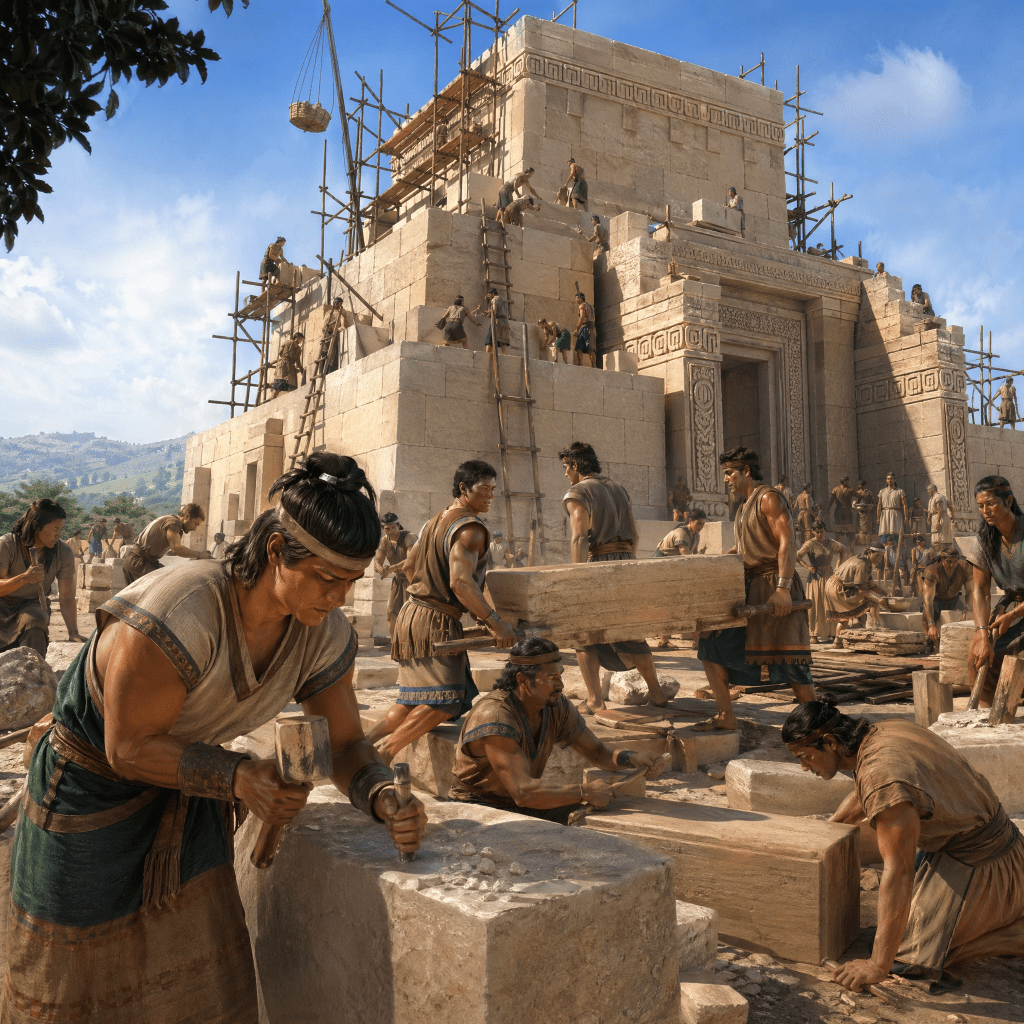
16: “And I, Nephi, did build a temple; and I did construct it after the manner of the temple of Solomon save it were not built of so many precious things; for they were not to be found upon the land, wherefore, it could not be built like unto Solomon’s temple. But the manner of the construction was like unto the temple of Solomon; and the workmanship thereof was exceedingly fine.”
No. This absolutely did not happen. Let’s open our Bibles to 1 Kings 5:13-16. According to this passage, King Solomon had 30,000 manual laborers that were sent to Lebanon in companies of 10,000 for one month at a time. There were 70,000 transporters, or men who hauled building materials and equipment. Then, there were 80,000 men tasked with quarrying and carving the stone used in the temple. He had 3,300 men who were overseeing all this labor. So there were over 180,000 men for this massive undertaking. In 1 Kings 6:38, we find this project took seven years to complete. Nephi and however many dozens of people who accompanied him absolutely did not build a replica of Solomon’s temple. We are expected to believe that the only difference is that different materials were used. We have no reason to believe this happened and every reason not to believe it.
17: “And it came to pass that I, Nephi, did cause my people to be industrious, and to labor with their hands.”
18: “And it came to pass that they would that I should be their king. But I, Nephi, was desirous that they should have no king; nevertheless, I did for them according to that which was in my power.”
This is reminiscent of the Israelites demanding a king. God, of course, was very displeased with this request, because their reason was so they could be like the surrounding pagan nations. God gave them a king, but He did so with great displeasure. You can read more about this in 1 Samuel 8.
20: “Wherefore, the word of the Lord was fulfilled which he spake unto me, saying that: Inasmuch as they will not hearken unto thy words they shall be cut off from the presence of the Lord. And behold, they were cut off from his presence.”
21: “And he had caused the cursing to come upon them, yea, even a sore cursing, because of their iniquity. For behold, they had hardened their hearts against him, that they had become like unto a flint; wherefore, as they were white, and exceedingly fair and delightsome, that they might not be enticing unto my people the Lord God did cause a skin of blackness to come upon them.”
That’s right, everyone. Nephi’s brothers and their groups were so evil that God turned them into Native Americans. Just to get the obvious out of the way first, no one who came from the middle east was “white, and exceedingly fair and delightsome.” This should not need to be explained. I have seen LDS apologists dance around this and try desperately to convince everyone that we aren’t reading exactly what we’re reading. I’ve witnessed some who attempt to paint this as a symbolic, spiritual darkness. That makes absolutely zero sense, because their skin color is clearly being described. Others have insisted that the curse was being separated from God, and the dark skin is just the mark that they were cursed, as if that’s somehow better. Another disturbing aspect, too, is God reportedly made them dark so “they might not be enticing to my people.” The strong implication here, is that Godly, “white and delightsome” folks can’t be attracted to darker-skinned people. The modern LDS church, of course, insists they aren’t a bunch of racists and they disavow racism. They’re simply scrambling to try to paint their history and their sacred text in a better light.
However, there is no hiding their past. Regarding black people, Brigham Young famously enacted a priesthood ban on blacks that persisted until 1978, when the church faced mounting pressure from civil rights activists and potential threats to their tax-exempt status. Young’s position was based on his belief that black people were descendants of Cain and black skin was the mark that God placed upon him, which he passed down. In his completely bizarre speech, he also refers to Eve as “Mama,” Adam as “Daddy,” and God as “Grandfather.” He also makes up other things about Cain’s curse, such as God telling him he can’t have the blessings of the priesthood. You can read his wild-eyed, disgustingly racist speech in its entirety, including his views on interracial couples, here: 4.2 Brigham Young articulates a racial priesthood restriction, February 5, 1852 · This Abominable Slavery · J. Willard Marriott Library Exhibits. You can also read more information here: Unexplaining the Mormon Priesthood Ban on Blacks | Christian Research Institute.
The LDS Church’s historical relationship with Native Americans has been complex and often brutal. On one hand, they believed it was their duty to minister to them. On the other hand, those ministries were fueled by the idea that they were savages in need of civilizing and redemption. To muddy the waters more, these beliefs also led to atrocious acts of violence against Native populations. This history is extensive, and I can’t possibly delve into every aspect of it, so I will do my best to provide an adequate summary.
Since LDS scripture taught that the dark skin was the mark of their curse, for over 100 years, members believed that by converting them, their skin would become white again. This comes from 2 Nephi 30:6, which originally stated, “And then shall they rejoice; for they shall know that it is a blessing unto them from the hand of God; and their scales of darkness shall begin to fall from their eyes; and many generations shall not pass away among them, save they shall be a white and a delightsome people.” In 1840, Joseph Smith swapped out “white” for the word, “pure.” However, all editions until 1981 still contained “white” instead of “pure.” This attitude is reflected in quotes from former LDS leaders, including Spencer Kimball, who insisted that the children in their home placement program (a sickening practice that I will expound upon in a bit) were becoming “white and delightsome” and these children appeared lighter than children still on the reservation. You can read more on that here: Question: Did some Church leaders believe that the skin of the Lamanites would turn white? – FAIR.
The Mormons’ relationships with Native American tribes began with Brigham Young and their settling of Utah. Young’s policies on them varied from a paternalistic view in which he wanted to convert them to violent confrontations. Young famously once said, “It is cheaper to feed than to fight the Indians.” On the surface, it appears he believed providing good and welfare to them was more economical and would foster peaceful relations. You can read that quote and other Young policies here: We Must Keep One Another. Be advised, however, that any history contained in this source is written through an LDS lens and needs to be compared with documented historical facts.
Despite these supposed policies of peace, however, Brigham Young cared very little for Indigenous people when it came to valuable resources for his settlers. As Mormons quickly settled the Utah Valley, many Timpanogos people were displaced, leading to disputes. In 1849, tensions flared and stoked the flames of conflict when Mormon settlers brutally murdered a Timpanogos man known as “Old Bishop” based upon the accusation that he stole a shirt from settlers. The Timpanogos people demanded the Mormons turn over the killers, which was refused. They then demanded goods to compensate for the loss of their tribe member, which was also refused. This led to months of the Timpanogos stealing crops and shooting at livestock that came onto their property. In January of 1850, the settlers demanded that Brigham Young take action, which he did by approving orders known as ” Special Orders No. 1 and 2.” These were extermination orders against the tribe, which is incredibly ironic and hypocritical, considering the extermination order issued by Governor Boggs against the Mormons in Missouri in 1838. This ghastly order led to a two-day battle in a nearby Timpanogos village in February of 1850. It was estimated that between 40 and 100 tribe members were killed, while the Mormon settlers lost one person. You can read more on this conflict here: An LDS pioneer-era extermination order still weighs on the Timpanogos Nation | KUER. The church has yet to rescind this order and formally apologize.
The Mormon settlers made enemies out of other tribes as well. Their settling of lands that the Ute tribe used for hunting and gathering eventually led to The Walker War (1853-1854). In July of 1853, some Utes were trading at the home of a settler named James Ivie when a dispute broke out between a Ute man and his wife over her inability to strike a good deal. Ivie intervened and ended up killing one of the men in the group, which happened to be a relative of their Chief Walkara. The Ute tribe demanded a settler be put to death as retribution, which the Mormons obviously refused. This led to more violence between the two groups, which finally ended in May of 1854 with a peace settlement between Chief Walkara and Brigham Young. For more information, see: The Walker War | History to Go.
Another horrifying act of violence is known as the Bear River Massacre of 1863. As Mormon settlements grew, more and more Shoshone Indians were pushed further and further out of their lands in Northern Utah. Some Shoshone reacted to this by leading raids on settlers. On January 29th, Colonel Patrick E. Connor led a group of volunteer soldiers from Fort Douglas in Salt Lake City to hunt down Shoshone tribe members who were responsible for those raids (Bear River Massacre Site in the Bear River Heritage Area). What followed next was the deadliest slaughter of Indigenous people in the history of the American West. Catching the tribe, who were largely defenseless, by surprise in their camp by the Bear River, these soldiers killed around 400 men, women, and children (Telling the stories of the Bear River Massacre – @theU).
In addition to these violent conflicts, Brigham Young also legalized slavery in the Utah Territory in 1852. The result was indentured servitude of Native American children in Mormon households in an attempt to “civilize” them. Under the Act in Relation to Service law, children could be “apprenticed” in Mormon families for up to 20 years. In his address during the legislative session on January 5th, 1852, Young decried the practice of slavery but advocated for “servitude” and made it clear that “the seed of Canaan” was inferior to white people. It is important to note, however, that this attitude wasn’t necessarily unique to Mormons.
Young believed removing them from their families and culture could aid in their conversion and recovery from their curse. Now, in the interest of fairness and proper historical context, I’d be remiss if I didn’t add the detail that some Ute slave traders would threaten to kill children in front of potential buyers if they weren’t purchased. As terribly racist as Young’s ideology was, I can’t honestly say I could fault some families for buying children under these circumstances ( The Trial of Don Pedro León Luján – BYU Studies). It would also be disingenuous of me if I also failed to recognize that the Native American slave trade was by no means instigated by the Mormons. It was widespread in the American West, and I’m willing to concede to the notion that many Mormons, perhaps even including Young, may have believed they were rescuing some of these children from traffickers, some of whom were Indigenous themselves. At the same time, however, Young viewed this “rescue” as a debt to be repaid by indentured servitude. You can read more on this here: 1.3 Excerpt from Governor’s Message, January 5, 1852 · This Abominable Slavery · J. Willard Marriott Library Exhibits. This is indeed a subject with some nuance. While we should not act as if Young and the Mormon settlers were the only villains in this story, we also shouldn’t view their cause as noble or good, either.
Unfortunately, the belief that Native American children were better off with Mormon families did not disappear with the slave trade. From about 1947 to 2000, the LDS church operated what was known as the Indian Placement Program. Spencer W. Kimball was the president of the church when this program first began unofficially. Native American children from the ages of 8 to 18 were baptized into the Mormon Church, despite not fully grasping what was to come. From there, these children and teens were placed with Mormon families during the school year and returned to the reservations during the summer. While the church painted this program as a noble endeavor that would give these children better opportunities, I think we can gather what the real motivation was given Kimball’s earlier referenced quote. In a letter to the first presidency, Golden Buchanan, who worked on this placement program, wrote, “The Indian people are ready. They are looking to us for leadership as they have never looked before… I feel strongly that the Church cannot neglect its responsibilities further. Today the children are pliable and can be molded.” While some program participants did have positive experiences, many did not, and the program was widely viewed as an attempt to erase a distinct culture and replace it with whiteness and Mormon beliefs. Around 50,000 children were placed in this program. You can read more on this here: The Indian Placement Program with The Church of Jesus Christ of Latter Day Saints – Lamanite Truth.
The LDS Church has yet to issue any formal apology for any of this to Indigenous people or even acknowledge any wrongdoing in these matters.
22: “And thus saith the Lord God: I will cause that they shall be loathsome unto thy people, save they shall repent of their iniquities.”
23: “And cursed shall be the seed of him that mixeth with their seed; for they shall be cursed even with the same cursing. And the Lord spake it, and it was done.”
So, interracial marriages were also a no-go. As Mayor of Nauvoo, Joseph Smith fined black men for attempting to marry white women. He stated in 1843: “Had I anything to do with the negro, I would confine them to their own species.” Charming. Brigham Young took a more extreme approach, with his insistence that interracial couples, namely white and black ones, needed to be put to death, a concept made famous in the “blood atonement” doctrine (Brigham says those in mixed-race marriages should have their blood shed as an atonement. | B. H. Roberts). While later church presidents did not advocate for the death penalty, interracial marriages were still, at the very least, strongly discouraged (What has been taught regarding interracial marriage?). Ironically enough, marriages between white men and Native American women were encouraged (Mormonism and Interracial Marriage – C. Randall Nicholson).
While we can’t say that Joseph Smith and Brigham Young had unique attitudes towards interracial marriage (though, Young’s was extreme even for that time), I can’t help but wonder, if this was God’s one true church, then why were they so much like the world? Why, if they had a living “prophet, seer, and revelator,” would they be borrowing such terrible and unholy views from their non-Mormon neighbors? While there were professing Christians at the time who advocated for terribly racist policies, we can safely say those were based on a deliberate misrepresentation of Scripture to conform to their sinful wants. We can’t say that about the Mormons of that time. Their racism was based upon their own scriptures that reflected the attitudes of that time.
24: “And because of their cursing which was upon them they did become an idle people, full of mischief and subtlety, and did seek in the wilderness for beasts of prey.”
Oh.
25: “And the Lord God said unto me: They shall be a scourge unto thy seed, to stir them up in remembrance of me; and inasmuch as they will not remember me, and hearken unto my words, they shall scourge them even unto destruction.”
26: “And it came to pass that I, Nephi, did consecrate Jacob and Joseph, that they should be priests and teachers over the land of my people.”
This didn’t happen. Even IF Nephi and his family existed, this would have been a completely inappropriate action because only Levites were permitted to be priests. See my post No. You’re Not a Levite. – The Inquisitive Christian for a more in-depth discussion of this.
27: “And it came to pass that we lived after the manner of happiness.”
And it came to pass that I started to question my decision to undertake reading the Book of Mormon.
Verses 28-34 discuss Nephi making more plates and writing more things on them.
Given the prominent discussion of racism in this post, I think it best to end with Galatians 3:28: “There is neither Jew nor Greek, there is neither slave nor free man, there is neither male nor female; for you are all one in Christ Jesus.”
 The Inquisitive Christian
Leave a comment