
I overdid it today, friends. I had surgery on my right heel less than 3 weeks ago, and I thought it would be a brilliant idea this morning to don my walking boot and, instead of using the crutches my surgeon advised me to use, put full weight on it while I hobbled around my kitchen before getting ready. I happily reported to my mother that I put full weight on it and had no pain. Only, I spoke too soon. Halfway through my first patient visit of the day (I’m a home health nurse), my heel began throbbing, aching, and telling me EXACTLY what it thought of my foolishness earlier. I put up with the pain and saw my remaining patients for the day and am now planted firmly on my couch, icing that heel to dull its bitter complaints.
After doing something so stupid, I like to try to reflect on my bad decisions and figure out why I did what I did. In this instance, I thought I knew better than the surgeon, who has gone to school YEARS longer than I ever will and is skilled enough to slice open my heel and remove a bone deformity. That’s whose judgment I questioned. Now, think of how it looks to question God’s judgment and His word. Imagine what God must think when someone rewrites His word because they think they know better. If your eyebrows are furrowed in befuddlement at why someone would do such a thing, then good. You’re about to read someone doing that very thing.
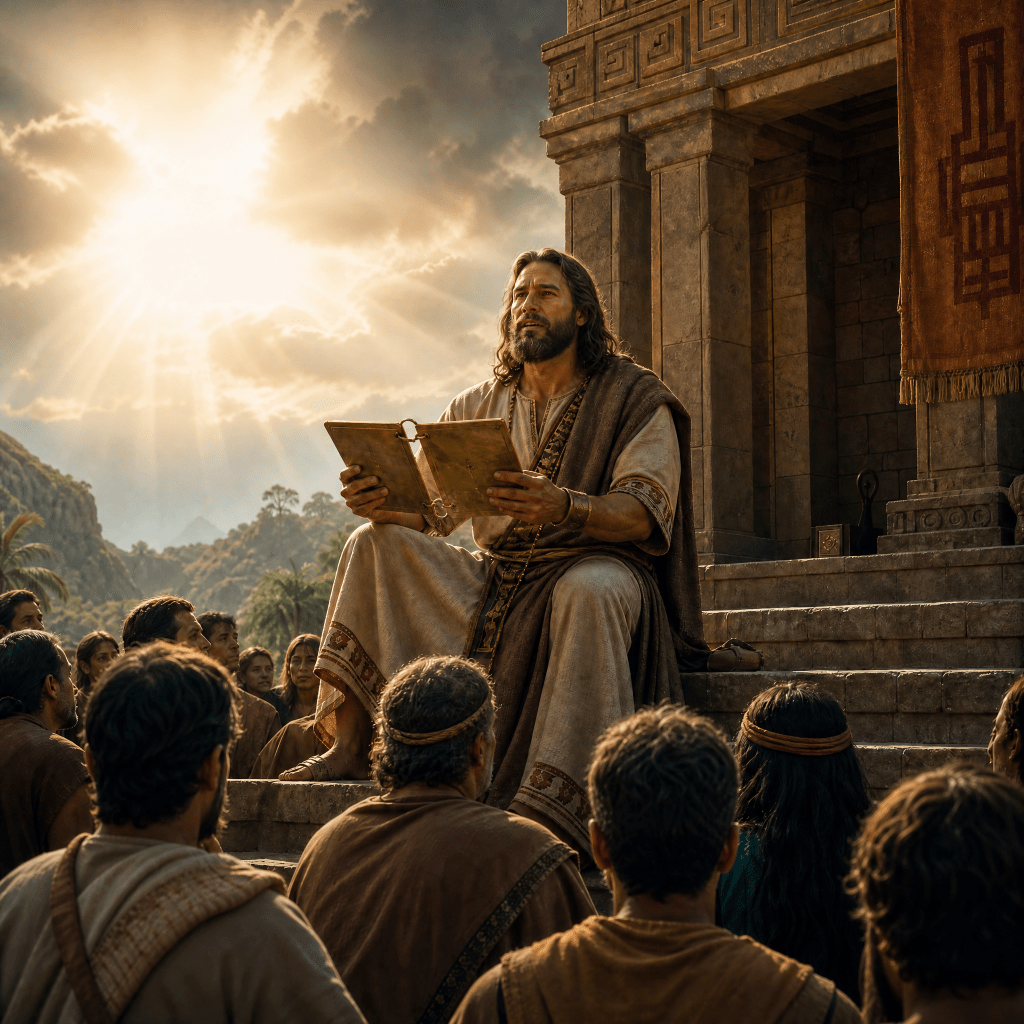
2 Nephi Chapter 7
Jacob continues reading from Isaiah: Isaiah speaks messianically—The Messiah will have the tongue of the learned—He will give His back to the smiters—He will not be confounded—Compare Isaiah 50. About 559–545 B.C.
1: “Yea, for thus saith the Lord: Have I put thee away, or have I cast thee off forever? For thus saith the Lord: Where is the bill of your mother’s divorcement? To whom have I put thee away, or to which of my creditors have I sold you? Yea, to whom have I sold you? Behold, for your iniquities have ye sold yourselves, and for your transgressions is your mother put away.”
The KJV of Isaiah 50:1 reads, “Thus saith the Lord, Where is the bill of your mother’s divorcement, whom I have put away? or which of my creditors is it to whom I have sold you? Behold, for your iniquities have ye sold yourselves, and for your transgressions is your mother put away.”
There is absolutely no reason at all to add the extra words and phrases here. The Bible is perfectly fine as is and doesn’t need help from Joseph Smith or anyone else.
In this verse in the Bible, God is calling out the Israelites for their disobedience and insistence that God has left them high and dry. He starts the chapter out by asking rhetorical questions. There is, of course, no bill of divorce, and there are no creditors to which they have been sold. Then, he lets them know their distress is their own fault. He allowed the Babylonian captivity to happen as punishment. They were fairly warned throughout the Old Testament that captivity would happen as a result of their disobedience.
I will say here that Isaiah 50 was written about the Babylonian captivity. Some scholars, as I’ve detailed in previous posts, believe Isaiah chapters 40-66 were written by different authors than Isaiah. The basic premise of those arguments is that the narration appears to switch at chapter 40 into someone speaking about the Babylonian captivity as if it had already happened. Others, as I’ve pointed out, believe Isaiah simply saw over a century into the future and wrote the entire book. I have already presented both arguments previously, and I’m not going to keep beating that dead horse. No matter which theory you believe, this opening verse is clearly talking about the specific predicament the Israelites found themselves in. This is going to matter a little later.
2: “Wherefore, when I came, there was no man; when I called, yea, there was none to answer. O house of Israel, is my hand shortened at all that it cannot redeem, or have I no power to deliver? Behold, at my rebuke I dry up the sea, I make their rivers a wilderness and their fish to stink because the waters are dried up, and they die because of thirst.”
“Wherefore, when I came, was there no man? when I called, was there none to answer? Is my hand shortened at all, that it cannot redeem? or have I no power to deliver? behold, at my rebuke I dry up the sea, I make the rivers a wilderness: their fish stinketh, because there is no water, and dieth for thirst.”
Note that in Nephi, Joseph Smith altered the text of Isaiah 50:2 to start with declarations instead of rhetorical questions. When God asks those types of questions of us, it’s because He is wanting us to humbly acknowledge that He is right. Declaring instead of asking takes away that acknowledgment. In this instance, God has no need to make declarations at the beginning of the verse because He asserts His absolute authority in the last part of the verse. God did not yet deliver them from Babylon; not because He couldn’t, but because He chose not to.
Now, Mormons see this verse completely differently than Christians do. For absolutely no good reason whatsoever, they see this verse as speaking in the future as if it were already past and that this is Jehovah (who they believe is Jesus and a different God than Yahweh) reminding them that He tried to redeem them when he came to earth as Jesus. This was read in an LDS commentary I found on 2 Nephi 7. They appear to also believe the differences between this chapter and Isaiah 50 are due to earlier Hebrew manuscripts losing these variations. There is no evidence whatsoever to back this up, and the only scholars who say so are Mormons at BYU.
3: “I clothe the heavens with blackness, and I make sackcloth their covering.”
“I clothe the heavens with blackness, and I make sackcloth their covering.”
Here, God is emphasizing what He established in the previous verse: what He says goes. His power is unmatched. He can eclipse the heavenly lights at will by thick and dark clouds.
Unsurprisingly, Mormons also have a different teaching of this verse. Since this verse is repeated in the Doctrine and Covenants 133:66-69, they believe this is a prophecy of the Second Coming. They suspect (again, for absolutely no good reason) that the blackness and sackcloth this verse mentions are referring to smoke from wars obstructing the sky. This interpretation makes very little sense when you consider that this verse is God declaring his ability to blacken the sky as he chooses. Darkening the sky with smoke from fires in wars would be caused by man, not God.
4: “The Lord God hath given me the tongue of the learned, that I should know how to speak a word in season unto thee, O house of Israel. When ye are weary he waketh morning by morning. He waketh mine ear to hear as the learned.”
“The Lord God hath given me the tongue of the learned, that I should know how to speak a word in season to him that is weary: he wakeneth morning by morning, he wakeneth mine ear to hear as the learned.”
As you can see, Smith rephrased verse 4 to specify Israel, even though Isaiah (and we’re going to assume he wrote the whole book, if nothing else than at least for the sake of simplicity) wrote only “to him that is weary.” It makes sense that that it would be more generalized when we realize who this verse is about: Jesus.
This is the part of Isaiah that starts getting more and more into Messianic prophecies. At first glance, this verse seems to be Isaiah talking about himself. However, the next few verses of this chapter make it clear that this is Jesus talking about himself and how he will be in the flesh. While Jesus absolutely was God incarnate, his position as a human made him subservient to the Father (see John 14:28. A full discussion of Christ’s dual nature is outside the scope of this post). Christ was both fully God and fully human. As a human, the Father endowed him with the tongue of the learned to comfort those who are weary.
Some Mormons think this a specific reference to Jesus when he was found in the temple at 12 years old, speaking with teachers of the law, who were amazed at his questions and answers. This doesn’t make much sense, however, because the verse goes on to say he has the tongue of the learned to “speak a word in season to him that is weary.” He wasn’t encouraging weary people in the temple.
Others believe it refers to the prophets’ calling to preach in Jerusalem. They take it a step further and say that it also fits Joseph Smith’s and the elders’ of “restored Israel” calling to “cause the wisdom of wise men to perish” (Isaiah 29:14). This is, of course, absolute lunacy and has no basis in reality. Bible passages only “fit” with anything pertaining to Joseph Smith if one deliberately contorts Scripture into something unrecognizable.
5: “The Lord God hath opened mine ear, and I was not rebellious, neither turned away back.”
“The Lord God hath opened mine ear, and I was not rebellious, neither turned away back.” This is speaking of Christ’s obedience to the Father in his work, no matter what hardships he faced.
6: “I gave my back to the smiter, and my cheeks to them that plucked off the hair. I hid not my face from shame and spitting.”
“ I gave my back to the smiters, and my cheeks to them that plucked off the hair: I hid not my face from shame and spitting.”
Jesus willingly endured the horrifying pain and indignity of being lashed, beaten, and spit upon. He could have hidden his face, but he didn’t. He was willing to pay the cost of our freedom from sin.
The LDS commentary, which I will cite near the end of this post, ties it back to the opening verse of this chapter, stating that “in spite of such rejection and treatment, he still did not divorce Israel or sell her as a slave. The covenant was still in effect, and Israel would be restored to the status of a free and faithful wife of Jehovah.” This makes very little sense when you consider the opening verse was more specific to the Babylonian captivity. Even in a broader sense, this interpretation is still strange because Christ’s death and resurrection put forth a new covenant. The old was no longer in effect. The new covenant, of course, came to be as a result of Jesus fulfilling the Old Testament law once and for all, making it null and void for that generation onward (See Matt. 5:17). It also meant that salvation was freely offered to everyone, not just the Jews. See Acts 10:45, Acts 13:47, Romans 1:16, Romans 15:9-12, Galatians 3:14, and Ephesians 3:6.
While the final restoration of Israel is certainly prophesied (see Jeremiah 31 and Zechariah 8), the church is the Bride of Christ, not specifically Israel. Ephesians 5:25-27 is the primary passage for this imagery. It is further developed in verses 31 and 32: “For this cause a man shall leave his father and mother, and shall cleave to his wife; and the two shall become one flesh. This mystery is great; but I am speaking with reference to Christ and the church.” In 2 Corinthians 11:2, Paul likens the church as being betrothed to Christ. In Revelation 19:7-9, the “marriage of the Lamb” is celebrated, with the church representing the bride.
7: “For the Lord God will help me, therefore shall I not be confounded. Therefore have I set my face like a flint, and I know that I shall not be ashamed.”
“For the Lord God will help me; therefore shall I not be confounded: therefore have I set my face like a flint, and I know that I shall not be ashamed.”
The Son relied on strength from the Father to endure what was to come. The phrase “I have set my face like a flint” describes his unshakable and steadfast resolve to fulfill his mission. This is further echoed in Luke 9:51 (NASB): “And it came about, when the days were approaching for His ascension, that He resolutely set His face to go to Jerusalem.”
Mormons, however, seem to believe this imagery is about the scattered Israel, who has also been “smitten and spat upon and scourged throughout the centuries. Still, Israel is represented as “The Lord God will help me… I shall not be ashamed.” There is not a single credible Biblical scholar alive who would agree with this view.
8: “And the Lord is near, and he justifieth me. Who will contend with me? Let us stand together. Who is mine adversary? Let him come near me, and I will smite him with the strength of my mouth.”
“He is near that justifieth me; who will contend with me? let us stand together: who is mine adversary? let him come near to me.”
The Father is near the Son, and the Son is challenging all who oppose him. He puts all his opponents to shame, and they can only be silent in return. Now, Isaiah didn’t write anything about anyone smiting anyone else with mouth strength. He also only wrote “He is near,” not “the Lord is near.” So why did Smith add those? And what do Mormons make of this?
Turns out, they’re still on the Isreal train with this passage, believing it to demonstrate Israel’s trust in God. Talk about missing the mark.
9: “For the Lord God will help me. And all they who shall condemn me, behold, all they shall wax old as a garment, and the moth shall eat them up.”
“Behold, the Lord God will help me; who is he that shall condemn me? lo, they all shall wax old as a garment; the moth shall eat them up.” This is again a rhetorical question.
According to Matthew Henry’s commentary on Isaiah 50 (which I’ve been using as a guide for this post), Christ is challenging anyone to condemn him. There is no condemnation for those whom God justifies. He further states, “There were those that did condemn them, but what became of them? They all shall wax old as a garment. The righteous cause of Christ and his prophets shall outlive all opposition. The moth shall eat them up silently and insensibly; a little thing will serve to destroy them. But the roaring lion himself shall not prevail against God’s witnesses. All believers are enabled to make this challenge, Who is he that shall condemn? It is Christ that died.”
The Mormons, again, think this might be about Israel. The commentary I found insists that “As with the other servant songs, controversy surrounds the interpretation of these verses. The servant could be any number of people or peoples. Perhaps it is the prophet Isaiah… perhaps it is the nation of Israel…” This is patently false. The overwhelming majority of scholars agree verses 4-9 comprise one of the Servant Songs, and it is absolutely about Jesus. Traditional Christian theology also recognizes this, and it’s backed up by the New Testament. Matthew 26:67 and Mark 14:65 confirm the suffering of Jesus in verse 6 of this chapter. Romans 8:33-34 echoes the language of verse 9 here: “Who will bring a charge against God’s elect? God is the one who justifies; who is the one who condemns? Christ Jesus is He who died…”
10: “Who is among you that feareth the Lord, that obeyeth the voice of his servant, that walketh in darkness and hath no light?”
“Who is among you that feareth the Lord, that obeyeth the voice of his servant, that walketh in darkness, and hath no light? let him trust in the name of the Lord, and stay upon his God.”
This is a verse of comfort, promising that those who love God can trust in Him, no matter what trials they may face. This even seems to be a nice summary of the Gospel: whoever believes in Him shall be saved.
However, because the Book of Mormon has left out the phrase “let him trust in the name of the Lord, and stay upon his God,” they take it as a warning directed at nonbelievers in conjunction with verse 11. Even without the aforementioned phrase, their interpretation of this verse makes no sense. Anyone who “feareth the Lord, that obeyeth the voice of his servant,” is obviously not a nonbeliever. People who fit that description that “walketh in darkness, and hath no light,” are clearly believers who are going through some dark trial.
11: “Behold all ye that kindle fire, that compass yourselves about with sparks, walk in the light of your fire and in the sparks which ye have kindled. This shall ye have of mine hand—ye shall lie down in sorrow.”
“Behold, all ye that kindle a fire, that compass yourselves about with sparks: walk in the light of your fire, and in the sparks that ye have kindled. This shall ye have of mine hand; ye shall lie down in sorrow.”
This is a warning to nonbelievers who trust only in themselves and not God. Their “fire” and “sparks” are their own understanding. The following instruction to “walk in the light of your fire, and in the sparks that ye have kindled,” is essentially, “enjoy it while it lasts.” God’s hand shall ultimately prevail against them.
While the LDS commentary seems to agree with this assessment, something stuck out to me: “They who refuse God’s revelations and put their trust in their own reason ‘shall lie down in sorrow.’” The LDS church teaches that they have a “living prophet” who reveals God’s words through progressive revelation. They snuck that description of this verse in there to include those of us who ignore their “prophet’s revelations.” Sneaky.
For the wonderful Matthew Henry commentary, see Commentary on Isaiah 50 by Matthew Henry. For the not-so-wonderful LDS commentary, see 2 Nephi 7 / Isaiah 50—the Third Servant Song – Search Isaiah.
Hopefully, this shed light on a very important fact: viewing the Bible through an LDS lens is a surefire way to horribly misunderstand it, and, by extension, to horribly misunderstand God Himself.


Leave a Reply