
We’re in for some nasty weather here. Dark, ominous clouds are gathering on the horizon. The wind is picking up, rustling the leaves of nearby trees and stirring up the dust from our normally dry climate. So here I am, safely inside on my couch in front of my computer, with my cat contentedly purring in my lap. I’ve been slowly picking through 2 Nephi 9, turning each verse over in my mind, figuring out how to organize my thoughts on a chapter with 54 verses.
There are theological principles that are not fully realized until the New Testament. I have addressed some of these issues in previous posts. I would strongly recommend reading or reviewing my previous post on the concepts of Satan and hell before proceeding: https://theinquisitivechristian.blog/2026/03/26/the-devil-is-in-the-details/. This topic rears its head quite often in this chapter. Reading that previous post will equip you to accurately critique this chapter’s mention of eternal punishment and the devil as our ultimate adversary. It will also prevent me from having to repeat a bunch of material that I’ve already covered in depth. In order to not misrepresent the meanings of this chapter, I will be using the LDS source Gospel Doctrine (2 Nephi 9 | Gospel Doctrine) to decipher the themes discussed here. Let us begin.
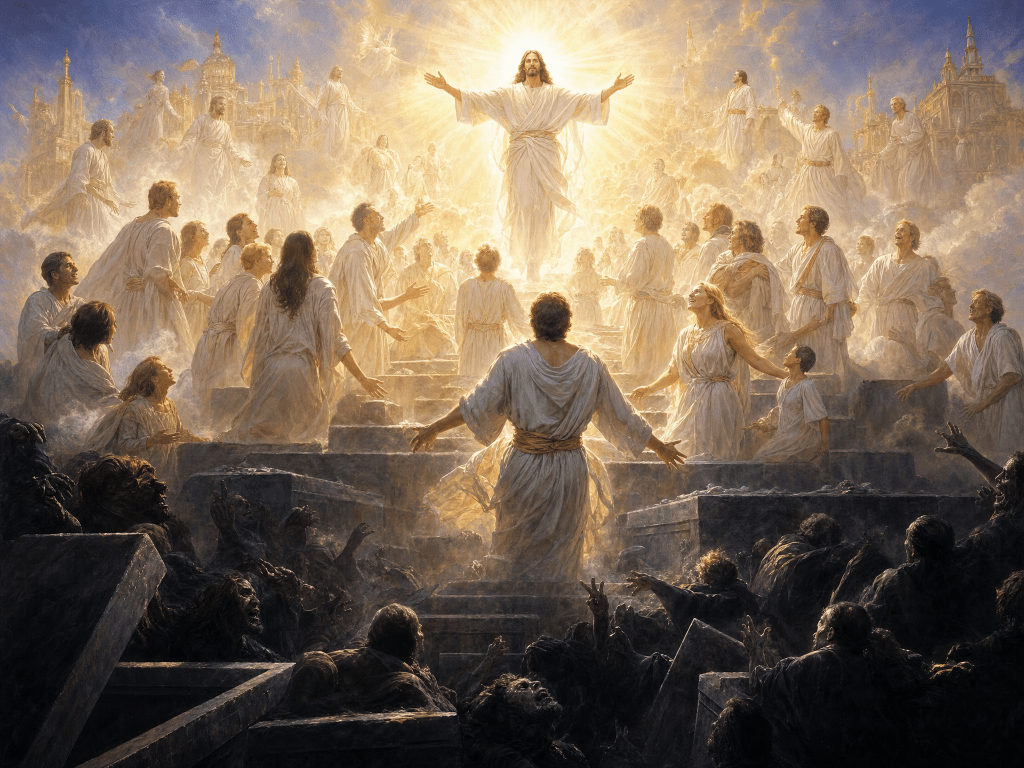
2 Nephi Chapter 9
Jacob explains that the Jews will be gathered in all their lands of promise—The Atonement ransoms man from the Fall—The bodies of the dead will come forth from the grave, and their spirits from hell and from paradise—They will be judged—The Atonement saves from death, hell, the devil, and endless torment—The righteous are to be saved in the kingdom of God—Penalties for sins are set forth—The Holy One of Israel is the keeper of the gate. About 559–545 B.C.
1: “And now, my beloved brethren, I have read these things that ye might know concerning the covenants of the Lord that he has covenanted with all the house of Israel—”
2: “That he has spoken unto the Jews, by the mouth of his holy prophets, even from the beginning down, from generation to generation, until the time comes that they shall be restored to the true church and fold of God; when they shall be gathered home to the lands of their inheritance and shall be established in all their lands of promise.”
For the thousandth time: the word “church” did not exist in the Old Testament. The Israelites are often referred to in the Old Testament as “the assembly” or “congregation.” Church is specific to Christianity and the concept of it did not exist until the New Testament.
Also, there are no multiple “lands of promise.” There is only one. I’m going to simply copy and paste what I said about this in my previous post, “An Implausible Discovery”: Per the Old Testament, the “promised land” consisted of Canaan, which roughly corresponds to modern day Israel and Palestine. Genesis 12 is where God promises this land to Abraham. See Genesis 26:2-3; 28:12-13; 35:9-12; 48:3-4; and 50:24 for the repeating of these promises to Jacob and Joseph. See Genesis 15:18, Exodus 23:31, and Numbers 34:1-12 for a description of this land and its borders. Genesis 13:15 states, “All the land that you see I will give to you and to your offspring forever.”
3: “Behold, my beloved brethren, I speak unto you these things that ye may rejoice, and lift up your heads forever, because of the blessings which the Lord God shall bestow upon your children.”
4: “For I know that ye have searched much, many of you, to know of things to come; wherefore I know that ye know that our flesh must waste away and die; nevertheless, in our bodies we shall see God.”
The phrase “in our bodies we shall see God” caught my eye in this verse. The popular LDS website (run my members and not the church) interprets this verse as follows: “This comment sparks Jacob’s discussion of the resurrection. He knows that there is something after heaven and hell. He understands that heaven and hell end in the resurrection to be replaced by kingdoms of different glories. Since the Bible speaks mostly of heaven and hell, and rarely speaks of events thereafter, this concept is important. It was taught by Job who said, And though after my skin worms destroy this body, yet in my flesh shall I see God (Job 19:26).” This should go without saying, but there are no “kingdoms of different glories.” There’s heaven. That’s it.
Depending on which translation one uses, there is some discussion about the phrase “in my flesh I shall see God.” Some translations use the phrase “out of my flesh.” Because of this, what Job actually means isn’t 100% apparent. Taken literally, “in my flesh” would likely mean Job believed he would see God while in a physical, restored, resurrected body. If one uses the phrase “out of my flesh,” this could mean Job meant he would see God from a spiritual state. I’m personally fine with either interpretation. It’s not a hill worth dying on, because it’s a minor issue that has no bearing on a person’s salvation. The LDS teaching on this verse would have been ok besides the mention of kingdoms of other glories, but then they kept going.
The second paragraph on this verse argues that will the context here is talking about seeing God in a resurrected state, Nephi and Jacob knew that if you have enough faith and purity, it is possible to see God while in the flesh, but the body has to undergo some sort of transformation “so that it can withstand the presence of God.” They then quote from the Book of Moses, from Pearl of Great Price. There is no Biblical support for this at all. In Exodus 33:20, God informs Moses “You cannot see My face, for no man shall see Me and live.” We also see this echoed in the New Testament in John 1:18: “No man has seen God at any time; the only begotten God, who is in the bosom of the Father, He has explained Him.” I’m not going to go too far off into the woods here, but the Christian understanding of this principle is that Old Testament sightings of God were early sightings of Jesus. This is the only logical explanation because it doesn’t contradict other Scripture.
5: “Yea, I know that ye know that in the body he shall show himself unto those at Jerusalem, from whence we came; for it is expedient that it should be among them; for it behooveth the great Creator that he suffereth himself to become subject unto man in the flesh, and die for all men, that all men might become subject unto him.”
The definition of “behoove” is to be necessary, proper, or advantageous for someone to do something. The theological implications of applying this term to God are very strange. God does not do anything for His own advantage, because He doesn’t need to. Exodus 3:14 is God introducing Himself to Moses as “I AM WHO I AM.” This is God asserting His self-existence. While the meaning of this phrase isn’t fully understood by Biblical scholars, it suggests the timelessness of God, the very foundation of all existence. There’s also a hint of this in Revelation 1:4: “from Him who is, and who was, and who is to come.” In regard to who he is, Jesus stated in John 8:58, “Before Abraham was, I AM.” (which also supports the doctrine of the Trinity).
EDIT: So, apparently, when saying something “behooves” God, it actually means “it is fitting for God.” So, if it behooves God to do something, what the text is actually saying is that something is fitting for God to do, NOT that it’s beneficial to him. Look at me learning new things! Haha! So, the things I say here about God being self-sufficient are indeed true, but they are misapplied in this context.
God needs absolutely nothing, in fact. Acts 17:24-25 says, “The God who made the world and all things in it, since He is Lord of heaven and earth, does not dwell in temples made with hands; neither is He served by human hands, as though He needed anything, since He Himself gives to all life and breath and all things.” There is nothing in this world whatsoever that would “behoove” God, and to suggest otherwise is to deny His very nature. It certainly didn’t benefit HIM to take on flesh and suffer a horrific death. That was done for our benefit out of His infinite mercy. We really need to know our place here.
Gospel Doctrine glosses over all of that and instead focuses on the last part of this verse: “…he suffereth himself to become subject unto man in the flesh, and die for all men, that all men might become subject unto him.” It is true that Jesus subjected himself to worldly rulers, especially near the end of his life on earth. To Pontious Pilate he said, “You would have no authority over Me, unless it had been given you from above…” Yet, he allowed himself to be handed over to and judged by Pilate. In John 10:17-18, Jesus tells those listening, “For this reason the Father loves Me, because I lay down My life that I may take it again. No one has taken it away from Me, but I lay it down on My own initiative. I have authority to lay it down, and I have authority to take it up again. This commandment I received from My Father.” So, Jesus willingly laid down his life for us. We owe our allegiance to him and should be subject to him. In return, he delivers us from sin. This is one example, I think, of the Book of Mormon containing just enough truth mixed in with blatant falsehoods to be believable to those who are largely unfamiliar with the Bible. It’s just palatable enough to swallow the whole thing to those who don’t know better.
6: “For as death hath passed upon all men, to fulfil the merciful plan of the great Creator, there must needs be a power of resurrection, and the resurrection must needs come unto man by reason of the fall; and the fall came by reason of transgression; and because man became fallen they were cut off from the presence of the Lord.”
This is a definite change in tone regarding the attitude of 2 Nephi 2, where Adam and Eve are held up as heroes for disobeying God. The Book of Mormon now admits the death and resurrection of Christ was necessary because of what they did. For my thorough breakdown of that chapter, see https://theinquisitivechristian.blog/2026/04/01/thanks-i-hate-it/.
7: “Wherefore, it must needs be an infinite atonement—save it should be an infinite atonement this corruption could not put on incorruption. Wherefore, the first judgment which came upon man must needs have remained to an endless duration. And if so, this flesh must have laid down to rot and to crumble to its mother earth, to rise no more.”
I looked at this verse with a certain level of befuddlement, because what on earth is “infinite atonement”? Atonement is atonement. Gospel Doctrine’s take on this verse is as follows: “The atonement must be infinite in that it must conquer death for all of Adam’s children. In a more profound sense, it must pay the price for those sins which are committed by the followers of Christ. Those that exercise faith in him are given the promise of forgiveness of sins. How can one count the number of those sins? The infinite atonement means that no matter how many sins need forgiving, no matter how many people turn to the Lord as their Savior, no matter how many mistakes we make, there will never come a point when the redemptive power of the atonement runs out.”
I see a couple of issues with this. The first is that it’s redundant. John 3:16 lays it out pretty clearly when it says, “whosoever believes in him shall not perish but have everlasting life.” It goes to follow that includes sins of anyone, no matter who they are. There doesn’t need to be some sort of super-duper extra special atonement for Christians who commit sins, so that’s a very strange implication of the meaning of this verse. The second issue, which is more serious, is the idea that Christians just keep on sinning. We shouldn’t be. That’s the whole point of Christ’s atonement. Does this mean once we surrender fully to Christ, we’ll live lives of sinless perfection? Certainly not, but when we casually tell people that no matter how many sins we commit after being saved, God will forgive them all, we do ourselves and others a disservice by implying that it’s no big deal.
It is very important to draw a distinction between habitual sin and occasional, rare instances of weakness that lead to succumbing to temptation. John had a few things to say about this in his 1st epistle. 1 John 3:6 states, “No one who abides in Him sins; no one who sins has seen Him or knows Him.” This is echoed again in verse 9: “No one who is born of God practices sin, because His seed abides in him; and he cannot sin, because he is born of God.” I should note that some translations say, “he cannot keep sinning” instead of simply “cannot sin.” In either case, the implication is the same: no one who is a Christian can keep casually and carelessly sinning. This is further emphasized in 5:18: “We know that no one who is born of God sins; but He who was born of God keeps him and the evil one does not touch him.”
As I stated, none of this means that we will attain sinless perfection in this life. 1 John 2 opens with “My little children, I am writing these things to you that you may not sin. And if anyone sins, we have an Advocate with the Father, Jesus Christ the righteous; and He Himself is the propitiation for our sins; and not for ours only, but also for those of the whole world.” Taken in proper contexts, all of these verses tell us that while no one who is in Christ keeps on sinning, a sin may be committed on occasion. If that happens, God forgives after sincere repentance. His grace and forgiveness should never be abused and used as “get out of hell free” cards. Our view of sin needs to be balanced.
Unsurprisingly, however, Mormons take this concept to a place that never even crossed my mind: they think that since there are an infinite number of worlds with people on them, the infinite atonement also means it extends infinitely to these numbers of planets. As Bruce McConkie once stated, “When the prophets speak of an infinite atonement, they mean just that. Its effects cover all men, the earth itself and all forms of life thereon, and reach out into the endless expanses of eternity….Now our Lord’s jurisdiction and power extend far beyond the limits of this one small earth on which we de\well. He is under the Father, the creator of worlds without number (Moses 1:33). And through the power of his atonement the inhabitants of these worlds, the revelation says, ‘are begotten sons and daughters unto God’ (DC 76:24), which means that the atonement of Christ, being literally and truly infinite, applies to an infinite number of earths.” (Mormon Doctrine, pp. 64-5 as taken from Latter-day Commentary on the Book of Mormon compiled by K. Douglas Bassett, p. 113-4).
Now, the theological and logical implications of all this will have to be revisited when I read Pearl of Great Price. For now, I’m going to say that only God is infinite and eternal, and there’s no Biblical support whatsoever that God created an infinite number of worlds.
8: “O the wisdom of God, his mercy and grace! For behold, if the flesh should rise no more our spirits must become subject to that angel who fell from before the presence of the Eternal God, and became the devil, to rise no more.”
Gospel Doctrine explains that this verse essentially answers the question of what would happen if Jesus had decided not to go through with his death and resurrection. The Bible never even addresses this idea. It doesn’t need to because it didn’t happen and it never was going to.
9: “And our spirits must have become like unto him, and we become devils, angels to a devil, to be shut out from the presence of our God, and to remain with the father of lies, in misery, like unto himself; yea, to that being who beguiled our first parents, who transformeth himself nigh unto an angel of light, and stirreth up the children of men unto secret combinations of murder and all manner of secret works of darkness.”
Now comes the part where I really hope you read “The Devil is in the Details” before you decided to read this post. He is not called “the father of lies” or “an angel of light” until the New Testament. See John 8:44 and 2 Corinthians 11:14.
10: “O how great the goodness of our God, who prepareth a way for our escape from the grasp of this awful monster; yea, that monster, death and hell, which I call the death of the body, and also the death of the spirit.
11: “And because of the way of deliverance of our God, the Holy One of Israel, this death, of which I have spoken, which is the temporal, shall deliver up its dead; which death is the grave.”
12: “And this death of which I have spoken, which is the spiritual death, shall deliver up its dead; which spiritual death is hell; wherefore, death and hell must deliver up their dead, and hell must deliver up its captive spirits, and the grave must deliver up its captive bodies, and the bodies and the spirits of men will be restored one to the other; and it is by the power of the resurrection of the Holy One of Israel.”
13: “O how great the plan of our God! For on the other hand, the paradise of God must deliver up the spirits of the righteous, and the grave deliver up the body of the righteous; and the spirit and the body is restored to itself again, and all men become incorruptible, and immortal, and they are living souls, having a perfect knowledge like unto us in the flesh, save it be that our knowledge shall be perfect.”
I’ll get to the Mormon explanation of these verses in a bit. There are two prophecies in the Old Testament concerning a general resurrection of the dead. Isaiah 26:19 says, “Your dead will live; their corpses will rise. You who lie in the dust, awake and shout for joy, for your dew is as the dew of the dawn, and the earth will give birth to the departed spirits.” The second one is Daniel 12, which is an end times prophecy. Verse 2 reads, “And many of those who sleep in the dust of the ground will awake, these to everlasting life, but the others to disgrace and everlasting contempt.” So, there is precedent in the Old Testament on resurrection of the dead, but they’re not anywhere near this specific.
There are similar prophecies in the New Testament. In John 11, when Jesus is going to raise Lazarus from the dead, Jesus assured Martha that her brother would rise again in verse 23. Verse 24 records Martha as responding, “I know that he will rise again in the resurrection on the last day.” In verse 25 and 26, Jesus states, “I am the resurrection and the life; he who believes in Me shall live, even if he dies, and everyone who lives and believes in Me shall never die. Do you believe this?” Here we see that a resurrection of the dead was a belief held amongst Jews in Jesus’ day. We also see his promise of this resurrection and eternal life.
Paul builds upon this in 1 Corinthians 15:20-22: “But now Christ has been raised from the dead, and the first fruits of those who are asleep. For since by a man came death, by a man also came the resurrection of the dead. For as in Adam all die, so also in Christ all shall be made alive.” In 1 Thessalonians 4:16-17, Paul foretells the return of Christ and how “the dead in Christ will rise first” to meet him. We know, then, that there will definitely be a resurrection of the dead, but we’re not entirely sure what that’s going to look like.
Besides the odd specificity (which I think was definitely purposeful on Smith’s part) of verses 10-13, they’re not completely terrible on their own. It’s what Mormons attach to them that should give someone pause. In the words of Gospel Doctrine: “Through the atonement death and hell are overcome. Death is overcome for all who live on the earth. Hell is overcome for all but the sons of perdition (DC 76:43-44). Even those of the telestial kingdom will be redeemed in the due time of the Lord (DC 76:31-44). They also are blessed with the ministration of the Holy Ghost and are therefore not cast out of God’s presence forever (DC 76:86). For the sons of perdition, it is a different story. They are cast out of the presence of God to rule with the devil and his angels in eternity (DC 76:44). So, for all but the most wicked-because they were not willing to enjoy that which they might have received (DC 88:32)-mankind is saved from the grips of that awful monster.” While they do tie some of their principles in these verses to some Biblical references, the majority of support you see for their ideas doesn’t come from the Bible, but from their own Mormon writings that are unbiblical upon examination.
First, there is zero Biblical support for different levels of heaven. There are no telestial, terrestrial, and celestial kingdoms. Multiple verses in the New Testament tell us that all believers go to the same place to dwell with Christ for all eternity. Second, we know that all it takes for a person to wind up in hell is for them to reject Christ and his offer of salvation. In John 14:6, Jesus says, “I am the way, the truth, and the life; no one comes to the Father, but through me.” That’s pretty cut-and dried. The idea that eternal punishment is reserved only for “the most wicked,” is a lie that creates a false sense of security. If people believe that they’ll at least go to some level of heaven as long as they’re not cooking meth for little kids and beating up old ladies in the Dairy Queen parking lot, then what reason do they have for surrendering to Christ at all? You can be a perfectly nice human being who does good things and that won’t get you into heaven.
The third issue here is the idea that anyone is going to “rule with the devil and his angels in eternity.” In this previous post here, https://theinquisitivechristian.blog/2025/11/13/satan-isnt-in-charge-of-hell-obvously/, you will read how Satan does not run hell. He is not in charge. His demons are not in charge. Neither are these so-called “sons of perdition.” Hell is a place of eternal punishment and torment for Satan, his demons, and those who go his way on earth. There is no hierarchy there. EVERYONE experiences the torment. A religion that claims to be Christian but can’t even get their doctrines on hell right isn’t one that should be followed.
14: “Wherefore, we shall have a perfect knowledge of all our guilt, and our uncleanness, and our nakedness; and the righteous shall have a perfect knowledge of their enjoyment, and their righteousness, being clothed with purity, yea, even with the robe of righteousness.”
15: “And it shall come to pass that when all men shall have passed from this first death unto life, insomuch as they have become immortal, they must appear before the judgement seat of the Holy One of Israel; and then cometh the judgment, and then must they be judged according to the holy judgment of God.”
Per GD (Gospel Doctrine), this is basically saying that on judgement day, we will be reminded of every single thing we did, good or bad. This is in line with Revelation 20:12, where John describes the scene when everyone who has ever lived will stand before God: “And I saw the dead, the great and the small, standing before the throne, and the books were opened; and another book was opened, which is the book of life, and the dead were judged from the things which were written in the books, according to their deeds.”
But wait! There’s more! There’s always more. At first glance, this doesn’t seem problematic at all. And then, you read further into it using LDS sources, and you find out that they can’t seem to leave well enough alone. According to LDS doctrine, God isn’t going to be the only one judging. According to GD, “We always imagine that Christ will be our judge. However, He is not the only one who will judge us at the judgment-seat. Nephi declared, I shall meet many souls spotless at his judgment-seat…and you and I shall stand face to face before his bar; and ye shall know that I have been commanded of him to write these things (2 Ne 33:7,11). Moroni also will be at the judgment-seat, we shall meet before the judgment-seat of Christ, where all men shall know that my garments are not spotted with your blood (Ether 12:38). The Savior gave the responsibility of judging the twelve tribes of Israel to his apostles (Matt 19:28) and the responsibility of judging the descendants of Lehi to the disciples of the Americas (3 Ne 27:27). Therefore, the Savior and his servants, who wrote the scriptures before us, will judge us according to our faithfulness to the light we had received in mortality.”
So, let’s start with Matthew 19:28, which reads, “And Jesus said to them, ‘Truly I say to you, that you who have followed Me, in the regeneration when the Son of Man will sit on His glorious throne, you also shall sit upon twelve glorious thrones, judging the twelve tribes of Israel.” So, does it mean what GD says it does? No. Pay attention to the word “regeneration.” Some translations say, “the renewal of all things.” There are three possible meanings of this passage that I will briefly explain.
The first is the Premillennial View, sees this verse in the context of a literal 1,000-year reign of Christ on earth when he returns. Those who hold this view believe the Twelve Apostles will serve as co-rulers during this reign. The second is known as the Heavenly Reward Concept. This view holds this verse as a promise of special honor to be bestowed upon the apostles in the final, heavenly order. The third view is the Present Messianic Era, which posits that the “regeneration” speaks of the Christian age that commenced on the Day of Pentecost. You can read about these in much more detail here: The Regeneration – A Study of Matthew 19:28 | Christian Courier. No matter which view you hold, none of them involve anyone besides God making the final judgment on everyone.
On the contrary, we will all be required to give an account of ourselves to God alone on Judgment Day. See Romans 14:10-12, Revelation 20:11-15, and Romans 14:12. Even if you believe Nephi, Moroni, or any of the other prophets specific to the Book of Mormon existed, you would still have no reason to believe they’ll be participating in any final judgment if you also claim to believe the Bible. The Book of Mormon and the Bible cannot both be true.
16: “And assuredly, as the Lord liveth, for the Lord God hath spoken it, and it is his eternal word, which cannot pass away, that they who are righteous shall be righteous still, and they who are filthy shall be filthy still; wherefore, they who are filthy are the devil and his angels; and they shall go away into everlasting fire, prepared for them; and their torment is as a lake of fire and brimstone, whose flame ascendeth up forever and ever and has no end.”
This mimics the wording in Revelation 22:11, which states, “He that is unjust, let him be unjust still: and he which is filthy, let him be filthy still: and he that is righteous, let him be righteous still: and he that is holy, let him be holy still.” This means that at the final judgment, any door to turn to Christ is closed. Both believers and unbelievers are locked into their final state of obedience or disobedience to Christ.
GD certainly had the opportunity to reference this passage in Revelation, but they decided instead to use D&C: “This phrase suggests a willful rebellion against God. The D&C teaches this principle beautifully: ‘he who cannot abide the law of a telestial kingdom cannot abide a telestial glory; therefore he is not meet for a kingdom of glory. Therefore he must abide a kingdom which is not a kingdom of glory…That which breaketh a law, and abideth not by law, but seeketh to become a law unto itself, and willeth to abide in sin, and altogether abideth in sin, cannot be sanctified by law, neither by mercy, justice, nor judgment. Therefore, they must remain filthy still.’ (DC 88:24,35).
17: “O the greatness and the justice of our God! For he executeth all his words, and they have gone forth out of his mouth, and his law must be fulfilled.”
18: “But, behold, the righteous, the saints of the Holy One of Israel, they who have believed in the Holy One of Israel, they who have endured the crosses of the world, and despised the shame of it, they shall inherit the kingdom of God, which was prepared for them from the foundation of the world, and their joy shall be full forever.”
19: “O the greatness of the mercy of our God, the Holy One of Israel! For he delivereth his saints from that awful monster the devil, and death, and hell, and that lake of fire and brimstone, which is endless torment.”
20: “O how great the holiness of our God! For he knoweth all things, and there is not anything save he knows it.”
21: “And he cometh into the world that he may save all men if they will hearken unto his voice; for behold, he suffereth the pains of all men, yea, the pains of every living creature, both men, women, and children, who belong to the family of Adam.”
These verses seem to me to be a wordy rehashing of principles already laid out in this chapter: final judgement, believers being saved from hell, the suffering and death of Christ… you get the idea. In fact, I was going to leave verse 21 alone until I read what GD published concerning it. This heretical quote from late apostle James E. Talmage needs attention: “Christ’s agony in the garden is unfathomable by the finite mind, both as to intensity and cause. The thought that He suffered through fear of death is untenable. Death to Him was preliminary to resurrection and triumphal return to the Father from whom He had come, and to a state of glory even beyond what He had before possessed…” I beg your finest pardon? A state of glory even beyond what he had before possessed?
Philippians 2:5-8 states, “Have this attitude in yourselves which was also in Christ Jesus, who although He existed in the form of God, did not regard equality with God a thing to be grasped, but emptied Himself, taking the form of a bond-servant, and being make in the likeness of men. And being found in appearance as a man, He humbled Himself by becoming obedient to the point of death, even death on a cross.” This may seem cryptic, but bear with me.
The fact that He existed in the form of God means that Jesus is equal to God the Father. This is also evident in John 10:30, when Jesus says, “I and the Father are one.” Now, there are verses that seem to contradict this principle. In John 14:28, Jesus states, “The Father is greater than I,” and Matthew 24:36 says, “Of that day and hour no one knows, not even the angels of heaven, nor the Son, but the Father alone.” These would seem to indicate that they are not equal. However, in John 10:29, Jesus says, “My Father who has given them to me, is greater than all; and no one is able to snatch them out of my Father’s hand.” What follows is “I and the Father are one” in verse 30. Per my Greek dictionary, the word for “one” here in Greek is “hen,” which is in the neuter gender (in Greek and other languages, words themselves are gendered) and which does not mean one person, but one in essence, power, and quality. Jesus was saying, then, that in order to snatch His true disciples out of His hand would be to snatch them out of His Father’s hand because He and the Father are One: one in power, design, action, agreement, and essence. So, they are not one person, but two persons, yet both of them are God.
Philippians 2:6-8 is all about the humiliation and death of Christ for the sake of redeeming us. He was God incarnate and could have avoided death, but He didn’t. What’s interesting here is the Greek word for “existed” is “huparchon,” which means that He was in continuation of what He was before. So, being in essential form as God, He continued to be that when He took on the form of a man. When it says that He “did not regard equality with God as a thing to be grasped,” it’s saying that Jesus did not consider being equal with God as something to be forcibly taken from God. His essence of deity was not something that He took, but something that He always had and never lost.
In verse 7, when it says, “He emptied Himself,” it means He voluntarily surrendered Himself to the humiliation of being human and suffering and dying. We’re not entirely sure of what He emptied Himself of, but we can be assured that no one took away from Him what He was. In John 17:5, Jesus asked the Father, “And now, glorify Thou Me together with Thyself, Father, with the glory which I had with Thee before the world was.” This is clear evidence that after His ascension, Jesus went back to his previous glory that He had before becoming a man. Since Jesus is God, it is impossible for Him to have been elevated to a greater level of glory upon returning to heaven. In order to believe that Jesus received greater glory upon His return, you would have to disbelieve that He is God, thereby denying who He really is.
Again, the verses themselves don’t seem particularly problematic until you dig a little deeper. Just enough truth to make it seem believable.
23: “And he commandeth all men that they must repent, and be baptized in his name, having perfect faith in the Holy One of Israel, or they cannot be saved in the kingdom of God.”
24: “And if they will not repent and believe in his name, and be baptized in his name, and endure to the end, they must be damned; for the Lord God, the Holy One of Israel, has spoken it.”
Being baptized did not exist in the Old Testament. While we can say that the practice has roots in the Old Testament in the form of consecration rituals, the practice itself did not exist until the New Testament. The first mention of it, in fact, is when John the Baptist was doing just that. This was done as a public sign of repentance and in preparation for the Messiah. Not a single soul was baptized in anyone’s name before the New Testament.
GD expounds upon this anachronism some more, which makes everything worse. They insist that early Nephites practiced baptism as an essential part of the Gospel. In their own words: “The teachings of Jacob clearly indicate that the early Nephites considered baptism an essential ordinance of the gospel. (2 Nephi 9:23-24.) Nephi also taught the necessity of baptism (2 Nephi 31:5-13), and then, referring to the baptism of the Savior, he counseled his followers to ‘do the things which I have told you I have seen that your Lord and your Redeemer should do; for, for this cause have they been shown unto me, that ye might know the gate by which ye should enter. For the gate by which ye should enter is repentance and baptism by water’ (2 Nephi 31:17).”
This should go without saying, but the Gospel hadn’t happened yet. Not only that, but there is no Old Testament prophecy concerning Jesus’ baptism. While his anointing from the Holy Spirit is foretold in Isaiah 11:2 and 61:1, there is not a single description of him being baptized with water by John the Baptist.
Per GD, Joseph Fielding Smith wrote: ” The Book of Mormon teaches us that baptism for the remission of sins was a fundamental principle of the gospel among the Nephites from the time of Lehi all through their history… All through the Book of Mormon there are references to baptism as an ordinance for the remission of sins. What their word for baptism was not revealed, but in the translation the Prophet Joseph Smith used the familiar expression of our time.” In other words, they’re trying to tell us there were Christians before Christ. That is quite preposterous. Baptism for the remission of sins did not take place until Acts 2:38, when Peter commands believers to “Repent, and let each of you be baptized in the name of Jesus Christ for the forgiveness of your sins; and you shall receive the gift of the Holy Spirit.”
25: “Wherefore, he has given a law; and where there is no law given there is no punishment; and where there is no punishment there is no condemnation; and where there is no condemnation the mercies of the Holy One of Israel have claim upon them, because of the atonement; for they are delivered by the power of him.”
26: “For the atonement satisfieth the demands of his justice upon all those who have not the law given to them, that they are delivered from that awful monster, death and hell, and the devil, and the lake of fire and brimstone, which is endless torment; and they are restored to that God who gave them breath, which is the Holy One of Israel.”
My understanding of these verses, based upon what I read in GD, is that you’re basically only punished by God if you know better and don’t do better. So, if someone is ignorant of God’s commands but they follow their conscience, they’re ok. But is this true? What of people who have never heard the Gospel, but do the best they can according to their conscience?
This is actually a much-debated topic in Christian circles. The exclusivist position holds that belief in Christ is necessary for salvation (which is true), but they take that to mean that if someone dies without hearing of him, their soul will be lost. Inclusivists, on the other hand, acknowledge that while salvation is only through Christ, God extends His grace to those who have not heard the Gospel but follow what little light they may have through their conscience. I take the second position, especially in light of Romans 2:13-15, which says, “For not the hearers of the Law are just before God, but the doers of the Law will be justified. For when Gentiles who do not have the Law do instinctively the things of the Law, these, not having the Law, are a law to themselves, in that they show the work of the Law written in their hears, their conscience bearing witness, and their thoughts alternately accusing or else defending them.”
27: “But wo unto him that has the law given, yea, that has all the commandments of God, like unto us, and that transgresseth them, and that wasteth the days of his probation, for awful is his state!”
I agree that it’s pretty bad news if you know the expectations of God and choose not to fulfill them. For example, if you know what the Bible says and you choose to twist it and deceive people, that’s going to put you in a very bad position with God.
28: “O that cunning plan of the evil one! O the vainness, and the frailties, and the foolishness of men! When they are learned they think they are wise, and they hearken not unto the counsel of God, for they set it aside, supposing they know of themselves, wherefore, their wisdom is foolishness and it profiteth them not. And they shall perish.”
This principle is in keeping with Proverbs 14:12, which tells us, “There is a way that seems right to a man, but its end is the way of death.” In contrast, Proverbs 9:10, states, “The fear of the Lord is the beginning of wisdom, and knowledge of the Holy One is understanding.”
Rather than compare this principle with the Bible, however, GD simply quotes people like Ezra Taft Benson (the 13th President of the LDS church), Boyd K. Packer (former President of the Quorum of the Twelve Apostles), and Theodore Burton (late general authority in the LDS church). There is a common and disturbing theme in these quotes: the idea that education and reasoning should be approached with caution because it can lead people away from the LDS church. Some winning quotes are as follows (which you can read on the GD website I linked in my introduction):
“Increasingly the Latter-day Saints must choose between the reasoning of men and the revelations of God. This is a crucial choice, for we have those within the Church today who, with their worldly wisdom, are leading some of our members astray.” – Ezra Benson
“There is almost a universal tendency for men and women who are specialists in an academic discipline to judge the Church against the principles of their profession. There is a great need in my mind for us, as students and as teachers, to consciously and continually subjugate this tendency and relegate our professional training to a position secondary to the principles of the gospel of Jesus Christ. In other words, rather than to judge the Church and its program against the principles of our profession, we would do well to set the Church and its accepted program as the rule, then judge our academic training against this rule.” – Boyd Packer
“Many men who are well-trained in one limited field feel that this equally qualifies them to express learned opinions in the field of faith and religion…Now, brothers and sisters, in our Church in this day and age, when education is becoming more and more” popular and more and more necessary, there is grave danger of intellectual apostasy…(2 Ne 9:28-9).” – Theodore Burton
So, if someone is trained in genetics and they draw the conclusion that there’s no basis at all for the notion that ancient Jews are ancestors to Native Americans, would this count as intellectual apostasy? While it is true that some people can get a little big for their britches and view faith and religion as beneath them, but this does not mean we should be leery of education, as that is a heart issue, not a mind issue. This does not mean we should continue believing things that cannot pass the tests of reason. It doesn’t mean we should blindly believe something for which there is no evidence or which the evidence contradicts. That’s not faith. That’s indoctrination and delusion. If multiple leaders of your religion are so cautious of education, that should be a red flag.
Verses 29-38 don’t contain anything particularly noteworthy or scandalous. They more or less name people who will not inherit the kingdom of God.
39: “O, my beloved brethren, remember the awfulness in transgressing against that Holy God, and also the awfulness of yielding to the enticings of that cunning one. Remember, to be carnally-minded is death, and to be spiritually-minded is life eternal.”
Being carnally minded is a New Testament concept, and this is taken almost verbatim from Romans 8:6: “For to be carnally minded is death; but to be spiritually minded is life and peace.”
40: “O, my beloved brethren, give ear to my words. Remember the greatness of the Holy One of Israel. Do not say that I have spoken hard things against you; for if ye do, ye will revile against the truth; for I have spoken the words of your Maker. I know that the words of truth are hard against all uncleanness; but the righteous fear them not, for they love the truth and are not shaken.”
This is not a controversial idea. The Bible is full of wicked people not wanting to hear bad things about themselves. 1 Kings 22:8 is a prime example of this, when King Ahab is complaining about the prophet Micaiah.
41: “O then, my beloved brethren, come unto the Lord, the Holy One. Remember that his paths are righteous. Behold, the way for man is narrow, but it lieth in a straight course before him, and the keeper of the gate is the Holy One of Israel; and he employeth no servant there; and there is none other way save it be by the gate; for he cannot be deceived, for the Lord God is his name.”
This is a very interesting verse because this does not reflect what the LDS church actually teaches. Consider the following quotes:
“This Church is the ensign on the mountain spoken of by the Old Testament prophets. It is the way, the truth, and the life” (Conference Report, April, 1961, pg. 119). -Marion Romney
In a conference speech delivered on April 8, 1973, LDS Apostle Mark E. Petersen proclaimed that salvation “comes only through the Church itself as the Lord established it… Therefore it was made clearly manifest that salvation is in the Church, and of the Church, and is obtained only through the Church.”
” There is no salvation without Joseph Smith.” (Doctrines of Salvation 1:189). -Joseph Fielding Smith
“From the day that the priesthood was taken from the earth to the winding up things of all things, every man and woman must have the certificate of Joseph Smith, junior, as a passport to their entrance into the mansion where God and Christ are — I with you and you with me. I cannot go there without his consent” (Journal of Discourses 7:289. See also Search These Commandments, 1984, pg. 133). -Brigham Young
“How are you going to get your resurrection? You will get it by the President of the resurrection pertaining to this generation, and that is Joseph Smith Jun. Hear it all ye ends of the earth; if ever you enter into the kingdom of God it is because Joseph Smith let you go there. This will apply to Jews and Gentiles, to the bond, and the free; to friends and foes; no man or woman in this generation will get a resurrection and be crowned, without Joseph Smith saying so. The man who was martyred in Carthage Jail, State of Illinois, holds the keys of life and death to this generation. He is the President of the resurrection in this dispensation, …” (An unpublished discourse given October 8, 1854. Also found on page 99 of Eugene E. Campbell’s book titled The Essential Brigham Young“).
George Q. Cannon, a former member of the First Presidency, also said that salvation is also through Joseph Smith. “If we get our salvation, we shall have to pass by him; if we enter into our glory, it will be through the authority that he has received” (Gospel Truth, pp. 199, 200).
“If it had not been for Joseph Smith and the restoration, there would be no salvation. There is no salvation outside The Church of Jesus Christ of Latter-day Saints” (Bruce R. McConkie, Mormon
Doctrine, 1966, p. 670).
I could absolutely continue, but I think you all get the idea. They don’t actually believe that God is the only keeper of the gate and he employs no servants there. It is absolutely true that our salvation is ONLY through Christ. No church on earth has the authority to deny our salvation. These quotes and others are exactly why people accuse Mormons of worshipping Joseph Smith. Don’t even get me started on the hymn “Praise to the Man.” These quotes and others can be read here: No Salvation Without Joseph Smith – Mormonism Research Ministry and Citations on Salvation – Mormonism Research Ministry.
42: “And whoso knocketh, to him will he open; and the wise, and the learned, and they that are rich, who are puffed up because of their learning, and their wisdom, and their riches—yea, they are they whom he despiseth; and save they shall cast these things away, and consider themselves fools before God, and come down in the depths of humility, he will not open unto them.”
43: “But the things of the wise and the prudent shall be hid from them forever—yea, that happiness which is prepared for the saints.”
This is basically reiterating and expounding upon verse 28.
44: “O, my beloved brethren, remember my words. Behold, I take off my garments, and I shake them before you; I pray the God of my salvation that he view me with his all-seraching eye; wherefore, ye shall know at the last day, when all men shall be judged of their works, that the God of Israel did witness that I shook your iniquities from my soul, and that I stand with brightness before him, and am rid of your blood.”
This is Jacob essentially telling the people that he’s fulfilling his obligation to teach them about the laws of God and calling them to repentance. He therefore won’t be held accountable for their sins. Verses 45-52 are further calls to repentance and obedience to God. Verses 50 and 51 take the wording of Isaiah 51:30 and Isaiah 55:2.
53 “And behold how great the covenants of the Lord, and how great his condescensions unto the children of men; and because of his greatness, and his grace and mercy, he has promised unto us that our seed shall not utterly be destroyed, according to the flesh, but that he would preserve them; and in future generations they shall become a righteous branch unto the house of Israel.”
54: “And now, my brethren, I would speak unto you more; but on the morrow I will declare unto you the remainder of my words. Amen.”
GD reports that the Nephites were destroyed in a great battle in 325 A.D. (of which there is exactly zero archeological or historical evidence). They get around this contradiction between preservation and total destruction by pointing out that the Book of Moron records there were Lamanites and others among Nephites and Nephites among Lamanites. They were supposedly gathered into tribes by ideas and beliefs and not necessarily genetics. This makes no difference, however, because genetic testing has revealed there is no Middle Eastern DNA in indigenous populations in the Americas. You can read more on that here: Dissecting the Pre-Columbian Genomic Ancestry of Native Americans along the Andes–Amazonia Divide – PMC.
As I have demonstrated, the Book of Mormon does contain nuggets of truth here and there, but their presence is deceptive and dangerous. Underneath these are insidious lies that infect a person’s soul and grasp of Biblical truths about who God is. They are the peanut butter coating the deadly rat poison tucked inside.


Leave a comment