
One of the major issues I’ve seen with the Book of Mormon is that many of its claims, especially spiritual ones, are only “verified” internally. That is, Mormon apologists frequently cite their own scriptures (the Book of Mormon, Doctrine and Covenants, and Pearl of Great Price) to bolster the claims made in their own scriptures. While they may also cite passages of the Bible in attempts to demonstrate cohesiveness with it, we have seen thus far that their interpretations of those passages differ greatly from accepted Christian understanding of them. What this boils down to, then, is essentially, “The Book of Mormon must be true because these other Mormon scriptures say it is.”
These LDS sacred texts are not accepted by anyone else as authoritative. In order for any truth claim to be verified, it must have corroborating evidence from at least several different outside sources. For example, certain events in the Bible are accepted as true because there is archeological evidence for them, and there are extra-biblical sources that report on them. While not every single event in the Bible can be verified with outside evidence, many of them can be, and that is why so many scholars, religious and non-religious alike, take it seriously enough to study it.
The same cannot be said for the Book of Mormon. No outside sources affirm the existence of the people, places, or events reported in it. What the LDS church and its apologists are asking of us, then, is to believe things that have no evidence or, in some instances, to believe things that contradict evidence. By and large, non-LDS scholars appear to have very little interest, if at all, in their scripture canon. We should probably ask ourselves why.
I will be using two pro-LDS sources in this post. The first is Gospel Doctrine (2 Nephi 10 | Gospel Doctrine), which is a source I’ve used before. The second is Step by Step Through the Book of Mormon (2 Nephi 10 – Step by Step), another website that is also run by members of the church.
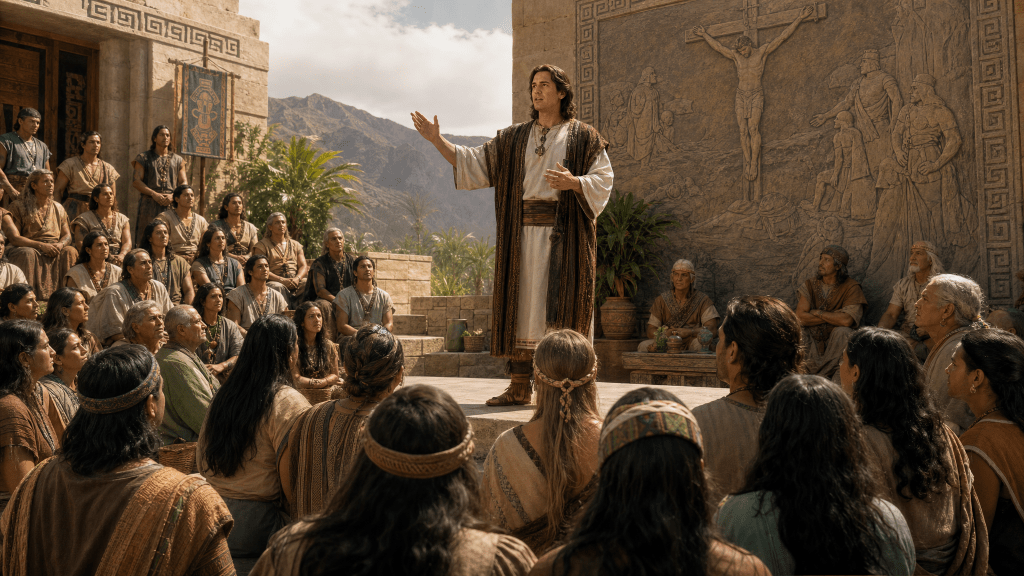
2 Nephi Chapter 10
Jacob explains that the Jews will crucify their God—They will be scattered until they begin to believe in Him—America will be a land of liberty where no king will rule—Reconcile yourselves to God and gain salvation through His grace. About 559–545 B.C.
1: “And now I, Jacob, speak unto you again, my beloved brethren, concerning this righteous branch of which I have spoken.”
This righteous branch spoken of here is the family of Lehi, per GD.
2: “For behold, the promises which we have obtained are promises unto us according to the flesh; wherefore, as it has been shown unto me that many of our children shall perish in the flesh because of unbelief, nevertheless, God will be merciful unto many; and our children shall be restored, that they may come to that which will give them the true knowledge of their Redeemer.”
3: “Wherefore, as I said unto you, it must needs be expedient that Christ—for in the last night the angel spake unto me that this should be his name—should come among the Jews, among those who are the more wicked part of the world; and they shall crucify him—for thus it behooveth our God, and there is none other nation on earth that would crucify their God.
The first issue that jumps out here is that Christ is not a name. It is a title. Furthermore, it was not a title used in the Old Testament at all. The word “Christ” is transliterated from the Greek word “Christos,” which means “anointed one.” It is a translation of the Hebrew word “Messiah.” (Meaning of Christ: The Lost Meaning in Transliteration). An angel would not have revealed a title to be a name, and a Greek word (Christos) would not have been found in the Americas, especially when one considers these were Hebrew people writing about this. Both GD and Step by Step admit this, and both of them try to explain it away. Step by Step makes the argument that “Christ” has become a name through common usage in reference to Jesus. However, Mormons claim the Book of Mormon to be an ancient record, so it surely would not have been considered a name in ancient times. Step by Step attempts to circumvent this issue by citing Mark 15:32, which they say refers to Jesus as “Christ the King of Israel.” Their argument is that even New Testament writers used “Christ” as a proper name. The issue with this is that even in Mark 15:32, Christ is still being used as a title, not a name. Let’s take a look at this verse ourselves. In the NASB, the beginning of it says, “Let this Christ, the King of Israel, now come down from this cross…” So, Step by Step’s claim is quite disingenuous and is easily toppled simply by looking up the verse.
They also attempt to get around this by insisting that Joseph Smith must have seen whatever Nephite word was used in the golden plates and used the English equivalent, which is Christ. This requires a wild leap of faith that shouldn’t be taken. For one, the golden plates are conveniently not able to be examined by anyone. Two, Joseph Smith wrote down some “caractors” (which Mormons call “Reformed Egyptian”) from the supposed gold plates, and they are not recognized by any scholar outside Mormonism as any legitimate known language, ancient or otherwise. You can view that document and read about it here: Appendix 2: Copies of Book of Mormon Characters, Introduction, Page 1. One man by the name of Jerry Grover claims to have translated those characters, which he details in a book (Translation of the “Caractors” Document | ScriptureCentral). However, no one outside Mormonism takes this work seriously at all.
Another issue with this verse is the use of the word “crucify.” This word doesn’t appear anywhere in the Old Testament, and for good reason. That method of execution was not standard during the Old Testament by the Hebrews. Developed around the 6th century B.C., it was used primarily by the Persians, Seleucids, Carthaginians, and Romans until around the 4th century A.D. (Crucifixion | Description, History, Punishment, & Jesus | Britannica). While Christians understand certain passages to prophesy the crucifixion (Psalm 22, Isaiah 53, Zechariah 12:10, just to name a few), some of these passages were written before crucifixion was even developed. If Nephi and his family came to the Americas in 600 B.C., then this method of execution wouldn’t have been known to them, either.
Both LDS sources acknowledge this glaring issue, and the chalk it up to miraculous revelation. That’s it. Then, they affirm this by, you guessed it, citing other Mormon scriptures. Per Step by Step: “According to McConkie and Millet, when Jacob said, “they shall crucify him” (2 Nephi 10:3), he was not the first to announce the death of the Son of God by crucifixion. Enoch had seen “the Son of Man lifted up on the cross” (Moses 7:55), as had Zenock, whose words were had by the Nephites (1 Nephi 19:10). Such knowledge could only be had by revelation. The fulfillment of the prophecy required not only that the Jews reject and kill their Messiah but also that he die by crucifixion. The prophecy was the more remarkable because crucifixion was unknown to Hebrew law.” This is another absurd leap of faith that requires blind allegiance to the Mormon religion, even in the face of evidence that disproves its narrative.
Also, do I detect a hint of antisemitism here? Referring to the Jews as “among those who are the more wicked part of the world” and insisting that they’re the only ones evil enough to crucify their God paints quite the picture. Step by Step claims the reason Jesus came to the Jews is because they were the only people wicked enough to crucify him. I don’t think anyone is going to argue against the notion that it was indeed quite evil to crucify Jesus, but the Jews certainly had help from the Romans in that endeavor.
4: “For should the mighty miracles be wrought among other nations they would repent, and know that he be their God.”
This is a bold claim, and it’s pure speculation that other nations would have been more receptive to Jesus.
5: “But because of priestcrafts and iniquities, they at Jerusalem will stiffen their necks against him, that he be crucified.”
The word “priestcrafts” is unique to Mormonism and doesn’t appear anywhere else. The LDS church website defines priestcrafts as “men preach and set themselves up for a light unto the world, that they may get gain and praise of the world; but they seek not the welfare of Zion” per 2 Nephi 26:29. They then go on to describe five characteristics of these so-called priestcrafts, and I’m going to list them because the irony is quite something to behold. You can find the source for this here: What is priestcraft? Is it something I need to worry about?
The first characteristic they list is these men preach and tell people what to believe and how to live their lives. You mean like telling people they can’t drink coffee or tea? These restrictions are laid out in the Word of Wisdom, which can be found here: Doctrine and Covenants 89. Now, this also advises against alcohol and tobacco, which I have no issue with. Modern interpretations also caution against illicit substances or using medications outside accepted medical use. That’s sound advice that can be found in lots of different places. But hot beverages? Really? Some may say that this is simply a guideline that has no real bearing on salvation, but that isn’t what the LDS church teaches. On its website regarding the Word of Wisdom, the LDS church labels it as a commandment and promises that God will provide protection, health, wisdom, and knowledge to those who follow it (Word of Wisdom).
The second trait is they set themselves up as the light of the world instead of Jesus. This is clarified as “They’re telling people to look to them (not Jesus Christ) for the teachings and example to follow.” While it is true that Jesus is absolutely the only way to salvation, does the LDS church actually teach this? Or do they set themselves up to be the only spiritual authority; the gatekeepers of salvation? The church believes that God sets up modern prophets to lead the church, and they receive divine revelation on how the church is to be run and what doctrines to follow. How much emphasis is placed on following the prophet? Is questioning acceptable? Let’s take a look at some real life examples.
Regarding obedience to the prophets, the LDS church (The Role of Prophets) states thus: “Following prophets can require “patience and faith” because we may not always understand the divine purpose of revelations and teachings revealed to a prophet. Though we may have questions, the Lord asks us to follow the direction of His servants with faith in His perfect knowledge and the power of His Atonement. When we heed the words of prophets, we invite the Holy Spirit into our lives…As we follow prophetic counsel, we gain access to the blessings of divine power and eternal peace promised to those who enter into and keep gospel covenants.” What is this? I thought Jesus was the light of the world and we should be following him. It goes further on to say, “For example, where possible, we can act on the prophet’s counsel to make a regular appointment to worship in the house of the Lord. As we do, we can watch for the blessings the prophet promised. Recognizing these blessings strengthens our faith in the words of living prophets.” So, the prophet is the one who promises us blessings. The prophets are the ones we should have faith in.
It appears they try to make this not sound as bad by declaring that prophets are not infallible and that Jesus is the only one who ever lived a perfect life. This is all well and good, but it then states, “Like ancient prophets, they commune with God and reveal His will. They have divine authority to guide the Church by revelation, administer the ordinances of the gospel, and direct the Lord’s work on the earth.” I can deduce from these statements that questioning the prophets is either outright forbidden or strongly discouraged.
In fact, when he was a member of the Quorum of the Twelve, current president Dallin Oaks famously said in a PBS interview (which you can read in its entirety here: Elder Oaks Interview Transcript from PBS Documentary) in 1986 that “It’s wrong to criticize leaders of the Church, even if the criticism is true, because it diminishes their effectiveness as a servant of the Lord. One can work to correct them by some other means, but don’t go about saying that they misbehaved when they were a youngster or whatever.” He admitted that sounded like censorship. In that same interview, he insisted that “not everything that is true is useful.” In an attempt to make this sound better than it was, he clarified, “In the course of writing history, I said that people ought to be careful in what they publish because not everything that’s true is useful. See a person in context; don’t depreciate their effectiveness in one area because they have some misbehavior in another area — especially from their youth. I think that’s the spirit of that.” But doesn’t seeing a person in context mean that some terrible things they did should be brought to light? For example, it’s well-documented in many sources that Joseph Smith practiced folk magic with “seer stones” to find buried treasure in his younger days. He never found any. He was actually dragged into court for being a “disorderly person” because of it. In my view, this youthful practice is relevant because it reveals a pattern of habitual dishonesty.
He is not the only LDS leader to discourage questioning authority. In fact, in a devotional given in 1980, Apostle and later President Ezra Taft Benson said, “the prophet is the only man who speaks for the Lord in everything” as well as “the living prophet is more vital to us than the standard works.” He also shockingly said, “The prophet and the presidency—the living prophet and the first presidency—follow them and be blessed; reject them and suffer.” For more on this, see Members Again Reminded To Follow the “Living Prophet” – Mormonism Research Ministry. Notice that none of these quotes or articles contain one single shred of following Jesus. It’s all about the prophet.
The Third characteristic of a “priestcraft” is that they preach to get money. As far as centralized wealth is concerned, the LDS church is the wealthiest church in the world (on a strictly per capita basis. The Catholic Church is likely wealthier when one considers its global influence, real estate, and priceless artwork and artifacts). The LDS church is worth at least an estimated $293 billion, according to some sources. Per the Widow’s Mite report, an organization that attempts to track the church’s wealth, their investment reserves alone at the end of 2025 was around $230 billion. You can read these reports here: The Widow’s Mite Report.
Part of their wealth comes from investments done through the investment arm of the church, Ensign Peak Advisors. Another source comes from tithing, which, according to countless former members, was incredibly coercive in nature. One indication of the validity of these claims is the necessity for tithing in order to receive or renew a temple recommend. Per the LDS church’s webpage on tithing (Tithing), paying full tithing makes one worthy of accessing the temple and partaking in temple ordinances and ceremonies. No one without a temple recommend can enter the temple. That means they are denied access to things that the church deems necessary for a person’s salvation and entrance into the Celestial Kingdom, or the highest level of heaven. In order to get a temple recommend, one has to take part in a worthiness interview done with his or her bishop. In other words, church leadership gets to decide who is and isn’t worthy of God’s blessings. You can read more about temple recommends here: 26. Temple Recommends. I’ll warn you, however, that it’s incredibly depressing and egregious. Salvation is through Christ alone, NOT through a bunch of weird ceremonies inspired by Freemasonry.
The fourth criterion for a priestcraft is they preach to get the praise of the world. They don’t preach to reveal any sort of truth, but to impress people. I think the LDS church’s incessant self-congratulatory posts and articles on their charitable projects would certainly fall into this category. Because of all of my research into this religion, my social media algorithms hate me, and I’m bombarded by pro-LDS pages blasting all of their good works onto my newsfeed. Now, there is absolutely nothing wrong at all with helping people. No one in their right mind is going to find fault with that. We are commanded by the Bible to help others. But we’re also commanded not to publicize it. Matthew 6:3-4 says, “But when you give alms, do not let your left hand know what your right hand is doing that your alms may be in secret; and your Father who sees in secret will repay you.”
The fifth trait listed is they “seek not the welfare of Zion.” To clarify, this means, “They do not want God’s kingdom on earth (also called Zion or the Church of Jesus Christ) to prosper.” Now, it’s important to note here that the LDS church considers themselves to be “the Church of Jesus Christ.” In fact, they view themselves at the ONLY true church (The Only True Church). Furthermore, according to Joseph Smith’s first vision, God told him that all Christian churches were wrong, that our creeds were abominations, and that all our teachers were corrupt and so he should join no church (Join None of Them – Joseph Smith Quotes; see also Strange Creeds of Christendom and “All Their Creeds Were an Abomination” | Religious Studies Center). What’s strange is how often Mormons attempt to gloss over these declarations by insisting that they’re “Christians, too.” However, I think the word “too” is simply a mask. With these sentiments, plus their belief that they are the only one true church, my conclusion is what they actually mean is “We’re the only Christians.” That would mean they certainly “seek not the welfare of Zion.”
6: “Wherefore, because of their iniquities, destructions, famines, pestilences, and bloodshed shall come upon them; and they who shall not be destroyed shall be scattered among all nations.”
7: “But behold, thus saith the Lord God: When the day cometh that they shall believe in me, that I am Christ, then have I covenanted with their fathers that they shall be restored in the flesh, upon the earth, unto the lands of their inheritance.”
8: “And it shall come to pass that they shall be gathered in from their long dispersion, from the isles of the sea, and from the four parts of the earth; and the nations of the Gentiles shall be great in the eyes of me, saith God, in carrying them forth to the lands of their inheritance.”
9: “Yea, the kings of the Gentiles shall be nursing fathers unto them, and their queens shall become nursing mothers; wherefore, the promises of the Lord are great unto the Gentiles, for he hath spoken it, and who can dispute?”
This imagery is taken from Isaiah 49:22-23.
10: “But behold, this land, said God, shall be a land of thine inheritance, and the Gentiles shall be blessed upon the land.”
These two verses are referring to America. Per GD and Step by Step, Mormons believe that Zion is in America and Jerusalem is, of course, in Israel. Both sources make incredibly poor attempts at defending this stance with passages of the Bible, namely parts of Isaiah. Step by Step declares that ” this interpretation of two gathering places can be backed up by the words of Isaiah. In the early chapters of Isaiah, the prophet always separates his messages to Zion (the Americas) and to Jerusalem (see Isaiah 3:1-15 and 3:16–4:3-4; chapter 25 to Zion and chapter 26 to Jerusalem). In the later chapters of Isaiah, including the ones Jacob quotes in 2 Nephi 6-8, the prophet speaks of the two gathering places in conjunction (Isaiah 40:9) as well as giving separate messages to each (see Isaiah 48 to Judah, Isaiah 49 to the Isles of the Sea [Zion]; 51:3-16 and 51:16-23; 52:1-2; see also TPJS 362).”
There are plenty of issues with this. For one, absolutely no one in the Bible knew that America existed. No one was prophesying things about places they didn’t know about. Secondly, Zion is a section of Jerusalem. Originally, Zion was the name of a Jebusite fortress that was conquered by King David. This area was then referred to as the City of David. When Solomon built the Temple Mount, the term Zion was broadened to include this as well. In other areas of the Bible, Zion is used to refer to Jerusalem as a whole and the two appear to be used interchangeably. In a spiritual and theological sense, Zion is also often used to denote God’s dwelling place. For more information, see Zion and Jerusalem – The Israel Bible and The Meaning of Zion in the Bible — FIRM Israel. In other words, NONE of the Biblical passages cited by Step by Step has anything to do with the Americas. Christians understand Isaiah 49 to be a Messianic prophecy, and the “isles of the sea” is simply referring to the ends of the earth in a general sense. They are once again shoehorning their own personal interpretations into the Bible to make it fit their Book of Mormon narrative.
11: “And this land shall be a land of liberty unto the Gentiles, and there shall be no kings upon the land, who shall raise up unto the Gentiles.”
It is strange that Joseph Smith would include such a prophecy, because various parts of the Americas were absolutely ruled by kings of different countries at different points in time. It’s true the kings weren’t physically present on these continents, but they were still under their rule. So, even if the Book of Mormon really was an ancient text, this would surely constitute a false prophecy and could only be considered true by some based upon a technicality.
Interestingly, writer Nephi Lowell Morris views the Monroe Doctrine as a fulfillment of this prophecy, as cited on GD. He states: “One could imagine that the Book of Mormon prophet might have been standing at the elbow of President Monroe when he signed the document as it was handed to him by the Secretary of State, John Quincy Adams. For the Monroe Doctrine is nothing more than the Book of Mormon prophecy put in the form of a state paper.” This is a stretch. Our founding fathers simply understood the dangers of a monarchy and wanted to avoid it at all costs.
12: “And I will fortify this land against all other nations.”
13: “And he that fighteth against Zion shall perish, saith God.”
From Step by Step: “According to Joseph Smith, “The whole of America is Zion itself from north to south, and is described by the prophets, who declare that it is the Zion where the mountain of the Lord should be . . .” Brigham Young said the following: “And what is Zion? In one sense Zion is the pure in heart. But is there a land that ever will be called Zion? Yes, brethren. What land is it? It is the land that the Lord gave to Jacob, who bequeathed it to his son, Joseph, and his posterity, and they inhabit it, and that land is North and South America. The children of Zion have not yet much in their possession, but their territory is North and South America, to begin with. As to the spirit of Zion, it is in the hearts of the Saints of those who live and serve the Lord with all their might, mind and strength!”
GD reports that this promise isn’t just spiritual: “The phrase, he that fighteth against Zion shall perish, has both a literal and a spiritual meaning. The context of verses 11-14 show that the Lord will fortify the land of America against all other nations. This is not a spiritual fortification but a military one and will remain in force as long as the inhabitants of the land are righteous. This interpretation has been applied to this scripture by many of the brethren.” America has not been righteous in a VERY long time. Whether the United States specifically continues to be a major world power remains to be seen.
14: “For he that raiseth up a king against me shall perish, for I, the Lord, the king of heaven, will be their king, and I will be a light unto them forever, that hear my words.”
15: “Wherefore, for this cause, that my covenants may be fulfilled which I have made unto the children of men, that I will do unto them while they are in the flesh, I must needs destroy the secret works of darkness, and of murders, and of abominations.”
16: “Wherefore, he that fighteth against Zion, both Jew and Gentile, both bond and free, both male and female, shall perish; for they are they who are the whore of all the earth; for they who are not for me are against me, saith our God.”
This appears to be another mention of what other parts of 1 and 2 Nephi have dubbed “the great and abominable church.” Indeed, Hugh Nibley, the late BYU professor and LDS apologist, wrote, “For him as for Nephi there are just two sides to the question. He groups all factions and complexions of people into two arbitrary categories. After naming seven different groups, he adds, “But I shall call them Lamanites that seek to destroy the people of Nephi, and those who are friendly to Nephi I shall call Nephites” (Jacob 1:14). In the same way, Nephi had explained: “He that fighteth against Zion, both Jew and Gentile . . . are they who are the whore of all the earth” (2 Nephi 10:16; italics added). By this reasoning there are never more than “save two churches only” in the world, and indeed Nephi’s much-commented remark to that effect (1 Nephi 14:10) reads more like a statement of general principle than the denunciation of one particular church among many. (An Approach to the Book of Mormon, p. 161).”
But is this really “more like a statement of general principle than the denunciation of one particular church among many”? I go into great detail about this in my post The Great and Abominable Church Revisited – The Inquisitive Christian. In Bruce McConkie’s “Mormon Doctrine,” he put forth the idea that it was referring to the Catholic Church. This, of course, was quite controversial, and later editions of the book omitted this declaration. In the abstract of his paper “Nephi’s Great and Abominable Church,” author Stephan E. Robinson writes “Clearly, the earliest apostate church and the great and abominable church are the same. A suggested description for this phenomenon, avoiding a denominational name, is hellenized Christianity.” What is “hellenized Christianity” you may ask? It’s the term anti-trinitarians and others call mainstream Christianity, with the accusation that Greek philosophical frameworks infiltrated Chrisitan doctrine. This is quite the strange accusation, since early church fathers regularly wrote against such things, but I digress. So again, LDS teachings, despite their denials, teach that all Christian churches are part of the great and abominable church. You cannot say that there are only two churches, insist your church is the only one true church, then insist you’re not singling anyone out. In a way, I suppose they’re not singling anyone out since they view all of us as the “whore of all the earth.”
These beliefs stem from what Mormons call “the Great Apostasy.” It’s the idea that Christ’s church died with the original apostles and the resulting church was apostate. They view their religion as the restoration of this original church, though there is zero evidence anywhere in any historical record that any teachings resembling anything close to Joseph Smith’s existed during this period. You can read more about this here: The Great Apostasy. If you want more extensive views on the Great Apostasy from Mormon leaders, you can go here: Citations on the Great Apostasy – Mormonism Research Ministry. I think my biggest issue about the notion of the Great Apostasy is that it makes a liar out of Jesus. In Matthew 16:18, Jesus says, “And I tell you, you are Peter, and on this rock I will build my church, and the gates of hell shall not prevail against it.”
17: “For I will fulfil my promises which I have made unto the children of men, that I will do unto them while they are in the flesh—”
18: “Wherefore, my beloved brethren, thus saith our God: I will afflict thy seed by the hand of the Gentiles; nevertheless, I will soften the hearts of the Gentiles, that they shall be like unto a father to them; wherefore, the Gentiles shall be blessed and numbered among the house of Israel.”
According to Joseph Smith, those who are baptized into the LDS church literally become descendants of Abraham and are therefore entitled to the same blessings. Per GD: “for as the Holy Ghost falls upon one of the literal seed of Abraham, it is calm and serene; and his whole soul and body are only exercised by the pure spirit of intelligence; while the effect of the Holy Ghost upon a Gentile, is to purge out the old blood, and make him actually of the seed of Abraham. That man that has none of the blood of Abraham (naturally) must have a new creation by the Holy Ghost.” (Teachings, p. 149-150).” GD then goes onto cite 3 Nephi 21:22-25: “But if they will repent and hearken unto my words, and harden not their hearts, I will establish my church among them, and they shall come in unto the covenant and be numbered among this the remnant of Jacob, unto whom I have given this land for their inheritance; And they shall assist my people, the remnant of Jacob, and also as many of the house of Israel as shall come, that they may build a city, which shall be called the New Jerusalem. And then shall they assist my people that they may be gathered in, who are scattered upon all the face of the land, in unto the New Jerusalem. And then shall the power of heaven come down among them; and I also will be in the midst.”
Not only is this a strange teaching, but it goes against the Bible. We are not under the Old Covenant, but the New one that was established with Christ’s death and resurrection. The New Covenant opened up the possibility of salvation to everyone, not just the Jews. This is made evident in the New Testament. Romans 10:13 says, “For everyone who calls on the name of the Lord will be saved.” 1 Timothy 2:3-4 tells us the God “desires all men to be saved and to come to the knowledge of the truth.” Titus 2:11 says, “For the grace of God has appeared, bringing salvation for all people.” 2 Peter 3:9 assures us God is “not wishing for any to perish but for all to come to repentance.” And finally, Galatians 3:28 says, “There is neither Jew nor Greek, there is neither slave nor free man, there is neither male nor female, for you are all one in Christ Jesus.” It is completely unnecessary, then, for anyone to have to become literal descendants of Abraham in order to receive God’s promises.
19: “Wherefore, I will consecrate this land unto thy seed, and them who shall be numbered among thy seed, forever, for the land of their inheritance; for it is a choice land, saith God unto me, above all other lands, wherefore I will have all men that dwell thereon that they shall worship me, saith God.”
20: “And now, my beloved brethren, seeing that our merciful God has given us so great knowledge concerning these things, let us remember him, and lay aside our sins, and not hang down our heads, for we are not cast off; nevertheless, we have been driven out of the land of our inheritance; but we have been led to a better land, for the Lord has made the sea our path, and we are upon an isle of the sea.”
I’ve already repeatedly addressed the fact that there was only one Promised Land for the Hebrews. I’m not going to keep beating that dead horse.
21: “But great are the promises of the Lord unto them who are upon the isles of the sea; wherefore as it says isles, there must needs be more than this, and they are inhabited also by our brethren.”
GD again attempts to use passages from Isaiah to prove there were prophesies about the Americas. I have addressed this earlier in this post.
22: “For behold, the Lord God has led away from time to time from the house of Israel, according to his will and pleasure. And now behold, the Lord remembereth all them who have been broken off, wherefore he remembereth us also.”
23: “Therefore, cheer up your hearts, and remember that ye are free to act for yourselves—to choose the way of everlasting death or the way of eternal life.”
24: “Wherefore, my beloved brethren, reconcile yourselves to the will of God, and not to the will of the devil and the flesh; and remember, after ye are reconciled unto God, that it is only in and through the grace of God that ye are saved.”
25: “Wherefore, may God raise you from death by the power of the resurrection, and also from everlasting death by the power of the atonement, that ye may be received into the eternal kingdom of God, that ye may praise him through grace divine. Amen.”
The concepts of eternal punishment and eternal life were not fully realized or understood until the New Testament. That is not to say that the idea eternal life is never mentioned (see Daniel 12:2, Psalm 16:10-11, and Psalm 133:3), but the phrase “eternal life” is not used, and these things are mentioned in passing with no real explanation. The notion of our immortal souls going to heaven or hell was not realized until the New Testament. You can see my post “The Devil is in the Details” for more information on why the concept of the devil is used anachronistically here.
The deeper I get into this project, the more I realize how anti-Biblical this entire belief system is. Decent, honest, sincere people are being horribly misled by an institution that is only interested in controlling them. People are being told to put their faith in a man who was completely dishonest and immoral, in a book for which there is no evidence and which more evidence contradicts, and in leaders who are deliberately twisting the Bible for their own ends. These are blind leaps of faith, and what is waiting to catch them is nothing good.

 The Inquisitive Christian
Leave a comment