
As promised, I am back with the remaining verses in 2 Nephi, chapter 12. I highly recommend you read my previous post on verses 1-9 to get a better understanding of this chapter as a whole. I will be using the same sources that I used last time: John Oswalt’s commentary, “The Book of Isaiah Chapters 1-39,” 2) Matthew Henry’s commentary on Isaiah chapter 2: Commentary on Isaiah 2 by Matthew Henry, and 3) Gospel Doctrine: 2 Nephi 12 | Gospel Doctrine.
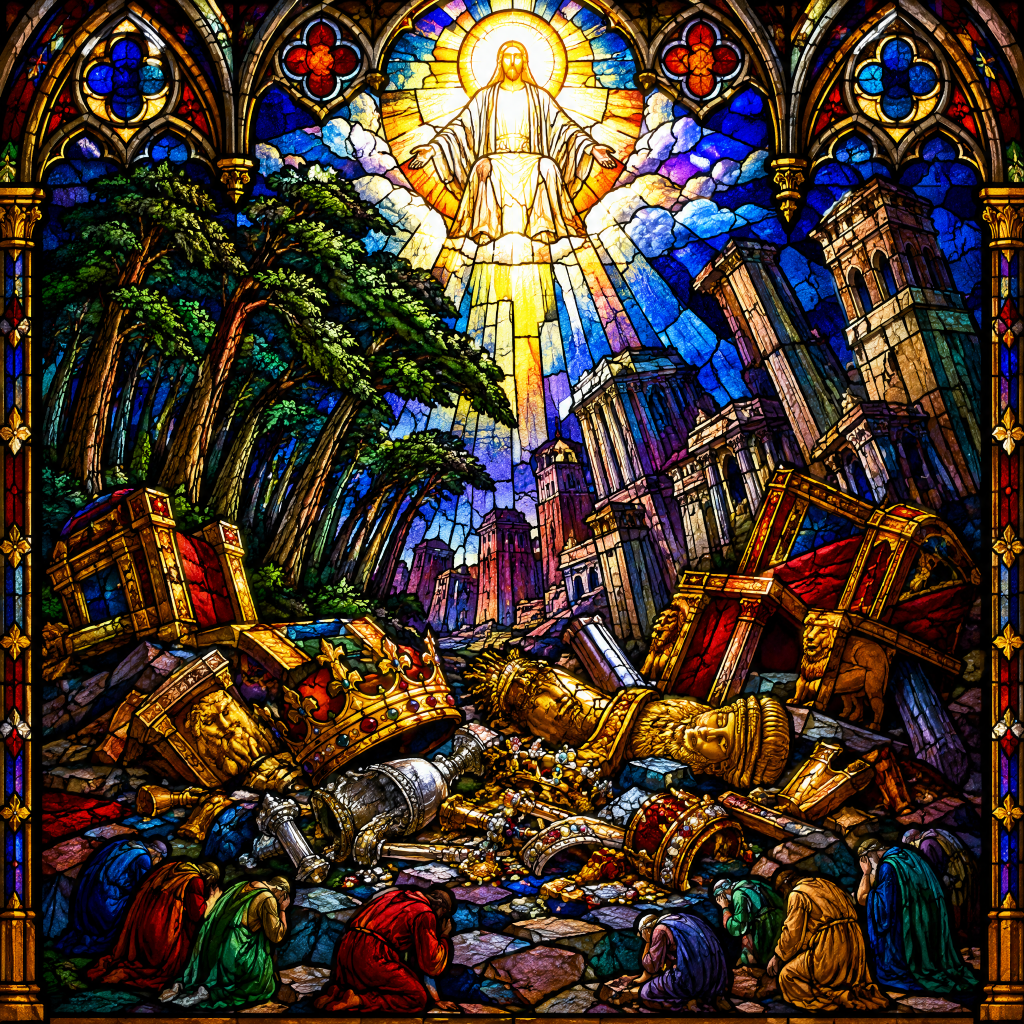
2 Nephi Chapter 12, v 10-22
10 O ye wicked ones, enter into the rock, and hide thee in the dust, for the fear of the Lord and the glory of his majesty shall smite thee.
This is what the KJV actually reads: “Enter into the rock, and hide thee in the dust, for fear of the Lord, and for the glory of his majesty.” There is nothing in there about smiting anyone, though that may be part of his righteous judgment. Regardless, Smith had zero right to alter the Bible to suit his own liking.That alone should be enough to denounce him as a false prophet.
Oswalt has little to say on this verse by itself but includes it in the broader context of verses 9-11. The main point of verses 10 and 11 is a description of how and why they will be brought to such a lowly state: “…because the true source of greatness will appear. The God from whom their self-worship has alienated them will appear, and there will be no more cause to glory in human greatness than there would be to praise a flashlight in broad daylight.”
Henry expounds upon the intended meaning of this segment of Isaiah. He wrote that it could be regarding the specific destruction by the Chaldeans first, then their destruction by the Romans, or it could mean a general way that God humbles proud sinners who live in rebellion against him. It could also be applied to all three of these. He further wrote: “We are here told that sooner or later God will find out a way to startle and awaken secure sinners, who cry peace to themselves, and bid defiance to God and his judgments (v. 10): “Enter into the rock; God will attack you with such terrible judgments, and strike you with such terrible apprehensions of them, that you shall be forced to enter into the rock, and hide yourself in the dust, for fear of the Lord. You shall lose all your courage, and tremble at the shaking of a leaf; your heart shall fail you for fear (Lu. 21:26), and you shall flee when none pursues,” Prov. 28:1.”
Gospel Doctrine has no comments on verse 10. The remaining verses have a common, overarching theme of God humbling the proud, who will flee in terror from his judgment. Thus, not every verse will need to be addressed individually.
11 And it shall come to pass that the lofty looks of man shall be humbled, and the haughtiness of men shall be bowed down, and the Lord alone shall be exalted in that day.
The KJV does not include the phrase, “And it shall come to pass.” But I suppose Smith couldn’t resist inserting his favorite phrase.
12 For the day of the Lord of Hosts soon cometh upon all nations, yea, upon every one; yea, upon the proud and lofty, and upon every one who is lifted up, and he shall be brought low.
This is also not what Isaiah wrote. This verse actually says, “For the day of the Lord of hosts shall be upon every one that is proud and lofty, and upon every one that is lifted up; and he shall be brought low:” Leave Isaiah alone, Joe.
In his commentary, Oswalt addresses verses 12-17 in one section rather than breaking it down verse by verse. This makes sense since they share a common theme and are detailed descriptions of this day of the Lord. The most prominent lesson in these verses is that God alone is high and lifted up. Oswalt also notes, “The contrast with vv. 1-4 is very striking. There is an act of grace God promises to lift Jerusalem to the highest place from which Israel will teach the nations God’s ways. Here, having learned the ways of the nations and having tried to use those means (wealth, power, and idolatry) to exalt themselves, the Hebrews, along with everything else which exalts itself, are hammered to the ground. When we exalt God, we, too, are lifted up (57:15). When we exalt ourselves we inevitably humiliate ourselves, leaving God alone exalted.”
He also writes about the prominence of the day of the Lord in the Old Testament prophets. The phrase appears to be used popularly to refer to a time when God would vindicate people and bless them. However, the prophets, both major and minor, wrote about this day being a time of destruction and terror. Only after that could God’s blessings come. As he points out: “The needed to disabuse the Israelites of the idea that merely because they were called by God’s name they deserved his favor. Surely blessing did result from election but only if that election was confirmed in humble and righteous living.”
13 Yea, and the day of the Lord shall come upon all the cedars of Lebanon, for they are high and lifted up; and upon all the oaks of Bashan;
According to Oswalt, this demonstrates that God opposes pride and arrogance. “Moreover,” he expounds, “Isaiah regularly uses nature, and particularly trees, in a symbolic way… There is thus every reason to see the passage as figurative (although not allegorical, where each element must represent one specific thing). The prophet has chosen a number of items that visually represent the spiritual condition of Israel… As surely as the wind uproots the trees and knocks down the ship, as surely as the earthquake moves the mountains and cracks the wall, so will the terror of the Lord remove all human pomp and pretension.”
Henry expresses similar sentiments: “The day of the Lord of hosts, the day of his wrath and judgment, shall be upon every one that is proud. He now laughs at their insolence because he sees that his day is coming, this day, which will be upon them ere they are aware, Ps. 37:13. This day of the Lord is here said to be upon all the cedars of Lebanon, that are high and lifted up. Jerome observes that the cedars are said to praise God (Ps. 148:9) and are trees of the Lord (Ps. 104:16), of his planting (Isa. 41:19), and yet here God’s wrath fastens upon the cedars, which denotes (says he) that some of every rank of men, some great men, will be saved, and some perish.”
Surprisingly, GD also sees these mighty trees as representative of pride.
14 And upon all the high mountains, and upon all the hills, and upon all the nations which are lifted up, and upon every people;
Again, no: “And upon all the high mountains, and upon all the hills that are lifted up,”. By now, some of you may be wondering why I’m picking at these differences. Even if they don’t completely change the meaning, the underlying arrogance required to rewrite the Bible to your liking is incredibly maddening. This should irritate anyone who values the Bible and views it as God’s Word.
15 And upon every high tower, and upon every fenced wall;
According to Henry, these high mountains and hills, these towers and wall, all represent proud and pretentious people. He further illustrates, “…these are the high mountains and the lofty hills that seem to fill the earth, that are gazed on by all, and think themselves immovable, but lie most obnoxious to God’s thunderstrokes. Feriuntique summos fulmina montes-The highest hills are most exposed to lightning. And before the power of God’s wrath these mountains are scattered and these hills bow and melt like wax, Hab. 3:6; Ps. 68:8. These vaunting men, who are as high towers in which the noisy bells are hung, on which the thundering murdering cannon are planted-these fenced walls, that fortify themselves with their native hardiness, and intrench themselves in their fastnesses-shall be brought down.”
16 And upon all the ships of the sea, and upon all the ships of Tarshish, and upon all pleasant pictures.
This is not what the KJV says. It’s actually, “And upon all the ships of Tarshish, and upon all pleasant pictures.”
Essentially, this means that God is also going to sink Israel’s revenue through trade (Henry.) The “pleasant pictures” referred to here are somewhat debated, with some believing these refer to paintings, some others thinking it’s about ornaments, and still others believing this must mean carvings on ships. Whatever your view, the point remains the same: anything pleasing to look at, anything that brings any joy, will also be ruined. This is not to say that nice things are, in and of themselves, bad. “But to place our pictures among our pleasant things, to be fond of them and proud of them, to spend that upon them which should be laid out in charity, and to set out hearts upon them, as it ill becomes those who have so many substantial things to take pleasure in, so it tends to provoke God to strip us of all such vain ornaments.” (Henry).
17 And the loftiness of man shall be bowed down, and the haughtiness of men shall be made low; and the Lord alone shall be exalted in that day.
18 And the idols he shall utterly abolish.
Both Oswalt and Henry emphasize the complete destruction of false idols and gods by forcing the ones who worship them to see the futility of it. Oswalt writes, “The idols by means of which they sought to deify themselves will be cast aside…” He further asserts: “… the point is plain. When God appears all the attempts to deify parts of creation are seen for what they are: foolishness.” To drive home the point that God will ruin these idols and false gods, Henry recalls the time when Dagon, a Phillistine god, was found face down before the Ark of the Covenant in his own temple (see 1 Samuel 5:4). There is also the time when God made complete fools out of the prophets of Baal on Mount Carmel (see 1 Kings 18. It’s one of my favorites.)
19 And they shall go into the holes of the rocks, and into the caves of the earth, for the fear of the Lord shall come upon them and the glory of his majesty shall smite them, when he ariseth to shake terribly the earth.
Smith has again chosen to add smiting to the agenda for the day. This verse in the KJV is: “And they shall go into the holes of the rocks, and into the caves of the earth, for fear of the Lord, and for the glory of his majesty, when he ariseth to shake terribly the earth.”
Per Oswalt, the picture Isaiah paints here is one of absolute humiliation. “Human beings,” he observes, “become troglodytes. Their ravenous ambition to be God has robbed them even of the dignity which could have been rightfully theirs. Had they submitted to God in recognition of his greatness and his right to rule in their lives, then they would have been his friends (Ps. 25:14)… But having refused to fear the Lord, they now know the terror of him, for he now comes as their enemy and they have no defense.” Unfortunately for these people, there is no hiding from God.
20 In that day a man shall cast his idols of silver, and his idols of gold, which he hath made for himself to worship, to the moles and to the bats;
This verse illustrates the realization of the people that their idols are, indeed, worthless. Oswalt points out the sarcasm and irony of this particular verse: “Thus the effect is to juxtapose the supposed preciousness of the idols with the squeamishness felt toward small, unclean rodents. Mighty gods? Hardly. The same people who made idols for themselves to worship (a telling phrase) now fling them away to their true domain. The God who alone is worthy of worship has appeared.”
GD misses the mark. They instead decide to focus on the eyesight of moles and bats: ” ‘The imagery of verse 20 is striking: the people will throw their gold and silver idols to moles and bats, animals who are blind from living so long in darkness. The irony of this is that people who understood the material value of the precious metals, and should also have seen the spiritual impotence of the idols, will throw these precious items to animals who will not be able to see them at all.’ (Isaiah: Prophet, Seer, and Poet, by Victor L Ludlow, p. 92).” While certainly not the worst thing that has come from this source, they are choosing to ignore (or are simply ignorant of) the cultural significance of these animals. Under Mosaic law, these were considered unclean and were not to be consumed, and their dead bodies were not to be touched. It makes much more sense to view this verse through this lens. The point is simple: unworthiness belongs with unworthiness. Unclean things belong with other unclean things. I will say that Henry briefly mentions the fact that these animals can’t see, but he does it for a different reason than GD. “The darkest holes, where the moles and the bats lodge, are the fittest places for idols, that have eyes and see not; and God can force men to cast their own idols there…”Idols shouldn’t be seen or worshipped, so that’s exactly where they belong.
21 To go into the clefts of the rocks, and into the tops of the ragged rocks, for the fear of the Lord shall come upon them and the majesty of his glory shall smite them, when he ariseth to shake terribly the earth.
Sigh. If God wanted Isaiah to include smiting in these passages, then that’s what Isaiah would have written. Instead, he wrote this: “To go into the clefts of the rocks, and into the tops of the ragged rocks, for fear of the Lord, and for the glory of his majesty, when he ariseth to shake terribly the earth.”
Henry makes some interesting observations regarding vv. 20-22. He observes that, “Those that will not be reasoned out of their sins sooner or later shall be frightened out of them.” So much, in fact, that they’ll toss their idols to the side so they can hide in nooks and crannies between rocks. Neither Henry nor Oswalt directly connect this to the end times specifically. Many Old Testament prophecies mentioning “the day of the Lord” often have more than one purpose. They refer to God’s judgment and wrath upon Israel for their disobedience, but many scholars also connect these passages with a broader day of judgment upon the whole earth. Based upon my research, I think it would be inaccurate and short-sighted to limit these prophecies to only one or the other. They appear to reference both.
However, this is not how GD views it. The folks over there seem pretty bent on seeing this only through an end times lens and go far enough to link this shaking of the earth refers to a specific earthquake mentioned in Revelation 11:13. They then go on to cite different passages in Doctrine and Covenents to bolster their view, which, of course, hold absolutely no weight whatsoever with me.
22 Cease ye from man, whose breath is in his nostrils; for wherein is he to be accounted of?
This final verse in Isaiah 2 makes clear that this chapter is not speaking about only idolatry. If it was, then it would say, “Cease ye from idols.” Idolatry is a symptom of an underlying spiritual sickness: the desire to exalt ourselves and be the center of all things. As Oswalt writes, “Is there any cause to the glory in humanity? None whatever. For we are mortal, as transitory as a sigh, as impermanent as a breath (Ps. 99:3-8)… In a biting and abrupt way, it [this verse] sums up the import of all that has been said. That mortal human beings should attempt to exalt themselves over God is ludicrous; such actions are the perfect evidence that those who do them are not worthy of being taken into account.”
I would certainly classify altering Scripture because you think you know better as exalting oneself. I think the doctrine of exaltation (the belief that faithful Mormons can one day become gods) would also fit nicely in this category. You can read about that detestable teaching here: Chapter 47: Exaltation.
As you will see, in order to support their claim that there are 3 levels of heaven, they twist the meaning of 2 Corinthians 12:2, where Paul describes being “caught up to the third heaven.” They deliberately twist the meaning of the word “heaven.” What they neglect to mention is that the word “heaven” can refer to the sky (Deut. 11:11, Ps. 104:12, and Is. 55:10), which would be the first heaven. Heaven can also mean outer space, which includes the stars and planets (Ps. 8:3, Is. 13:10). That would be the second heaven. The third heaven means the place where God dwells (Ps. 33:13-14, Is. 66:1, Matt. 6:9, Heb. 7:26, Rev. 11:19). Paul was simply reporting he was taken to where God dwells, NOT that he went to some third “level” of heaven.
The second passage they decide to mutilate is 1 Cor. 15:40-41. They insist this is Paul naming two of the kingdoms in heaven, even though he is doing nothing of the sort. He is contrasting our mortal, earthly (terrestrial) bodies with resurrected, immortal, and heavenly (celestial) bodies. If you look at verse 35, you will see that this is an answer to a question about how the dead will be resurrected and what bodies they’ll have. In verse 41, Paul is using different celestial lights as an analogy. The sun, moon, and stars shine with different levels of brightness, much like human bodies before and after the resurrection. He is NOT talking about different kingdoms of heaven.
Do you know who else twisted Scripture? Satan. See Matt. 4:1-11 and Luke 4:1-13. And if he had the audacity to take Scripture out of context straight to Jesus’ face, just think of how he can do the same thing through influencing various people. Do you know who else promised mankind they could be just like God? Satan, while he was in the form of the Serpent in the Garden of Eden (see Gen. 3:1-5).
If you’re reading this and can’t understand why Christians so strongly oppose the LDS church’s teachings, maybe now you understand why. I’ll be back soon with 2 Nephi, chapter 13.


Leave a Reply