
Goodness. Has it really been over a month since my last post? I suppose so! I’ve been busy enjoying the weather during our short summer, and I got my son moved into his own place 4 hours from here, where he got a new job as an EMT. Needless to say, things have been busy around here as of late! However, now that the move is over and I’m an empty nester, I think it’s time to get back into this project.
Today will be a relatively short post, because 2 Nephi 11 only has 8 verses. While this won’t be as extensive as previous posts, I still think there is much to glean. Plus, a short post after such a long hiatus seems like a good way to ease back into it. I will be using the site Gospel Doctrine to navigate the LDS explanation of this chapter, which you can view here: 2 Nephi 11 | Gospel Doctrine.
2 Nephi Chapter 11
Jacob saw his Redeemer—The law of Moses typifies Christ and proves He will come. About 559–545 B.C.
1: “And now, Jacob spake many more things to my people at that time; nevertheless only these things have I caused to be written, for the things which I have written sufficeth me.”
2: “And now I, Nephi, write more of the words of Isaiah, for my soul delighteth in his words. For I will liken his words unto my people, and I will send them forth unto all my children, for he verily saw my Redeemer, even as I have seen him.”
Per GD, this is Nephi’s introduction to including Isaiah 2-14 in 2 Nephi. From a Christian’s perspective, of course, this is simply plagiarism on Joseph Smith’s part. Based upon previous instances of Smith copying entire chapters of Isaiah, we can be fairly certain that these passages have been altered to fit within an LDS framework. Gospel Doctrine’s commentary on the inclusion of large swaths of Isaiah is both interesting and appalling.
The author of this article quotes the Bible Dictionary (an LDS publication) as saying, “….The reader today has no greater written commentary and guide to understanding Isaiah than the Book of Mormon and the Doctrine and Covenants. As one understands these works better he will understand Isaiah better, and as one understands Isaiah better, he more fully comprehends the mission of the Savior, and the meaning of the covenant that was placed upon Abraham and his seed by which all the families of the earth would be blessed.”
As we have seen in previous posts, Mormon commentaries on chapters in Isaiah are completely at odds with the accepted explanations of Biblical scholars. There are FAR superior commentaries on Isaiah, and they’re written on every single chapter, not just a select few. John Oswalt, whose work I have cited before, wrote an excellent commentary on Isaiah as part of the New International Commentary on the Old Testament series. Other scholars who have written good, solid commentaries on Isaiah include J. Alec Motyer, Edward J. Young, John L. Mackay, and Barry Webb.
Gospel Doctrine then goes on to say the quiet part out loud: “It is the opinion of the author of this website that one of the reasons that the chapters of Isaiah were included in the Book of Mormon is because most of the latter-day saints don’t read the Old Testament.” He then goes on to argue that the Book of Mormon contains the most important chapters of Isaiah, but people should still read the entire book of Isaiah, “even if it means reading the Old Testament.” Because studying the Bible in its entirety is just so terrible.
Something I’ve often said in my personal life is that the Bible is not a grocery store. You don’t get to just pick out the things you like and leave behind what you find less palatable. The Bible MUST be studied in its entirety, because context is everything. It is an intricate, woven theological tapestry that needs to be appreciated and studied for everything that it is. The Old Testament is setting up the New Testament, and understanding the numerous links and parallels between the two is foundational for understanding the Gospel. Jesus and the apostles regularly quoted from the Old Testament. If they read it and found it important enough to quote from it, then we should read it and understand it as well.
3: “And my brother, Jacob, also has seen him as I have seen him; wherefore, I will send their words forth unto my children to prove unto them that my words are true. Wherefore, by the words of three, God hath said, I will establish my word. Nevertheless, God sendeth more witnesses, and he proveth all his words.”
We do see that Isaiah had a vision in which he saw Christ in Isaiah 6:1-5. This is further affirmed in John 12:37-41, which states in part that Isaiah, “said these things because he saw Jesus’ glory and spoke about him.” What is certainly up for debate is the notion that Nephi and Jacob had similar visions. Naturally, Christians will say they couldn’t have, because Nephi and this Jacob didn’t exist.
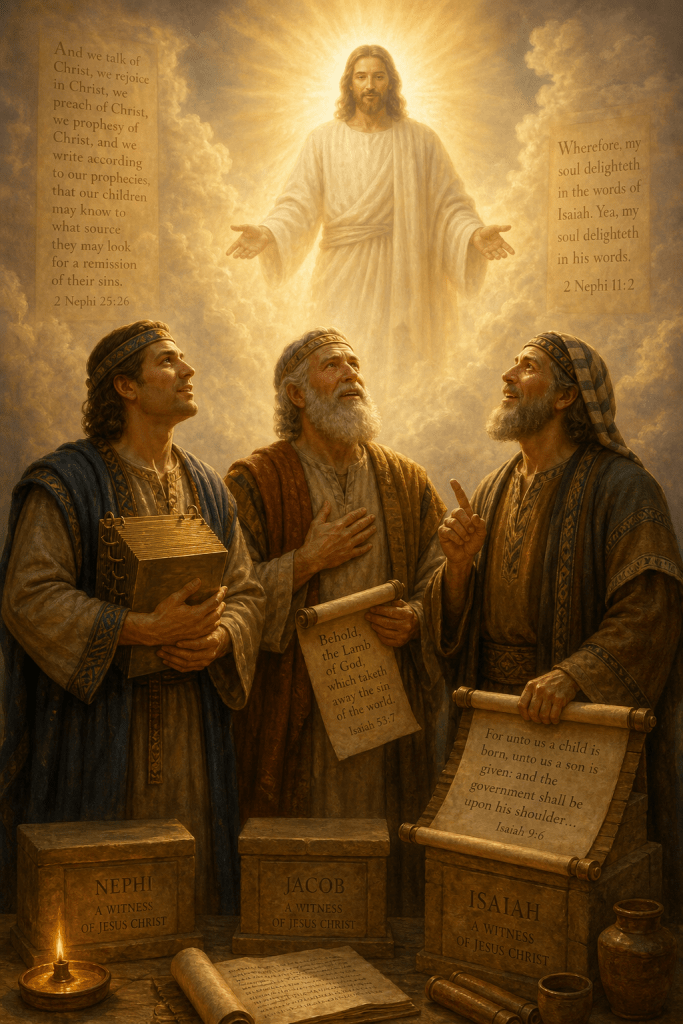
In yet another example of how Mormons falsely elevate the Book of Mormon to equality (and in some instances as superior) to the Bible, Former BYU president Jeffery R. Holland stated, “I am suggesting here that Nephi, Jacob, and Isaiah are three early types and shadows of Oliver Cowdery, David Whitmer, and Martin Harris, if you will-witnesses positioned right at the front of the book where Oliver, David, and Martin would be positioned-that Nephi, Jacob, and Isaiah are the three great ancient witnesses of the Book of Mormon…” Isaiah had nothing to do with the Book of Mormon and had no idea that such a book would even exist.
4: “Behold, my soul delighteth in proving unto my people the truth of the coming of Christ; for, for this end hath the law of Moses been given; and all things which have been given of God from the beginning of the world, unto man, are the typifying of him.”
The word Christ never appears in the Old Testament, so it makes absolutely zero sense that it would be used in something purported to be an ancient text from around the same time. Unless, of course, someone who was alive centuries upon centuries after Christ decided to make up a bunch of inaccurate things and try to pass it off as ancient.
5: “And also my soul delighteth in the covenants of the Lord which he hath made to our fathers; yea, my soul delighteth in his grace, and in his justice, and power, and mercy in the great and eternal plan of deliverance from death.”
6: “And my soul delighteth in proving unto my people that save Christ should come all men must perish.”
7: “For if there be no Christ there be no God; and if there be no God we are not, for there could have been no creation. But there is a God, and he is Christ, and he cometh in the fulness of his own time.”
This is another verse which definitely seems to support Trinitarianism. From the Christian’s perspective, since Christ is God, it is accurate to say that if there’s no Christ there’s also not God. This verse further supports this view with “But there is a God, and he is Christ…” Gospel Doctrine is oddly silent on this verse.
Based upon what I’ve gleaned from other sources, Mormons believe in what they called “the Godhead” which is three separate deities united in purpose. They believe that in the Old Testament, Jesus is the God Jehovah, and the Father is the God Elohim. I would like to point out that Mormons are the ONLY group that believes this. No non-LDS Biblical Scholar is going to come away from their study of the Old Testament with this same conclusion. This is just one of many things that makes them not Christians, despite their numerous protests to the contrary.
Quite honestly, I’m not sure why they want to be called Christians at all. Joseph Smith himself insisted that God said our creeds were “abominations.” As I’ve pointed out several times in this blog, the Book of Mormon states there are only two churches: the Church of the Lamb of God and the Great and Abominable Church, who is the whore of all the earth, whose founder is the Devil. Gee, I wonder which church is which?
They repeatedly refer to Christians as “apostates” and openly mock and deride our teachings. In fact, Bruce McConkie once stated, “Christ-Messiah is God! Such is the plain and pure pronouncement of all the prophets of all the ages. In our desire to avoid the false and absurd conclusions contained in the creeds of Christendom, we are wont to shy away from this pure and unadorned verity; we go to great lengths to use language that shows there is both a Father and a Son, that they are separate Persons and are not somehow mystically intertwined as an essence of spirit that is everywhere present. Such an approach is perhaps essential in reasoning with the Gentiles of sectarianism; it helps to overthrow the fallacies formulated in their creeds.” (Nephi’s Message to the Gentiles | Religious Studies Center). Doctrines like the Trinity are foundational to Christianity. Simply put, they do not believe with Christians believe.
What’s quite fascinating in my numerous interactions with Mormons is that it’s perfectly acceptable for them to believe and teach those things about Christians, but they are the first to scream about persecution and hate if you point out that they’re not actually Christians.
8: “And now I write some of the words of Isaiah, that whoso of my people shall see these words may lift up their hearts and rejoice for all men. Now these are the words, and ye may liken them unto you and unto all men.”
This is all for today. I will hopefully be back at it next weekend. These next chapters will likely prove to be interesting, and I will once again dig into some scholarly commentaries on these chapters in Isaiah.


Leave a Reply