
Welcome back, ladies and gents! As I stated previously, these next several chapters in 2 Nephi are taken from the book of Isaiah, with alterations made by Joseph Smith, because he apparently believed he knew better than Isaiah about what Isaiah needed to say. Because of this, I will be using the same format for these posts that I’ve used in other chapters that mimic Isaiah. I will compare the wording of 2 Nephi 13 to the KJV of Isaiah 3 (which you can see here: Isaiah 3 KJV – For, behold, the Lord, the LORD of – Bible Gateway). I will include the corresponding verses of Isaiah 3 where they differ from 2 Nephi 13. I will be continuing to compare and contrast commentary from biblical scholars and LDS sources on the meaning and themes of this chapter. Because these types of posts contain so much information, I will also be dividing this chapter into 2 parts.
My sources for this post are as follows: John N. Owalt’s The Book of Isaiah Chapters 1-39, from the New International Commentary on the Old Testament; Matthew Henry’s commentary on Isaiah 3 (Chapter 3 – Matthew Henry’s Commentary – Bible Gateway); David Guzik’s study guide on Isaiah 3 from the Blue Letter Bible (Study Guide for Isaiah 3 by David Guzik); and Gospel Doctrine’s article on 2 Nephi 13 (2 Nephi 13 | Gospel Doctrine).
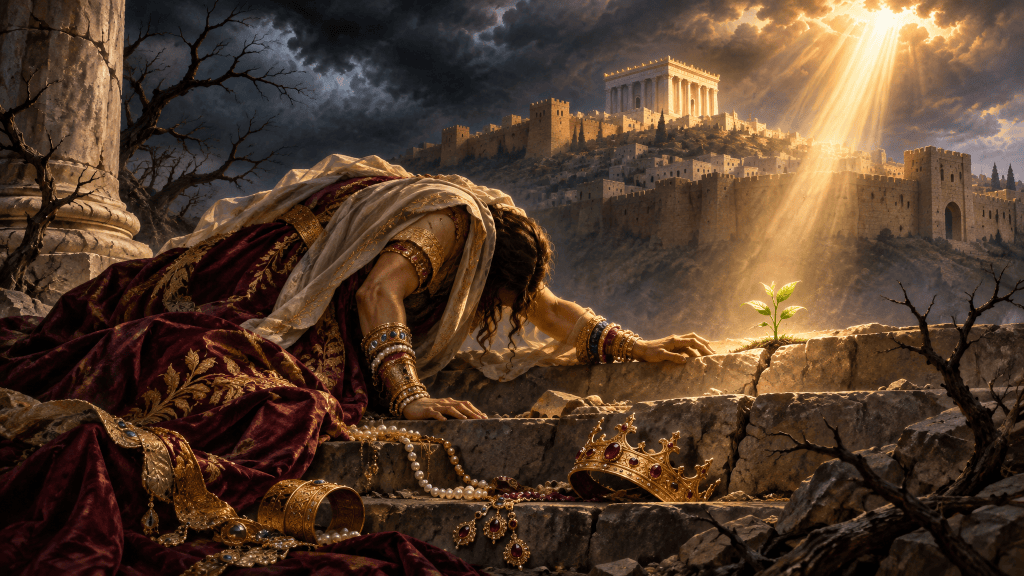
2 Nephi Chapter 13
Judah and Jerusalem will be punished for their disobedience—The Lord pleads for and judges His people—The daughters of Zion are cursed and tormented for their worldliness—Compare Isaiah 3. About 559–545 B.C.
1 For behold, the Lord, the Lord of Hosts, doth take away from Jerusalem, and from Judah, the stay and the staff, the whole staff of bread, and the whole stay of water—
Verse 1 here is a continuation from the previous chapter. The word “for” is what links Isaiah 3 to the end of chapter 2, which, as we reviewed, was a stark warning against self-exaltation and putting all of our trust in man. What follows in this chapter is God’s response to human exaltation and pride. Oswalt notes the repetition of the titles for God “contributes to the atmosphere of judgment.” It is emphasizing who it is that the Judeans are dealing with. He also makes note that the word “behold” in prophetic speech is generally used to convey a threat of some sort. This is setting the stage for WHO is judging them and the totality of the judgement about to be pronounced.
Guzik expounds a bit more on the repetition of the names for God. He notes that each Hebrew word here can be translated as “Lord.” The first instance of “Lord” in this verse utilizes the word “adonai,” which means “master, owner, sovereign.” The second time “Lord” is used, it is translated from the Hebrew “Yahweh,” which we all know is the divine, sacred name for God. The phrase “Lord of Hosts” is used to emphasize God’s ultimate power, authority, and majesty.
The KJV uses the word “stay” instead of “staff” of bread. The word “staff” being used to refer to a supply of bread might seem odd, and I’ll address that in the next paragraph. Henry connects the use of the word “staff” to another Old Testament passage and compares the state of Judah and Jerusalem here to the elderly in Zech. 8:4, who must lean on staffs for support due to age and frailty. He uses that to make the point that God is about to remove every single kind of support they think they have, not just food.
Gospel Doctrine insists once again that the Book of Mormon’s version of this verse makes more sense. Here’s the thing, though: no, it doesn’t. “The staff of bread” is used elsewhere in the Old Testament (Ez. 4:16, Lev. 26:26, Ps. 105:16), and it’s used specifically to refer to food supply. Oswalt points out that “stay” and “staff” are very closely related in Hebrew. The word for “stay” is a masculine noun and the word of “staff” is the feminine form of the noun. He writes that this “suggests that the prophet was engaging in a conscious wordplay to stress the totality of the removal.” Gospel Doctrine also notes this, but they use it to bolster their claim that their version makes more sense. If anything, it makes their version redundant and unnecessary, because the word “staff” is already used in the verse, and a stay of bread or water also means a supply.
Gospel Doctrine also attempts to tie this chapter into the destruction of the Temple in 70 AD and the First and Second Abominations of Desolation, but that makes no real sense. Most scholars and Christians view this specific chapter as a prophecy strictly regarding Judah and Jerusalem that was fulfilled through the Babylonian invasion and destruction in 586 B.C.
2 The mighty man, and the man of war, the judge, and the prophet, and the prudent, and the ancient;
3 The captain of fifty, and the honorable man, and the counselor, and the cunning artificer, and the eloquent orator.
These verses list any and all people who would be able to help Judah and Jerusalem in a rebellion against their captors or otherwise support them in any way. This list includes people who could give them guidance and direction. Oswalt writes, “Because Judah and Jerusalem had relied on human discernment rather than divine, the day was coming when that support would be removed. Then, perhaps, they would be forced to rely on God’s leadership again.”
4 And I will give children unto them to be their princes, and babes shall rule over them.
5 And the people shall be oppressed, every one by another, and every one by his neighbor; the child shall behave himself proudly against the ancient, and the base against the honorable.
If God takes away anyone and everyone who is fit to lead the people, then the logical result is incompetent leadership. While in some cases teenagers may have had to take over some leadership positions, Oswalt believes it’s more likely that Isaiah was speaking figuratively and comparing incoming leaders to immature, inept children. Guzik points out that this was eventually fulfilled in 2 Kings 24:14: “Also he carried into captivity all Jerusalem: all the captains and all the mighty men of valor, ten thousand captives, and all the craftsmen and smiths. None remained except the poorest people of the land.”
Under such incompetent leadership, only one thing can result: anarchy. The government collapses because of its inability to adequately govern, and everyone turns on one another. As Oswalt points out, “Then, when the government begins to collapse, all types of authority fall into contempt, and the natural inclinations of fallen human beings are allowed to run free.” Henry emphasizes the results of the young trampling on the wisdom of their elders: “When young people are conceited and pert, and behave scornfully towards their superiors, their conduct is not only a reproach to themselves, but of ill consequence to the public; it slackens the reins of government and weakens the hands that hold them. It is likewise ill with a people when persons of honour cannot support their authority, but are affronted by the base and beggarly, when judges are insulted and their powers set at defiance by the mob.”
GD doesn’t seem to grasp the all-out depravity this prophecy foretells. They instead focus on the lack of food and how no one is able to help their neighbors in time of need. They again try to tie this all to the destruction in 70 AD and cite Josephus’ description of men robbing their neighbors in attempts to find sustenance. What GD fails to realize is that this goes well beyond desperation for food. This is about man’s most base, selfish, disgusting desires taking over the whole land.
6 When a man shall take hold of his brother of the house of his father, and shall say: Thou hast clothing, be thou our ruler, and let not this ruin come under thy hand—
This is another verse that Joseph Smith altered by adding the word “not” and using the word “come” instead of “be.” The KJV of Isaiah 3:6 reads, “When a man shall take hold of his brother of the house of his father, saying, Thou hast clothing, be thou our ruler, and let this ruin be under thy hand…” The Book of Mormon’s rendering of this verse makes absolutely zero sense, and GD is strangely silent on this change. Isaiah is clearly speaking about a time when the people will be so desperate for a ruler that merely owning a coat will be viewed as a qualification to rule. They will demand someone completely unqualified to “let this ruin be under thy hand,” meaning, “You! YOU Take responsibility for this mess!”
7 In that day shall he swear, saying: I will not be a healer; for in my house there is neither bread nor clothing; make me not a ruler of the people.
Oswalt makes the case that these two verses demonstrate Isaiah’s knack for irony. He writes, “Hand is the expression of authority and power. But what is there left to rule? A ruin, nothing more. Yet even a heap of ruins is more than the chosen man cares to take on. Unlike those self-confident rulers of another day who thought in their arrogance that they could do anything, this man, chastened by disaster, fears he can do nothing… How are the mighty have fallen, Isaiah seems to say. Judah will go from a time when no mantle of glory was too great to assume to a time when even a dump heap constitutes more responsibility than a person would want.”
8 For Jerusalem is ruined, and Judah is fallen, because their tongues and their doings have been against the Lord, to provoke the eyes of his glory.
The word “for” used here in verse 8 could connect it to the two previous verses to explain why the chosen man refused to rule. It could also be connecting verse 8 to all the previous verses. Oswalt favors this second view, explaining that “the prophet would be saying that good government will disappear from the land because the land will have collapsed.” He then goes on to observe the switch from the future tense in this verse: “Most commentators regard has stumbled and has fallen as prophetic perfects which are used to describe future events so certain that they are seen as having already occurred. This is very probable. At the same time, a case may be made for seeing them as describing the present, as vv. 8b-15 seem to do. In this view, Jerusalem was then fallen in a moral and spiritual way and the coming destruction would be the result of the fall.”
The second part of this verse discusses their words and the way they live their lives. Other English translations use the phrase “are toward” instead of “against” the Lord. However, the meaning is the same. These people are living miserable, immoral, and disgusting lives in defiance of God right to his face.
GD not only tries to tie this into three different events (Babylonian captivity, Destruction of Jerusalem in 70 AD, and a future end times prophecy), but they state something patently false: “At the time Isaiah wrote this, the kingdom of Judah was relatively strong. There was no reason to predict its ruin. Yet by the spirit of prophecy, Isaiah knew that the people would ripen in wickedness…” The book of Isaiah covers the reigns of Uzziah, Jotham, Ahaz, and Hezekiah. Under Uzziah, prosperity led to pride (see 2 Chron. 26:16). Jotham’s reign saw economic and military stability, but he refused to address the moral decay of the people (2 Chron. 27:2). Ahaz was an absolutely wicked king who spearheaded a spiritual free fall into idolatry (2 Chron. 28:3-4, 24-25). Hezekiah introduced spiritual reform, but he unfortunately displayed a certain level of pride when he stupidly showed all his wealth to Babylon (Is. 39:5-7). So, it’s completely inaccurate to declare that “there was no reason to predict its ruin.” There absolutely was, and Isaiah personally witnessed it while he was alive. For a few more details, see What significance do the kings mentioned in Isaiah 1:1 have for understanding Judah’s state?
9 The show of their countenance doth witness against them, and doth declare their sin to be even as Sodom, and they cannot hide it. Wo unto their souls, for they have rewarded evil unto themselves!
In the KJV, this verse actually says, “The shew of their countenance doth witness against them; and they declare their sin as Sodom, they hide it not. Woe unto their soul! for they have rewarded evil unto themselves.”
Their very faces show how wicked and guilty they are. We’ve all seen the arrogant smirk of a person who isn’t remotely sorry for something they’ve done. I imagine this to be what God saw in their hearts when giving these prophecies to Isaiah.
I find Henry’s commentary on this verse to be perfect: “One may look them in the face and guess at the desperate wickedness that there is in their hearts: They declare their sin as Sodom, so impetuous, so imperious, are their lusts, and so impatient of the least check, and so perfectly are all the remaining sparks of virtue extinguished in them. The Sodomites declared their sin, not only by the exceeding greatness of it (Gen. 13:13), so that it cried to heaven (Gen. 18:20), but by their shameless owning of that which was most shameful (Gen. 19:5); and thus Judah and Jerusalem did: they were so far from hiding it that they gloried in it, in the bold attempts they made upon virtue, and the victory they gained over their own convictions.” They were to pay for these egregious sins, and they had no one to blame but themselves for it.
GD makes no real commentary on this verse other than to cite some weird quote from David O. McKay (a past president of the LDS church): “Every man and every person who lives in this world wields an influence, whether for good or for evil. It is not what he says alone; it is not alone what he does. It is what he is. Every man, every person radiates what he or she really is…It is what we are and what we radiate that affects the people around us. As individuals, we must think nobler thoughts. We must not encourage vile thoughts or low aspirations. We shall radiate them if we do. If we think noble thoughts; if we encourage and cherish noble aspirations, there will be that radiation when we meet people, especially when we associate with them.” (Man May Know for Himself, p. 108).”
What in the world does that have to do with any of this? Is the quote in and of itself bad? Not particularly, though it does seem to ignore that vile thoughts are a result of a vile heart, and we cannot fix that on our own. The issue I’m having is that it’s a shallow, trite sentiment that has nothing at all to do with this passage in Isaiah. Isaiah is discussing a people so wicked and unrepentant that they’re playing it all right in front of God’s face, not… whatever this is.
I’m wrapping this post up at this point and will be back later to finish the rest of this chapter. It’s dark outside, my stomach is growling, and I think it’s time to sign off for the night.


Leave a Reply