Goodness. Has it really been over a month since my last post? I suppose so! I’ve been busy enjoying the weather during our short summer, and I got my son moved into his own place 4 hours from here, where he got a new job as an EMT. Needless to say, things have been busy around here as of late! However, now that the move is over and I’m an empty nester, I think it’s time to get back into this project.
Today will be a relatively short post, because 2 Nephi 11 only has 8 verses. While this won’t be as extensive as previous posts, I still think there is much to glean. Plus, a short post after such a long hiatus seems like a good way to ease back into it. I will be using the site Gospel Doctrine to navigate the LDS explanation of this chapter, which you can view here: 2 Nephi 11 | Gospel Doctrine.
2 Nephi Chapter 11
Jacob saw his Redeemer—The law of Moses typifies Christ and proves He will come. About 559–545 B.C.
1: “And now, Jacob spake many more things to my people at that time; nevertheless only these things have I caused to be written, for the things which I have written sufficeth me.”
2: “And now I, Nephi, write more of the words of Isaiah, for my soul delighteth in his words. For I will liken his words unto my people, and I will send them forth unto all my children, for he verily saw my Redeemer, even as I have seen him.”
Per GD, this is Nephi’s introduction to including Isaiah 2-14 in 2 Nephi. From a Christian’s perspective, of course, this is simply plagiarism on Joseph Smith’s part. Based upon previous instances of Smith copying entire chapters of Isaiah, we can be fairly certain that these passages have been altered to fit within an LDS framework. Gospel Doctrine’s commentary on the inclusion of large swaths of Isaiah is both interesting and appalling.
The author of this article quotes the Bible Dictionary (an LDS publication) as saying, “….The reader today has no greater written commentary and guide to understanding Isaiah than the Book of Mormon and the Doctrine and Covenants. As one understands these works better he will understand Isaiah better, and as one understands Isaiah better, he more fully comprehends the mission of the Savior, and the meaning of the covenant that was placed upon Abraham and his seed by which all the families of the earth would be blessed.”
As we have seen in previous posts, Mormon commentaries on chapters in Isaiah are completely at odds with the accepted explanations of Biblical scholars. There are FAR superior commentaries on Isaiah, and they’re written on every single chapter, not just a select few. John Oswalt, whose work I have cited before, wrote an excellent commentary on Isaiah as part of the New International Commentary on the Old Testament series. Other scholars who have written good, solid commentaries on Isaiah include J. Alec Motyer, Edward J. Young, John L. Mackay, and Barry Webb.
Gospel Doctrine then goes on to say the quiet part out loud: “It is the opinion of the author of this website that one of the reasons that the chapters of Isaiah were included in the Book of Mormon is because most of the latter-day saints don’t read the Old Testament.” He then goes on to argue that the Book of Mormon contains the most important chapters of Isaiah, but people should still read the entire book of Isaiah, “even if it means reading the Old Testament.” Because studying the Bible in its entirety is just so terrible.
Something I’ve often said in my personal life is that the Bible is not a grocery store. You don’t get to just pick out the things you like and leave behind what you find less palatable. The Bible MUST be studied in its entirety, because context is everything. It is an intricate, woven theological tapestry that needs to be appreciated and studied for everything that it is. The Old Testament is setting up the New Testament, and understanding the numerous links and parallels between the two is foundational for understanding the Gospel. Jesus and the apostles regularly quoted from the Old Testament. If they read it and found it important enough to quote from it, then we should read it and understand it as well.
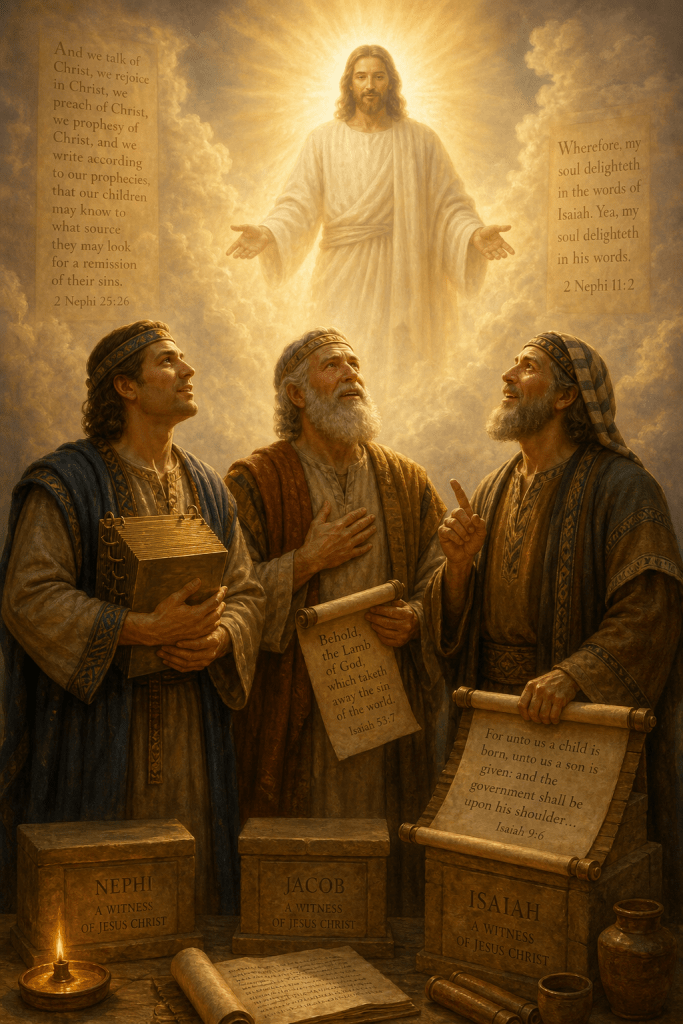
3: “And my brother, Jacob, also has seen him as I have seen him; wherefore, I will send their words forth unto my children to prove unto them that my words are true. Wherefore, by the words of three, God hath said, I will establish my word. Nevertheless, God sendeth more witnesses, and he proveth all his words.”
We do see that Isaiah had a vision in which he saw Christ in Isaiah 6:1-5. This is further affirmed in John 12:37-41, which states in part that Isaiah, “said these things because he saw Jesus’ glory and spoke about him.” What is certainly up for debate is the notion that Nephi and Jacob had similar visions. Naturally, Christians will say they couldn’t have, because Nephi and this Jacob didn’t exist.
In yet another example of how Mormons falsely elevate the Book of Mormon to equality (and in some instances as superior) to the Bible, Former BYU president Jeffery R. Holland stated, “I am suggesting here that Nephi, Jacob, and Isaiah are three early types and shadows of Oliver Cowdery, David Whitmer, and Martin Harris, if you will-witnesses positioned right at the front of the book where Oliver, David, and Martin would be positioned-that Nephi, Jacob, and Isaiah are the three great ancient witnesses of the Book of Mormon…” Isaiah had nothing to do with the Book of Mormon and had no idea that such a book would even exist.
4: “Behold, my soul delighteth in proving unto my people the truth of the coming of Christ; for, for this end hath the law of Moses been given; and all things which have been given of God from the beginning of the world, unto man, are the typifying of him.”
The word Christ never appears in the Old Testament, so it makes absolutely zero sense that it would be used in something purported to be an ancient text from around the same time. Unless, of course, someone who was alive centuries upon centuries after Christ decided to make up a bunch of inaccurate things and try to pass it off as ancient.
5: “And also my soul delighteth in the covenants of the Lord which he hath made to our fathers; yea, my soul delighteth in his grace, and in his justice, and power, and mercy in the great and eternal plan of deliverance from death.”
6: “And my soul delighteth in proving unto my people that save Christ should come all men must perish.”
7: “For if there be no Christ there be no God; and if there be no God we are not, for there could have been no creation. But there is a God, and he is Christ, and he cometh in the fulness of his own time.”
This is another verse which definitely seems to support Trinitarianism. From the Christian’s perspective, since Christ is God, it is accurate to say that if there’s no Christ there’s also not God. This verse further supports this view with “But there is a God, and he is Christ…” Gospel Doctrine is oddly silent on this verse.
Based upon what I’ve gleaned from other sources, Mormons believe in what they called “the Godhead” which is three separate deities united in purpose. They believe that in the Old Testament, Jesus is the God Jehovah, and the Father is the God Elohim. I would like to point out that Mormons are the ONLY group that believes this. No non-LDS Biblical Scholar is going to come away from their study of the Old Testament with this same conclusion. This is just one of many things that makes them not Christians, despite their numerous protests to the contrary.
Quite honestly, I’m not sure why they want to be called Christians at all. Joseph Smith himself insisted that God said our creeds were “abominations.” As I’ve pointed out several times in this blog, the Book of Mormon states there are only two churches: the Church of the Lamb of God and the Great and Abominable Church, who is the whore of all the earth, whose founder is the Devil. Gee, I wonder which church is which?
They repeatedly refer to Christians as “apostates” and openly mock and deride our teachings. In fact, Bruce McConkie once stated, “Christ-Messiah is God! Such is the plain and pure pronouncement of all the prophets of all the ages. In our desire to avoid the false and absurd conclusions contained in the creeds of Christendom, we are wont to shy away from this pure and unadorned verity; we go to great lengths to use language that shows there is both a Father and a Son, that they are separate Persons and are not somehow mystically intertwined as an essence of spirit that is everywhere present. Such an approach is perhaps essential in reasoning with the Gentiles of sectarianism; it helps to overthrow the fallacies formulated in their creeds.” (Nephi’s Message to the Gentiles | Religious Studies Center). Doctrines like the Trinity are foundational to Christianity. Simply put, they do not believe with Christians believe.
What’s quite fascinating in my numerous interactions with Mormons is that it’s perfectly acceptable for them to believe and teach those things about Christians, but they are the first to scream about persecution and hate if you point out that they’re not actually Christians.
8: “And now I write some of the words of Isaiah, that whoso of my people shall see these words may lift up their hearts and rejoice for all men. Now these are the words, and ye may liken them unto you and unto all men.”
This is all for today. I will hopefully be back at it next weekend. These next chapters will likely prove to be interesting, and I will once again dig into some scholarly commentaries on these chapters in Isaiah.
One of the major issues I’ve seen with the Book of Mormon is that many of its claims, especially spiritual ones, are only “verified” internally. That is, Mormon apologists frequently cite their own scriptures (the Book of Mormon, Doctrine and Covenants, and Pearl of Great Price) to bolster the claims made in their own scriptures. While they may also cite passages of the Bible in attempts to demonstrate cohesiveness with it, we have seen thus far that their interpretations of those passages differ greatly from accepted Christian understanding of them. What this boils down to, then, is essentially, “The Book of Mormon must be true because these other Mormon scriptures say it is.”
These LDS sacred texts are not accepted by anyone else as authoritative. In order for any truth claim to be verified, it must have corroborating evidence from at least several different outside sources. For example, certain events in the Bible are accepted as true because there is archeological evidence for them, and there are extra-biblical sources that report on them. While not every single event in the Bible can be verified with outside evidence, many of them can be, and that is why so many scholars, religious and non-religious alike, take it seriously enough to study it.
The same cannot be said for the Book of Mormon. No outside sources affirm the existence of the people, places, or events reported in it. What the LDS church and its apologists are asking of us, then, is to believe things that have no evidence or, in some instances, to believe things that contradict evidence. By and large, non-LDS scholars appear to have very little interest, if at all, in their scripture canon. We should probably ask ourselves why.
I will be using two pro-LDS sources in this post. The first is Gospel Doctrine (2 Nephi 10 | Gospel Doctrine), which is a source I’ve used before. The second is Step by Step Through the Book of Mormon (2 Nephi 10 – Step by Step), another website that is also run by members of the church.
2 Nephi Chapter 10
Jacob explains that the Jews will crucify their God—They will be scattered until they begin to believe in Him—America will be a land of liberty where no king will rule—Reconcile yourselves to God and gain salvation through His grace. About 559–545 B.C.
1: “And now I, Jacob, speak unto you again, my beloved brethren, concerning this righteous branch of which I have spoken.”
This righteous branch spoken of here is the family of Lehi, per GD.
2: “For behold, the promises which we have obtained are promises unto us according to the flesh; wherefore, as it has been shown unto me that many of our children shall perish in the flesh because of unbelief, nevertheless, God will be merciful unto many; and our children shall be restored, that they may come to that which will give them the true knowledge of their Redeemer.”
3: “Wherefore, as I said unto you, it must needs be expedient that Christ—for in the last night the angel spake unto me that this should be his name—should come among the Jews, among those who are the more wicked part of the world; and they shall crucify him—for thus it behooveth our God, and there is none other nation on earth that would crucify their God.
The first issue that jumps out here is that Christ is not a name. It is a title. Furthermore, it was not a title used in the Old Testament at all. The word “Christ” is transliterated from the Greek word “Christos,” which means “anointed one.” It is a translation of the Hebrew word “Messiah.” (Meaning of Christ: The Lost Meaning in Transliteration). An angel would not have revealed a title to be a name, and a Greek word (Christos) would not have been found in the Americas, especially when one considers these were Hebrew people writing about this. Both GD and Step by Step admit this, and both of them try to explain it away. Step by Step makes the argument that “Christ” has become a name through common usage in reference to Jesus. However, Mormons claim the Book of Mormon to be an ancient record, so it surely would not have been considered a name in ancient times. Step by Step attempts to circumvent this issue by citing Mark 15:32, which they say refers to Jesus as “Christ the King of Israel.” Their argument is that even New Testament writers used “Christ” as a proper name. The issue with this is that even in Mark 15:32, Christ is still being used as a title, not a name. Let’s take a look at this verse ourselves. In the NASB, the beginning of it says, “Let this Christ, the King of Israel, now come down from this cross…” So, Step by Step’s claim is quite disingenuous and is easily toppled simply by looking up the verse.
They also attempt to get around this by insisting that Joseph Smith must have seen whatever Nephite word was used in the golden plates and used the English equivalent, which is Christ. This requires a wild leap of faith that shouldn’t be taken. For one, the golden plates are conveniently not able to be examined by anyone. Two, Joseph Smith wrote down some “caractors” (which Mormons call “Reformed Egyptian”) from the supposed gold plates, and they are not recognized by any scholar outside Mormonism as any legitimate known language, ancient or otherwise. You can view that document and read about it here: Appendix 2: Copies of Book of Mormon Characters, Introduction, Page 1. One man by the name of Jerry Grover claims to have translated those characters, which he details in a book (Translation of the “Caractors” Document | ScriptureCentral). However, no one outside Mormonism takes this work seriously at all.
Another issue with this verse is the use of the word “crucify.” This word doesn’t appear anywhere in the Old Testament, and for good reason. That method of execution was not standard during the Old Testament by the Hebrews. Developed around the 6th century B.C., it was used primarily by the Persians, Seleucids, Carthaginians, and Romans until around the 4th century A.D. (Crucifixion | Description, History, Punishment, & Jesus | Britannica). While Christians understand certain passages to prophesy the crucifixion (Psalm 22, Isaiah 53, Zechariah 12:10, just to name a few), some of these passages were written before crucifixion was even developed. If Nephi and his family came to the Americas in 600 B.C., then this method of execution wouldn’t have been known to them, either.
Both LDS sources acknowledge this glaring issue, and the chalk it up to miraculous revelation. That’s it. Then, they affirm this by, you guessed it, citing other Mormon scriptures. Per Step by Step: “According to McConkie and Millet, when Jacob said, “they shall crucify him” (2 Nephi 10:3), he was not the first to announce the death of the Son of God by crucifixion. Enoch had seen “the Son of Man lifted up on the cross” (Moses 7:55), as had Zenock, whose words were had by the Nephites (1 Nephi 19:10). Such knowledge could only be had by revelation. The fulfillment of the prophecy required not only that the Jews reject and kill their Messiah but also that he die by crucifixion. The prophecy was the more remarkable because crucifixion was unknown to Hebrew law.” This is another absurd leap of faith that requires blind allegiance to the Mormon religion, even in the face of evidence that disproves its narrative.
Also, do I detect a hint of antisemitism here? Referring to the Jews as “among those who are the more wicked part of the world” and insisting that they’re the only ones evil enough to crucify their God paints quite the picture. Step by Step claims the reason Jesus came to the Jews is because they were the only people wicked enough to crucify him. I don’t think anyone is going to argue against the notion that it was indeed quite evil to crucify Jesus, but the Jews certainly had help from the Romans in that endeavor.
4: “For should the mighty miracles be wrought among other nations they would repent, and know that he be their God.”
This is a bold claim, and it’s pure speculation that other nations would have been more receptive to Jesus.
5: “But because of priestcrafts and iniquities, they at Jerusalem will stiffen their necks against him, that he be crucified.”
The word “priestcrafts” is unique to Mormonism and doesn’t appear anywhere else. The LDS church website defines priestcrafts as “men preach and set themselves up for a light unto the world, that they may get gain and praise of the world; but they seek not the welfare of Zion” per 2 Nephi 26:29. They then go on to describe five characteristics of these so-called priestcrafts, and I’m going to list them because the irony is quite something to behold. You can find the source for this here: What is priestcraft? Is it something I need to worry about?
The first characteristic they list is these men preach and tell people what to believe and how to live their lives. You mean like telling people they can’t drink coffee or tea? These restrictions are laid out in the Word of Wisdom, which can be found here: Doctrine and Covenants 89. Now, this also advises against alcohol and tobacco, which I have no issue with. Modern interpretations also caution against illicit substances or using medications outside accepted medical use. That’s sound advice that can be found in lots of different places. But hot beverages? Really? Some may say that this is simply a guideline that has no real bearing on salvation, but that isn’t what the LDS church teaches. On its website regarding the Word of Wisdom, the LDS church labels it as a commandment and promises that God will provide protection, health, wisdom, and knowledge to those who follow it (Word of Wisdom).
The second trait is they set themselves up as the light of the world instead of Jesus. This is clarified as “They’re telling people to look to them (not Jesus Christ) for the teachings and example to follow.” While it is true that Jesus is absolutely the only way to salvation, does the LDS church actually teach this? Or do they set themselves up to be the only spiritual authority; the gatekeepers of salvation? The church believes that God sets up modern prophets to lead the church, and they receive divine revelation on how the church is to be run and what doctrines to follow. How much emphasis is placed on following the prophet? Is questioning acceptable? Let’s take a look at some real life examples.
Regarding obedience to the prophets, the LDS church (The Role of Prophets) states thus: “Following prophets can require “patience and faith” because we may not always understand the divine purpose of revelations and teachings revealed to a prophet. Though we may have questions, the Lord asks us to follow the direction of His servants with faith in His perfect knowledge and the power of His Atonement. When we heed the words of prophets, we invite the Holy Spirit into our lives…As we follow prophetic counsel, we gain access to the blessings of divine power and eternal peace promised to those who enter into and keep gospel covenants.” What is this? I thought Jesus was the light of the world and we should be following him. It goes further on to say, “For example, where possible, we can act on the prophet’s counsel to make a regular appointment to worship in the house of the Lord. As we do, we can watch for the blessings the prophet promised. Recognizing these blessings strengthens our faith in the words of living prophets.” So, the prophet is the one who promises us blessings. The prophets are the ones we should have faith in.
It appears they try to make this not sound as bad by declaring that prophets are not infallible and that Jesus is the only one who ever lived a perfect life. This is all well and good, but it then states, “Like ancient prophets, they commune with God and reveal His will. They have divine authority to guide the Church by revelation, administer the ordinances of the gospel, and direct the Lord’s work on the earth.” I can deduce from these statements that questioning the prophets is either outright forbidden or strongly discouraged.
In fact, when he was a member of the Quorum of the Twelve, current president Dallin Oaks famously said in a PBS interview (which you can read in its entirety here: Elder Oaks Interview Transcript from PBS Documentary) in 1986 that “It’s wrong to criticize leaders of the Church, even if the criticism is true, because it diminishes their effectiveness as a servant of the Lord. One can work to correct them by some other means, but don’t go about saying that they misbehaved when they were a youngster or whatever.” He admitted that sounded like censorship. In that same interview, he insisted that “not everything that is true is useful.” In an attempt to make this sound better than it was, he clarified, “In the course of writing history, I said that people ought to be careful in what they publish because not everything that’s true is useful. See a person in context; don’t depreciate their effectiveness in one area because they have some misbehavior in another area — especially from their youth. I think that’s the spirit of that.” But doesn’t seeing a person in context mean that some terrible things they did should be brought to light? For example, it’s well-documented in many sources that Joseph Smith practiced folk magic with “seer stones” to find buried treasure in his younger days. He never found any. He was actually dragged into court for being a “disorderly person” because of it. In my view, this youthful practice is relevant because it reveals a pattern of habitual dishonesty.
He is not the only LDS leader to discourage questioning authority. In fact, in a devotional given in 1980, Apostle and later President Ezra Taft Benson said, “the prophet is the only man who speaks for the Lord in everything” as well as “the living prophet is more vital to us than the standard works.” He also shockingly said, “The prophet and the presidency—the living prophet and the first presidency—follow them and be blessed; reject them and suffer.” For more on this, see Members Again Reminded To Follow the “Living Prophet” – Mormonism Research Ministry. Notice that none of these quotes or articles contain one single shred of following Jesus. It’s all about the prophet.
The Third characteristic of a “priestcraft” is that they preach to get money. As far as centralized wealth is concerned, the LDS church is the wealthiest church in the world (on a strictly per capita basis. The Catholic Church is likely wealthier when one considers its global influence, real estate, and priceless artwork and artifacts). The LDS church is worth at least an estimated $293 billion, according to some sources. Per the Widow’s Mite report, an organization that attempts to track the church’s wealth, their investment reserves alone at the end of 2025 was around $230 billion. You can read these reports here: The Widow’s Mite Report.
Part of their wealth comes from investments done through the investment arm of the church, Ensign Peak Advisors. Another source comes from tithing, which, according to countless former members, was incredibly coercive in nature. One indication of the validity of these claims is the necessity for tithing in order to receive or renew a temple recommend. Per the LDS church’s webpage on tithing (Tithing), paying full tithing makes one worthy of accessing the temple and partaking in temple ordinances and ceremonies. No one without a temple recommend can enter the temple. That means they are denied access to things that the church deems necessary for a person’s salvation and entrance into the Celestial Kingdom, or the highest level of heaven. In order to get a temple recommend, one has to take part in a worthiness interview done with his or her bishop. In other words, church leadership gets to decide who is and isn’t worthy of God’s blessings. You can read more about temple recommends here: 26. Temple Recommends. I’ll warn you, however, that it’s incredibly depressing and egregious. Salvation is through Christ alone, NOT through a bunch of weird ceremonies inspired by Freemasonry.
The fourth criterion for a priestcraft is they preach to get the praise of the world. They don’t preach to reveal any sort of truth, but to impress people. I think the LDS church’s incessant self-congratulatory posts and articles on their charitable projects would certainly fall into this category. Because of all of my research into this religion, my social media algorithms hate me, and I’m bombarded by pro-LDS pages blasting all of their good works onto my newsfeed. Now, there is absolutely nothing wrong at all with helping people. No one in their right mind is going to find fault with that. We are commanded by the Bible to help others. But we’re also commanded not to publicize it. Matthew 6:3-4 says, “But when you give alms, do not let your left hand know what your right hand is doing that your alms may be in secret; and your Father who sees in secret will repay you.”
The fifth trait listed is they “seek not the welfare of Zion.” To clarify, this means, “They do not want God’s kingdom on earth (also called Zion or the Church of Jesus Christ) to prosper.” Now, it’s important to note here that the LDS church considers themselves to be “the Church of Jesus Christ.” In fact, they view themselves at the ONLY true church (The Only True Church). Furthermore, according to Joseph Smith’s first vision, God told him that all Christian churches were wrong, that our creeds were abominations, and that all our teachers were corrupt and so he should join no church (Join None of Them – Joseph Smith Quotes; see also Strange Creeds of Christendom and “All Their Creeds Were an Abomination” | Religious Studies Center). What’s strange is how often Mormons attempt to gloss over these declarations by insisting that they’re “Christians, too.” However, I think the word “too” is simply a mask. With these sentiments, plus their belief that they are the only one true church, my conclusion is what they actually mean is “We’re the only Christians.” That would mean they certainly “seek not the welfare of Zion.”
6: “Wherefore, because of their iniquities, destructions, famines, pestilences, and bloodshed shall come upon them; and they who shall not be destroyed shall be scattered among all nations.”
7: “But behold, thus saith the Lord God: When the day cometh that they shall believe in me, that I am Christ, then have I covenanted with their fathers that they shall be restored in the flesh, upon the earth, unto the lands of their inheritance.”
8: “And it shall come to pass that they shall be gathered in from their long dispersion, from the isles of the sea, and from the four parts of the earth; and the nations of the Gentiles shall be great in the eyes of me, saith God, in carrying them forth to the lands of their inheritance.”
9:“Yea, the kings of the Gentiles shall be nursing fathers unto them, and their queens shall become nursing mothers; wherefore, the promises of the Lord are great unto the Gentiles, for he hath spoken it, and who can dispute?”
This imagery is taken from Isaiah 49:22-23.
10: “But behold, this land, said God, shall be a land of thine inheritance, and the Gentiles shall be blessed upon the land.”
These two verses are referring to America. Per GD and Step by Step, Mormons believe that Zion is in America and Jerusalem is, of course, in Israel. Both sources make incredibly poor attempts at defending this stance with passages of the Bible, namely parts of Isaiah. Step by Step declares that ” this interpretation of two gathering places can be backed up by the words of Isaiah. In the early chapters of Isaiah, the prophet always separates his messages to Zion (the Americas) and to Jerusalem (see Isaiah 3:1-15 and 3:16–4:3-4; chapter 25 to Zion and chapter 26 to Jerusalem). In the later chapters of Isaiah, including the ones Jacob quotes in 2 Nephi 6-8, the prophet speaks of the two gathering places in conjunction (Isaiah 40:9) as well as giving separate messages to each (see Isaiah 48 to Judah, Isaiah 49 to the Isles of the Sea [Zion]; 51:3-16 and 51:16-23; 52:1-2; see also TPJS 362).”
There are plenty of issues with this. For one, absolutely no one in the Bible knew that America existed. No one was prophesying things about places they didn’t know about. Secondly, Zion is a section of Jerusalem. Originally, Zion was the name of a Jebusite fortress that was conquered by King David. This area was then referred to as the City of David. When Solomon built the Temple Mount, the term Zion was broadened to include this as well. In other areas of the Bible, Zion is used to refer to Jerusalem as a whole and the two appear to be used interchangeably. In a spiritual and theological sense, Zion is also often used to denote God’s dwelling place. For more information, see Zion and Jerusalem – The Israel Bible and The Meaning of Zion in the Bible — FIRM Israel. In other words, NONE of the Biblical passages cited by Step by Step has anything to do with the Americas. Christians understand Isaiah 49 to be a Messianic prophecy, and the “isles of the sea” is simply referring to the ends of the earth in a general sense. They are once again shoehorning their own personal interpretations into the Bible to make it fit their Book of Mormon narrative.
11: “And this land shall be a land of liberty unto the Gentiles, and there shall be no kings upon the land, who shall raise up unto the Gentiles.”
It is strange that Joseph Smith would include such a prophecy, because various parts of the Americas were absolutely ruled by kings of different countries at different points in time. It’s true the kings weren’t physically present on these continents, but they were still under their rule. So, even if the Book of Mormon really was an ancient text, this would surely constitute a false prophecy and could only be considered true by some based upon a technicality.
Interestingly, writer Nephi Lowell Morris views the Monroe Doctrine as a fulfillment of this prophecy, as cited on GD. He states: “One could imagine that the Book of Mormon prophet might have been standing at the elbow of President Monroe when he signed the document as it was handed to him by the Secretary of State, John Quincy Adams. For the Monroe Doctrine is nothing more than the Book of Mormon prophecy put in the form of a state paper.” This is a stretch. Our founding fathers simply understood the dangers of a monarchy and wanted to avoid it at all costs.
12: “And I will fortify this land against all other nations.”
13: “And he that fighteth against Zion shall perish, saith God.”
From Step by Step: “According to Joseph Smith, “The whole of America is Zion itself from north to south, and is described by the prophets, who declare that it is the Zion where the mountain of the Lord should be . . .” Brigham Young said the following: “And what is Zion? In one sense Zion is the pure in heart. But is there a land that ever will be called Zion? Yes, brethren. What land is it? It is the land that the Lord gave to Jacob, who bequeathed it to his son, Joseph, and his posterity, and they inhabit it, and that land is North and South America. The children of Zion have not yet much in their possession, but their territory is North and South America, to begin with. As to the spirit of Zion, it is in the hearts of the Saints of those who live and serve the Lord with all their might, mind and strength!”
GD reports that this promise isn’t just spiritual: “The phrase, he that fighteth against Zion shall perish, has both a literal and a spiritual meaning. The context of verses 11-14 show that the Lord will fortify the land of America against all other nations. This is not a spiritual fortification but a military one and will remain in force as long as the inhabitants of the land are righteous. This interpretation has been applied to this scripture by many of the brethren.” America has not been righteous in a VERY long time. Whether the United States specifically continues to be a major world power remains to be seen.
14: “For he that raiseth up a king against me shall perish, for I, the Lord, the king of heaven, will be their king, and I will be a light unto them forever, that hear my words.”
15: “Wherefore, for this cause, that my covenants may be fulfilled which I have made unto the children of men, that I will do unto them while they are in the flesh, I must needs destroy the secret works of darkness, and of murders, and of abominations.”
16: “Wherefore, he that fighteth against Zion, both Jew and Gentile, both bond and free, both male and female, shall perish; for they are they who are the whore of all the earth; for they who are not for me are against me, saith our God.”
This appears to be another mention of what other parts of 1 and 2 Nephi have dubbed “the great and abominable church.” Indeed, Hugh Nibley, the late BYU professor and LDS apologist, wrote, “For him as for Nephi there are just two sides to the question. He groups all factions and complexions of people into two arbitrary categories. After naming seven different groups, he adds, “But I shall call them Lamanites that seek to destroy the people of Nephi, and those who are friendly to Nephi I shall call Nephites” (Jacob 1:14). In the same way, Nephi had explained: “He that fighteth against Zion, both Jew and Gentile . . . are they who are the whore of all the earth” (2 Nephi 10:16; italics added). By this reasoning there are never more than “save two churches only” in the world, and indeed Nephi’s much-commented remark to that effect (1 Nephi 14:10) reads more like a statement of general principle than the denunciation of one particular church among many. (An Approach to the Book of Mormon, p. 161).”
But is this really “more like a statement of general principle than the denunciation of one particular church among many”? I go into great detail about this in my post The Great and Abominable Church Revisited – The Inquisitive Christian. In Bruce McConkie’s “Mormon Doctrine,” he put forth the idea that it was referring to the Catholic Church. This, of course, was quite controversial, and later editions of the book omitted this declaration. In the abstract of his paper “Nephi’s Great and Abominable Church,” author Stephan E. Robinson writes “Clearly, the earliest apostate church and the great and abominable church are the same. A suggested description for this phenomenon, avoiding a denominational name, is hellenized Christianity.” What is “hellenized Christianity” you may ask? It’s the term anti-trinitarians and others call mainstream Christianity, with the accusation that Greek philosophical frameworks infiltrated Chrisitan doctrine. This is quite the strange accusation, since early church fathers regularly wrote against such things, but I digress. So again, LDS teachings, despite their denials, teach that all Christian churches are part of the great and abominable church. You cannot say that there are only two churches, insist your church is the only one true church, then insist you’re not singling anyone out. In a way, I suppose they’re not singling anyone out since they view all of us as the “whore of all the earth.”
These beliefs stem from what Mormons call “the Great Apostasy.” It’s the idea that Christ’s church died with the original apostles and the resulting church was apostate. They view their religion as the restoration of this original church, though there is zero evidence anywhere in any historical record that any teachings resembling anything close to Joseph Smith’s existed during this period. You can read more about this here: The Great Apostasy. If you want more extensive views on the Great Apostasy from Mormon leaders, you can go here: Citations on the Great Apostasy – Mormonism Research Ministry. I think my biggest issue about the notion of the Great Apostasy is that it makes a liar out of Jesus. In Matthew 16:18, Jesus says, “And I tell you, you are Peter, and on this rock I will build my church, and the gates of hell shall not prevail against it.”
17: “For I will fulfil my promises which I have made unto the children of men, that I will do unto them while they are in the flesh—”
18: “Wherefore, my beloved brethren, thus saith our God: I will afflict thy seed by the hand of the Gentiles; nevertheless, I will soften the hearts of the Gentiles, that they shall be like unto a father to them; wherefore, the Gentiles shall be blessed and numbered among the house of Israel.”
According to Joseph Smith, those who are baptized into the LDS church literally become descendants of Abraham and are therefore entitled to the same blessings. Per GD: “for as the Holy Ghost falls upon one of the literal seed of Abraham, it is calm and serene; and his whole soul and body are only exercised by the pure spirit of intelligence; while the effect of the Holy Ghost upon a Gentile, is to purge out the old blood, and make him actually of the seed of Abraham. That man that has none of the blood of Abraham (naturally) must have a new creation by the Holy Ghost.” (Teachings, p. 149-150).” GD then goes onto cite 3 Nephi 21:22-25: “But if they will repent and hearken unto my words, and harden not their hearts, I will establish my church among them, and they shall come in unto the covenant and be numbered among this the remnant of Jacob, unto whom I have given this land for their inheritance; And they shall assist my people, the remnant of Jacob, and also as many of the house of Israel as shall come, that they may build a city, which shall be called the New Jerusalem. And then shall they assist my people that they may be gathered in, who are scattered upon all the face of the land, in unto the New Jerusalem. And then shall the power of heaven come down among them; and I also will be in the midst.”
Not only is this a strange teaching, but it goes against the Bible. We are not under the Old Covenant, but the New one that was established with Christ’s death and resurrection. The New Covenant opened up the possibility of salvation to everyone, not just the Jews. This is made evident in the New Testament. Romans 10:13 says, “For everyone who calls on the name of the Lord will be saved.” 1 Timothy 2:3-4 tells us the God “desires all men to be saved and to come to the knowledge of the truth.” Titus 2:11 says, “For the grace of God has appeared, bringing salvation for all people.” 2 Peter 3:9 assures us God is “not wishing for any to perish but for all to come to repentance.” And finally, Galatians 3:28 says, “There is neither Jew nor Greek, there is neither slave nor free man, there is neither male nor female, for you are all one in Christ Jesus.” It is completely unnecessary, then, for anyone to have to become literal descendants of Abraham in order to receive God’s promises.
19: “Wherefore, I will consecrate this land unto thy seed, and them who shall be numbered among thy seed, forever, for the land of their inheritance; for it is a choice land, saith God unto me, above all other lands, wherefore I will have all men that dwell thereon that they shall worship me, saith God.”
20: “And now, my beloved brethren, seeing that our merciful God has given us so great knowledge concerning these things, let us remember him, and lay aside our sins, and not hang down our heads, for we are not cast off; nevertheless, we have been driven out of the land of our inheritance; but we have been led to a better land, for the Lord has made the sea our path, and we are upon an isle of the sea.”
I’ve already repeatedly addressed the fact that there was only one Promised Land for the Hebrews. I’m not going to keep beating that dead horse.
21: “But great are the promises of the Lord unto them who are upon the isles of the sea; wherefore as it says isles, there must needs be more than this, and they are inhabited also by our brethren.”
GD again attempts to use passages from Isaiah to prove there were prophesies about the Americas. I have addressed this earlier in this post.
22: “For behold, the Lord God has led away from time to time from the house of Israel, according to his will and pleasure. And now behold, the Lord remembereth all them who have been broken off, wherefore he remembereth us also.”
23: “Therefore, cheer up your hearts, and remember that ye are free to act for yourselves—to choose the way of everlasting death or the way of eternal life.”
24: “Wherefore, my beloved brethren, reconcile yourselves to the will of God, and not to the will of the devil and the flesh; and remember, after ye are reconciled unto God, that it is only in and through the grace of God that ye are saved.”
25: “Wherefore, may God raise you from death by the power of the resurrection, and also from everlasting death by the power of the atonement, that ye may be received into the eternal kingdom of God, that ye may praise him through grace divine. Amen.”
The concepts of eternal punishment and eternal life were not fully realized or understood until the New Testament. That is not to say that the idea eternal life is never mentioned (see Daniel 12:2, Psalm 16:10-11, and Psalm 133:3), but the phrase “eternal life” is not used, and these things are mentioned in passing with no real explanation. The notion of our immortal souls going to heaven or hell was not realized until the New Testament. You can see my post “The Devil is in the Details” for more information on why the concept of the devil is used anachronistically here.
The deeper I get into this project, the more I realize how anti-Biblical this entire belief system is. Decent, honest, sincere people are being horribly misled by an institution that is only interested in controlling them. People are being told to put their faith in a man who was completely dishonest and immoral, in a book for which there is no evidence and which more evidence contradicts, and in leaders who are deliberately twisting the Bible for their own ends. These are blind leaps of faith, and what is waiting to catch them is nothing good.
We’re in for some nasty weather here. Dark, ominous clouds are gathering on the horizon. The wind is picking up, rustling the leaves of nearby trees and stirring up the dust from our normally dry climate. So here I am, safely inside on my couch in front of my computer, with my cat contentedly purring in my lap. I’ve been slowly picking through 2 Nephi 9, turning each verse over in my mind, figuring out how to organize my thoughts on a chapter with 54 verses.
There are theological principles that are not fully realized until the New Testament. I have addressed some of these issues in previous posts. I would strongly recommend reading or reviewing my previous post on the concepts of Satan and hell before proceeding: https://theinquisitivechristian.blog/2026/03/26/the-devil-is-in-the-details/. This topic rears its head quite often in this chapter. Reading that previous post will equip you to accurately critique this chapter’s mention of eternal punishment and the devil as our ultimate adversary. It will also prevent me from having to repeat a bunch of material that I’ve already covered in depth. In order to not misrepresent the meanings of this chapter, I will be using the LDS source Gospel Doctrine (2 Nephi 9 | Gospel Doctrine) to decipher the themes discussed here. Let us begin.
2 Nephi Chapter 9
Jacob explains that the Jews will be gathered in all their lands of promise—The Atonement ransoms man from the Fall—The bodies of the dead will come forth from the grave, and their spirits from hell and from paradise—They will be judged—The Atonement saves from death, hell, the devil, and endless torment—The righteous are to be saved in the kingdom of God—Penalties for sins are set forth—The Holy One of Israel is the keeper of the gate. About 559–545 B.C.
1: “And now, my beloved brethren, I have read these things that ye might know concerning the covenants of the Lord that he has covenanted with all the house of Israel—”
2: “That he has spoken unto the Jews, by the mouth of his holy prophets, even from the beginning down, from generation to generation, until the time comes that they shall be restored to the true church and fold of God; when they shall be gathered home to the lands of their inheritance and shall be established in all their lands of promise.”
For the thousandth time: the word “church” did not exist in the Old Testament. The Israelites are often referred to in the Old Testament as “the assembly” or “congregation.” Church is specific to Christianity and the concept of it did not exist until the New Testament.
Also, there are no multiple “lands of promise.” There is only one. I’m going to simply copy and paste what I said about this in my previous post, “An Implausible Discovery”:Per the Old Testament, the “promised land” consisted of Canaan, which roughly corresponds to modern day Israel and Palestine. Genesis 12 is where God promises this land to Abraham. See Genesis 26:2-3; 28:12-13; 35:9-12; 48:3-4; and 50:24 for the repeating of these promises to Jacob and Joseph. See Genesis 15:18, Exodus 23:31, and Numbers 34:1-12 for a description of this land and its borders. Genesis 13:15 states, “All the land that you see I will give to you and to your offspring forever.”
3: “Behold, my beloved brethren, I speak unto you these things that ye may rejoice, and lift up your heads forever, because of the blessings which the Lord God shall bestow upon your children.”
4: “For I know that ye have searched much, many of you, to know of things to come; wherefore I know that ye know that our flesh must waste away and die; nevertheless, in our bodies we shall see God.”
The phrase “in our bodies we shall see God” caught my eye in this verse. The popular LDS website (run my members and not the church) interprets this verse as follows: “This comment sparks Jacob’s discussion of the resurrection. He knows that there is something after heaven and hell. He understands that heaven and hell end in the resurrection to be replaced by kingdoms of different glories. Since the Bible speaks mostly of heaven and hell, and rarely speaks of events thereafter, this concept is important. It was taught by Job who said, And though after my skin worms destroy this body, yet in my flesh shall I see God (Job 19:26).” This should go without saying, but there are no “kingdoms of different glories.” There’s heaven. That’s it.
Depending on which translation one uses, there is some discussion about the phrase “in my flesh I shall see God.” Some translations use the phrase “out of my flesh.” Because of this, what Job actually means isn’t 100% apparent. Taken literally, “in my flesh” would likely mean Job believed he would see God while in a physical, restored, resurrected body. If one uses the phrase “out of my flesh,” this could mean Job meant he would see God from a spiritual state. I’m personally fine with either interpretation. It’s not a hill worth dying on, because it’s a minor issue that has no bearing on a person’s salvation. The LDS teaching on this verse would have been ok besides the mention of kingdoms of other glories, but then they kept going.
The second paragraph on this verse argues that will the context here is talking about seeing God in a resurrected state, Nephi and Jacob knew that if you have enough faith and purity, it is possible to see God while in the flesh, but the body has to undergo some sort of transformation “so that it can withstand the presence of God.” They then quote from the Book of Moses, from Pearl of Great Price. There is no Biblical support for this at all. In Exodus 33:20, God informs Moses “You cannot see My face, for no man shall see Me and live.” We also see this echoed in the New Testament in John 1:18: “No man has seen God at any time; the only begotten God, who is in the bosom of the Father, He has explained Him.” I’m not going to go too far off into the woods here, but the Christian understanding of this principle is that Old Testament sightings of God were early sightings of Jesus. This is the only logical explanation because it doesn’t contradict other Scripture.
5: “Yea, I know that ye know that in the body he shall show himself unto those at Jerusalem, from whence we came; for it is expedient that it should be among them; for it behooveth the great Creator that he suffereth himself to become subject unto man in the flesh, and die for all men, that all men might become subject unto him.”
The definition of “behoove” is to be necessary, proper, or advantageous for someone to do something. The theological implications of applying this term to God are very strange. God does not do anything for His own advantage, because He doesn’t need to. Exodus 3:14 is God introducing Himself to Moses as “I AM WHO I AM.” This is God asserting His self-existence. While the meaning of this phrase isn’t fully understood by Biblical scholars, it suggests the timelessness of God, the very foundation of all existence. There’s also a hint of this in Revelation 1:4: “from Him who is, and who was, and who is to come.” In regard to who he is, Jesus stated in John 8:58, “Before Abraham was, I AM.” (which also supports the doctrine of the Trinity).
EDIT: So, apparently, when saying something “behooves” God, it actually means “it is fitting for God.” So, if it behooves God to do something, what the text is actually saying is that something is fitting for God to do, NOT that it’s beneficial to him. Look at me learning new things! Haha! So, the things I say here about God being self-sufficient are indeed true, but they are misapplied in this context.
God needs absolutely nothing, in fact. Acts 17:24-25 says, “The God who made the world and all things in it, since He is Lord of heaven and earth, does not dwell in temples made with hands; neither is He served by human hands, as though He needed anything, since He Himself gives to all life and breath and all things.” There is nothing in this world whatsoever that would “behoove” God, and to suggest otherwise is to deny His very nature. It certainly didn’t benefit HIM to take on flesh and suffer a horrific death. That was done for our benefit out of His infinite mercy. We really need to know our place here.
Gospel Doctrine glosses over all of that and instead focuses on the last part of this verse: “…he suffereth himself to become subject unto man in the flesh, and die for all men, that all men might become subject unto him.” It is true that Jesus subjected himself to worldly rulers, especially near the end of his life on earth. To Pontious Pilate he said, “You would have no authority over Me, unless it had been given you from above…” Yet, he allowed himself to be handed over to and judged by Pilate. In John 10:17-18, Jesus tells those listening, “For this reason the Father loves Me, because I lay down My life that I may take it again. No one has taken it away from Me, but I lay it down on My own initiative. I have authority to lay it down, and I have authority to take it up again. This commandment I received from My Father.” So, Jesus willingly laid down his life for us. We owe our allegiance to him and should be subject to him. In return, he delivers us from sin. This is one example, I think, of the Book of Mormon containing just enough truth mixed in with blatant falsehoods to be believable to those who are largely unfamiliar with the Bible. It’s just palatable enough to swallow the whole thingto those who don’t know better.
6: “For as death hath passed upon all men, to fulfil the merciful plan of the great Creator, there must needs be a power of resurrection, and the resurrection must needs come unto man by reason of the fall; and the fall came by reason of transgression; and because man became fallen they were cut off from the presence of the Lord.”
This is a definite change in tone regarding the attitude of 2 Nephi 2, where Adam and Eve are held up as heroes for disobeying God. The Book of Mormon now admits the death and resurrection of Christ was necessary because of what they did. For my thorough breakdown of that chapter, see https://theinquisitivechristian.blog/2026/04/01/thanks-i-hate-it/.
7: “Wherefore, it must needs be an infinite atonement—save it should be an infinite atonement this corruption could not put on incorruption. Wherefore, the first judgment which came upon man must needs have remained to an endless duration. And if so, this flesh must have laid down to rot and to crumble to its mother earth, to rise no more.”
I looked at this verse with a certain level of befuddlement, because what on earth is “infinite atonement”? Atonement is atonement. Gospel Doctrine’s take on this verse is as follows: “The atonement must be infinite in that it must conquer death for all of Adam’s children. In a more profound sense, it must pay the price for those sins which are committed by the followers of Christ. Those that exercise faith in him are given the promise of forgiveness of sins. How can one count the number of those sins? The infinite atonement means that no matter how many sins need forgiving, no matter how many people turn to the Lord as their Savior, no matter how many mistakes we make, there will never come a point when the redemptive power of the atonement runs out.”
I see a couple of issues with this. The first is that it’s redundant. John 3:16 lays it out pretty clearly when it says, “whosoever believes in him shall not perish but have everlasting life.” It goes to follow that includes sins of anyone, no matter who they are. There doesn’t need to be some sort of super-duper extra special atonement for Christians who commit sins, so that’s a very strange implication of the meaning of this verse. The second issue, which is more serious, is the idea that Christians just keep on sinning. We shouldn’t be. That’s the whole point of Christ’s atonement. Does this mean once we surrender fully to Christ, we’ll live lives of sinless perfection? Certainly not, but when we casually tell people that no matter how many sins we commit after being saved, God will forgive them all, we do ourselves and others a disservice by implying that it’s no big deal.
It is very important to draw a distinction between habitual sin and occasional, rare instances of weakness that lead to succumbing to temptation. John had a few things to say about this in his 1st epistle. 1 John 3:6 states, “No one who abides in Him sins; no one who sins has seen Him or knows Him.” This is echoed again in verse 9: “No one who is born of God practices sin, because His seed abides in him; and he cannot sin, because he is born of God.” I should note that some translations say, “he cannot keep sinning” instead of simply “cannot sin.” In either case, the implication is the same: no one who is a Christian can keep casually and carelessly sinning. This is further emphasized in 5:18: “We know that no one who is born of God sins; but He who was born of God keeps him and the evil one does not touch him.”
As I stated, none of this means that we will attain sinless perfection in this life. 1 John 2 opens with “My little children, I am writing these things to you that you may not sin. And if anyone sins, we have an Advocate with the Father, Jesus Christ the righteous; and He Himself is the propitiation for our sins; and not for ours only, but also for those of the whole world.” Taken in proper contexts, all of these verses tell us that while no one who is in Christ keeps on sinning, a sin may be committed on occasion. If that happens, God forgives after sincere repentance. His grace and forgiveness should never be abused and used as “get out of hell free” cards. Our view of sin needs to be balanced.
Unsurprisingly, however, Mormons take this concept to a place that never even crossed my mind: they think that since there are an infinite number of worlds with people on them, the infinite atonement also means it extends infinitely to these numbers of planets. As Bruce McConkie once stated, “When the prophets speak of an infinite atonement, they mean just that. Its effects cover all men, the earth itself and all forms of life thereon, and reach out into the endless expanses of eternity….Now our Lord’s jurisdiction and power extend far beyond the limits of this one small earth on which we de\well. He is under the Father, the creator of worlds without number (Moses 1:33). And through the power of his atonement the inhabitants of these worlds, the revelation says, ‘are begotten sons and daughters unto God’ (DC 76:24), which means that the atonement of Christ, being literally and truly infinite, applies to an infinite number of earths.” (Mormon Doctrine, pp. 64-5 as taken from Latter-day Commentary on the Book of Mormon compiled by K. Douglas Bassett, p. 113-4).
Now, the theological and logical implications of all this will have to be revisited when I read Pearl of Great Price. For now, I’m going to say that only God is infinite and eternal, and there’s no Biblical support whatsoever that God created an infinite number of worlds.
8: “O the wisdom of God, his mercy and grace! For behold, if the flesh should rise no more our spirits must become subject to that angel who fell from before the presence of the Eternal God, and became the devil, to rise no more.”
Gospel Doctrine explains that this verse essentially answers the question of what would happen if Jesus had decided not to go through with his death and resurrection. The Bible never even addresses this idea. It doesn’t need to because it didn’t happen and it never was going to.
9: “And our spirits must have become like unto him, and we become devils, angels to a devil, to be shut out from the presence of our God, and to remain with the father of lies, in misery, like unto himself; yea, to that being who beguiled our first parents, who transformeth himself nigh unto an angel of light, and stirreth up the children of men unto secret combinations of murder and all manner of secret works of darkness.”
Now comes the part where I really hope you read “The Devil is in the Details” before you decided to read this post. He is not called “the father of lies” or “an angel of light” until the New Testament. See John 8:44 and 2 Corinthians 11:14.
10: “O how great the goodness of our God, who prepareth a way for our escape from the grasp of this awful monster; yea, that monster, death and hell, which I call the death of the body, and also the death of the spirit.
11: “And because of the way of deliverance of our God, the Holy One of Israel, this death, of which I have spoken, which is the temporal, shall deliver up its dead; which death is the grave.”
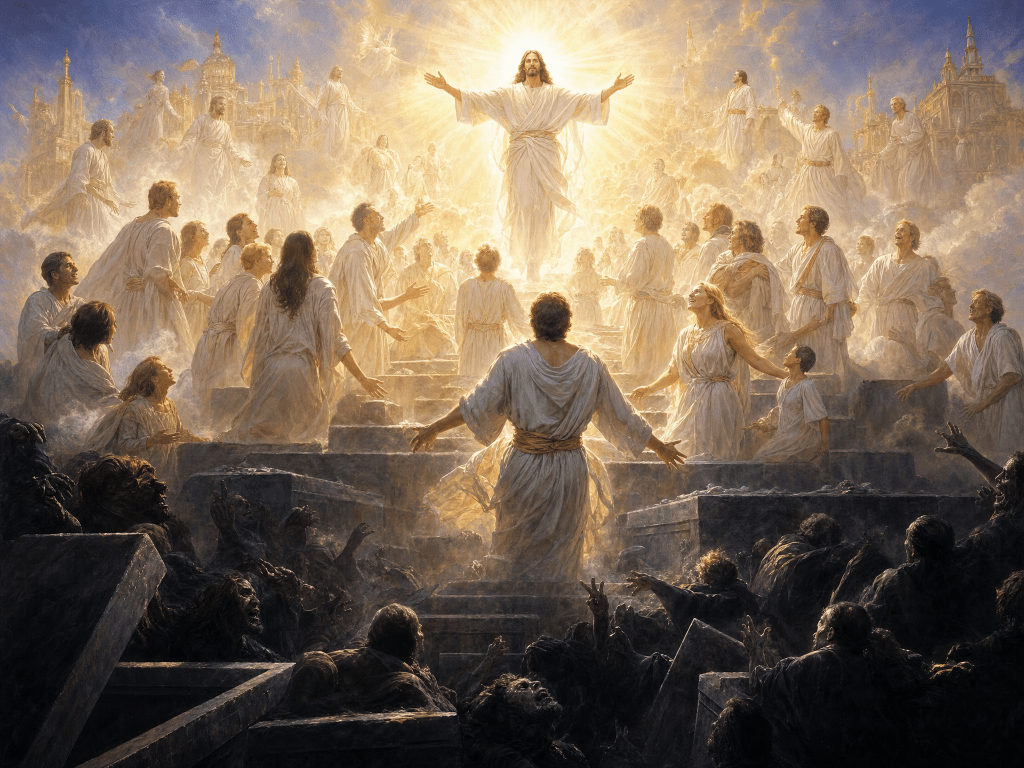
12: “And this death of which I have spoken, which is the spiritual death, shall deliver up its dead; which spiritual death is hell; wherefore, death and hell must deliver up their dead, and hell must deliver up its captive spirits, and the grave must deliver up its captive bodies, and the bodies and the spirits of men will be restored one to the other; and it is by the power of the resurrection of the Holy One of Israel.”
13: “O how great the plan of our God! For on the other hand, the paradise of God must deliver up the spirits of the righteous, and the grave deliver up the body of the righteous; and the spirit and the body is restored to itself again, and all men become incorruptible, and immortal, and they are living souls, having a perfect knowledge like unto us in the flesh, save it be that our knowledge shall be perfect.”
I’ll get to the Mormon explanation of these verses in a bit. There are two prophecies in the Old Testament concerning a general resurrection of the dead. Isaiah 26:19 says, “Your dead will live; their corpses will rise. You who lie in the dust, awake and shout for joy, for your dew is as the dew of the dawn, and the earth will give birth to the departed spirits.” The second one is Daniel 12, which is an end times prophecy. Verse 2 reads, “And many of those who sleep in the dust of the ground will awake, these to everlasting life, but the others to disgrace and everlasting contempt.” So, there is precedent in the Old Testament on resurrection of the dead, but they’re not anywhere near this specific.
There are similar prophecies in the New Testament. In John 11, when Jesus is going to raise Lazarus from the dead, Jesus assured Martha that her brother would rise again in verse 23. Verse 24 records Martha as responding, “I know that he will rise again in the resurrection on the last day.” In verse 25 and 26, Jesus states, “I am the resurrection and the life; he who believes in Me shall live, even if he dies, and everyone who lives and believes in Me shall never die. Do you believe this?” Here we see that a resurrection of the dead was a belief held amongst Jews in Jesus’ day. We also see his promise of this resurrection and eternal life.
Paul builds upon this in 1 Corinthians 15:20-22: “But now Christ has been raised from the dead, and the first fruits of those who are asleep. For since by a man came death, by a man also came the resurrection of the dead. For as in Adam all die, so also in Christ all shall be made alive.” In 1 Thessalonians 4:16-17, Paul foretells the return of Christ and how “the dead in Christ will rise first” to meet him. We know, then, that there will definitely be a resurrection of the dead, but we’re not entirely sure what that’s going to look like.
Besides the odd specificity (which I think was definitely purposeful on Smith’s part) of verses 10-13, they’re not completely terrible on their own. It’s what Mormons attach to them that should give someone pause. In the words of Gospel Doctrine: “Through the atonement death and hell are overcome. Death is overcome for all who live on the earth. Hell is overcome for all but the sons of perdition (DC 76:43-44). Even those of the telestial kingdom will be redeemed in the due time of the Lord (DC 76:31-44). They also are blessed with the ministration of the Holy Ghost and are therefore not cast out of God’s presence forever (DC 76:86). For the sons of perdition, it is a different story. They are cast out of the presence of God to rule with the devil and his angels in eternity (DC 76:44). So, for all but the most wicked-because they were not willing to enjoy that which they might have received (DC 88:32)-mankind is saved from the grips of that awful monster.” While they do tie some of their principles in these verses to some Biblical references, the majority of support you see for their ideas doesn’t come from the Bible, but from their own Mormon writings that are unbiblical upon examination.
First, there is zero Biblical support for different levels of heaven. There are no telestial, terrestrial, and celestial kingdoms. Multiple verses in the New Testament tell us that all believers go to the same place to dwell with Christ for all eternity. Second, we know that all it takes for a person to wind up in hell is for them to reject Christ and his offer of salvation. In John 14:6, Jesus says, “I am the way, the truth, and the life; no one comes to the Father, but through me.” That’s pretty cut-and dried. The idea that eternal punishment is reserved only for “the most wicked,” is a lie that creates a false sense of security. If people believe that they’ll at least go to some level of heaven as long as they’re not cooking meth for little kids and beating up old ladies in the Dairy Queen parking lot, then what reason do they have for surrendering to Christ at all? You can be a perfectly nice human being who does good things and that won’t get you into heaven.
The third issue here is the idea that anyone is going to “rule with the devil and his angels in eternity.” In this previous post here, https://theinquisitivechristian.blog/2025/11/13/satan-isnt-in-charge-of-hell-obvously/, you will read how Satan does not run hell. He is not in charge. His demons are not in charge. Neither are these so-called “sons of perdition.” Hell is a place of eternal punishment and torment for Satan, his demons, and those who go his way on earth. There is no hierarchy there. EVERYONE experiences the torment. A religion that claims to be Christian but can’t even get their doctrines on hell right isn’t one that should be followed.
14: “Wherefore, we shall have a perfect knowledge of all our guilt, and our uncleanness, and our nakedness; and the righteous shall have a perfect knowledge of their enjoyment, and their righteousness, being clothed with purity, yea, even with the robe of righteousness.”
15: “And it shall come to pass that when all men shall have passed from this first death unto life, insomuch as they have become immortal, they must appear before the judgement seat of the Holy One of Israel; and then cometh the judgment, and then must they be judged according to the holy judgment of God.”
Per GD (Gospel Doctrine), this is basically saying that on judgement day, we will be reminded of every single thing we did, good or bad. This is in line with Revelation 20:12, where John describes the scene when everyone who has ever lived will stand before God: “And I saw the dead, the great and the small, standing before the throne, and the books were opened; and another book was opened, which is the book of life, and the dead were judged from the things which were written in the books, according to their deeds.”
But wait! There’s more! There’s always more. At first glance, this doesn’t seem problematic at all. And then, you read further into it using LDS sources, and you find out that they can’t seem to leave well enough alone. According to LDS doctrine, God isn’t going to be the only one judging. According to GD, “We always imagine that Christ will be our judge. However, He is not the only one who will judge us at the judgment-seat. Nephi declared, I shall meet many souls spotless at his judgment-seat…and you and I shall stand face to face before his bar; and ye shall know that I have been commanded of him to write these things (2 Ne 33:7,11). Moroni also will be at the judgment-seat, we shall meet before the judgment-seat of Christ, where all men shall know that my garments are not spotted with your blood (Ether 12:38). The Savior gave the responsibility of judging the twelve tribes of Israel to his apostles (Matt 19:28) and the responsibility of judging the descendants of Lehi to the disciples of the Americas (3 Ne 27:27). Therefore, the Savior and his servants, who wrote the scriptures before us, will judge us according to our faithfulness to the light we had received in mortality.”
So, let’s start with Matthew 19:28, which reads, “And Jesus said to them, ‘Truly I say to you, that you who have followed Me, in the regeneration when the Son of Man will sit on His glorious throne, you also shall sit upon twelve glorious thrones, judging the twelve tribes of Israel.” So, does it mean what GD says it does? No. Pay attention to the word “regeneration.” Some translations say, “the renewal of all things.” There are three possible meanings of this passage that I will briefly explain.
The first is the Premillennial View, sees this verse in the context of a literal 1,000-year reign of Christ on earth when he returns. Those who hold this view believe the Twelve Apostles will serve as co-rulers during this reign. The second is known as the Heavenly Reward Concept. This view holds this verse as a promise of special honor to be bestowed upon the apostles in the final, heavenly order. The third view is the Present Messianic Era, which posits that the “regeneration” speaks of the Christian age that commenced on the Day of Pentecost. You can read about these in much more detail here: The Regeneration – A Study of Matthew 19:28 | Christian Courier. No matter which view you hold, none of them involve anyone besides God making the final judgment on everyone.
On the contrary, we will all be required to give an account of ourselves to God alone on Judgment Day. See Romans 14:10-12, Revelation 20:11-15, and Romans 14:12. Even if you believe Nephi, Moroni, or any of the other prophets specific to the Book of Mormon existed, you would still have no reason to believe they’ll be participating in any final judgment if you also claim to believe the Bible. The Book of Mormon and the Bible cannot both be true.
16: “And assuredly, as the Lord liveth, for the Lord God hath spoken it, and it is his eternal word, which cannot pass away, that they who are righteous shall be righteous still, and they who are filthy shall be filthy still; wherefore, they who are filthy are the devil and his angels; and they shall go away into everlasting fire, prepared for them; and their torment is as a lake of fire and brimstone, whose flame ascendeth up forever and ever and has no end.”
This mimics the wording in Revelation 22:11, which states, “He that is unjust, let him be unjust still: and he which is filthy, let him be filthy still: and he that is righteous, let him be righteous still: and he that is holy, let him be holy still.” This means that at the final judgment, any door to turn to Christ is closed. Both believers and unbelievers are locked into their final state of obedience or disobedience to Christ.
GD certainly had the opportunity to reference this passage in Revelation, but they decided instead to use D&C: “This phrase suggests a willful rebellion against God. The D&C teaches this principle beautifully: ‘he who cannot abide the law of a telestial kingdom cannot abide a telestial glory; therefore he is not meet for a kingdom of glory. Therefore he must abide a kingdom which is not a kingdom of glory…That which breaketh a law, and abideth not by law, but seeketh to become a law unto itself, and willeth to abide in sin, and altogether abideth in sin, cannot be sanctified by law, neither by mercy, justice, nor judgment. Therefore, they must remain filthy still.’ (DC 88:24,35).
17: “O the greatness and the justice of our God! For he executeth all his words, and they have gone forth out of his mouth, and his law must be fulfilled.”
18: “But, behold, the righteous, the saints of the Holy One of Israel, they who have believed in the Holy One of Israel, they who have endured the crosses of the world, and despised the shame of it, they shall inherit the kingdom of God, which was prepared for them from the foundation of the world, and their joy shall be full forever.”
19: “O the greatness of the mercy of our God, the Holy One of Israel! For he delivereth his saints from that awful monster the devil, and death, and hell, and that lake of fire and brimstone, which is endless torment.”
20: “O how great the holiness of our God! For he knoweth all things, and there is not anything save he knows it.”
21: “And he cometh into the world that he may save all men if they will hearken unto his voice; for behold, he suffereth the pains of all men, yea, the pains of every living creature, both men, women, and children, who belong to the family of Adam.”
These verses seem to me to be a wordy rehashing of principles already laid out in this chapter: final judgement, believers being saved from hell, the suffering and death of Christ… you get the idea. In fact, I was going to leave verse 21 alone until I read what GD published concerning it. This heretical quote from late apostle James E. Talmage needs attention: “Christ’s agony in the garden is unfathomable by the finite mind, both as to intensity and cause. The thought that He suffered through fear of death is untenable. Death to Him was preliminary to resurrection and triumphal return to the Father from whom He had come, and to a state of glory even beyond what He had before possessed…” I beg your finest pardon? A state of glory even beyond what he had before possessed?
Philippians 2:5-8 states, “Have this attitude in yourselves which was also in Christ Jesus, who although He existed in the form of God, did not regard equality with God a thing to be grasped, but emptied Himself, taking the form of a bond-servant, and being make in the likeness of men. And being found in appearance as a man, He humbled Himself by becoming obedient to the point of death, even death on a cross.” This may seem cryptic, but bear with me.
The fact that He existed in the form of God means that Jesus is equal to God the Father. This is also evident in John 10:30, when Jesus says, “I and the Father are one.” Now, there are verses that seem to contradict this principle. In John 14:28, Jesus states, “The Father is greater than I,” and Matthew 24:36 says, “Of that day and hour no one knows, not even the angels of heaven, nor the Son, but the Father alone.” These would seem to indicate that they are not equal. However, in John 10:29, Jesus says, “My Father who has given them to me, is greater than all; and no one is able to snatch them out of my Father’s hand.” What follows is “I and the Father are one” in verse 30. Per my Greek dictionary, the word for “one” here in Greek is “hen,” which is in the neuter gender (in Greek and other languages, words themselves are gendered) and which does not mean one person, but one in essence, power, and quality. Jesus was saying, then, that in order to snatch His true disciples out of His hand would be to snatch them out of His Father’s hand because He and the Father are One: one in power, design, action, agreement, and essence. So, they are not one person, but two persons, yet both of them are God.
Philippians 2:6-8 is all about the humiliation and death of Christ for the sake of redeeming us. He was God incarnate and could have avoided death, but He didn’t. What’s interesting here is the Greek word for “existed” is “huparchon,” which means that He was in continuation of what He was before. So, being in essential form as God, He continued to be that when He took on the form of a man. When it says that He “did not regard equality with God as a thing to be grasped,” it’s saying that Jesus did not consider being equal with God as something to be forcibly taken from God. His essence of deity was not something that He took, but something that He always had and never lost.
In verse 7, when it says, “He emptied Himself,” it means He voluntarily surrendered Himself to the humiliation of being human and suffering and dying. We’re not entirely sure of what He emptied Himself of, but we can be assured that no one took away from Him what He was. In John 17:5, Jesus asked the Father, “And now, glorify Thou Me together with Thyself, Father, with the glory which I had with Thee before the world was.” This is clear evidence that after His ascension, Jesus went back to his previous glory that He had before becoming a man. Since Jesus is God, it is impossible for Him to have been elevated to a greater level of glory upon returning to heaven. In order to believe that Jesus received greater glory upon His return, you would have to disbelieve that He is God, thereby denying who He really is.
Again, the verses themselves don’t seem particularly problematic until you dig a little deeper. Just enough truth to make it seem believable.
23: “And he commandeth all men that they must repent, and be baptized in his name, having perfect faith in the Holy One of Israel, or they cannot be saved in the kingdom of God.”
24: “And if they will not repent and believe in his name, and be baptized in his name, and endure to the end, they must be damned; for the Lord God, the Holy One of Israel, has spoken it.”
Being baptized did not exist in the Old Testament. While we can say that the practice has roots in the Old Testament in the form of consecration rituals, the practice itself did not exist until the New Testament. The first mention of it, in fact, is when John the Baptist was doing just that. This was done as a public sign of repentance and in preparation for the Messiah. Not a single soul was baptized in anyone’s name before the New Testament.
GD expounds upon this anachronism some more, which makes everything worse. They insist that early Nephites practiced baptism as an essential part of the Gospel. In their own words: “The teachings of Jacob clearly indicate that the early Nephites considered baptism an essential ordinance of the gospel. (2 Nephi 9:23-24.) Nephi also taught the necessity of baptism (2 Nephi 31:5-13), and then, referring to the baptism of the Savior, he counseled his followers to ‘do the things which I have told you I have seen that your Lord and your Redeemer should do; for, for this cause have they been shown unto me, that ye might know the gate by which ye should enter. For the gate by which ye should enter is repentance and baptism by water’ (2 Nephi 31:17).”
This should go without saying, but the Gospel hadn’t happened yet. Not only that, but there is no Old Testament prophecy concerning Jesus’ baptism. While his anointing from the Holy Spirit is foretold in Isaiah 11:2 and 61:1, there is not a single description of him being baptized with water by John the Baptist.
Per GD, Joseph Fielding Smith wrote: ” The Book of Mormon teaches us that baptism for the remission of sins was a fundamental principle of the gospel among the Nephites from the time of Lehi all through their history… All through the Book of Mormon there are references to baptism as an ordinance for the remission of sins. What their word for baptism was not revealed, but in the translation the Prophet Joseph Smith used the familiar expression of our time.” In other words, they’re trying to tell us there were Christians before Christ. That is quite preposterous. Baptism for the remission of sins did not take place until Acts 2:38, when Peter commands believers to “Repent, and let each of you be baptized in the name of Jesus Christ for the forgiveness of your sins; and you shall receive the gift of the Holy Spirit.”
25: “Wherefore, he has given a law; and where there is no law given there is no punishment; and where there is no punishment there is no condemnation; and where there is no condemnation the mercies of the Holy One of Israel have claim upon them, because of the atonement; for they are delivered by the power of him.”
26: “For the atonement satisfieth the demands of his justice upon all those who have not the law given to them, that they are delivered from that awful monster, death and hell, and the devil, and the lake of fire and brimstone, which is endless torment; and they are restored to that God who gave them breath, which is the Holy One of Israel.”
My understanding of these verses, based upon what I read in GD, is that you’re basically only punished by God if you know better and don’t do better. So, if someone is ignorant of God’s commands but they follow their conscience, they’re ok. But is this true? What of people who have never heard the Gospel, but do the best they can according to their conscience?
This is actually a much-debated topic in Christian circles. The exclusivist position holds that belief in Christ is necessary for salvation (which is true), but they take that to mean that if someone dies without hearing of him, their soul will be lost. Inclusivists, on the other hand, acknowledge that while salvation is only through Christ, God extends His grace to those who have not heard the Gospel but follow what little light they may have through their conscience. I take the second position, especially in light of Romans 2:13-15, which says, “For not the hearers of the Law are just before God, but the doers of the Law will be justified. For when Gentiles who do not have the Law do instinctively the things of the Law, these, not having the Law, are a law to themselves, in that they show the work of the Law written in their hears, their conscience bearing witness, and their thoughts alternately accusing or else defending them.”
27: “But wo unto him that has the law given, yea, that has all the commandments of God, like unto us, and that transgresseth them, and that wasteth the days of his probation, for awful is his state!”
I agree that it’s pretty bad news if you know the expectations of God and choose not to fulfill them. For example, if you know what the Bible says and you choose to twist it and deceive people, that’s going to put you in a very bad position with God.
28: “O that cunning plan of the evil one! O the vainness, and the frailties, and the foolishness of men! When they are learned they think they are wise, and they hearken not unto the counsel of God, for they set it aside, supposing they know of themselves, wherefore, their wisdom is foolishness and it profiteth them not. And they shall perish.”
This principle is in keeping with Proverbs 14:12, which tells us, “There is a way that seems right to a man, but its end is the way of death.” In contrast, Proverbs 9:10, states, “The fear of the Lord is the beginning of wisdom, and knowledge of the Holy One is understanding.”
Rather than compare this principle with the Bible, however, GD simply quotes people like Ezra Taft Benson (the 13th President of the LDS church), Boyd K. Packer (former President of the Quorum of the Twelve Apostles), and Theodore Burton (late general authority in the LDS church). There is a common and disturbing theme in these quotes: the idea that education and reasoning should be approached with caution because it can lead people away from the LDS church. Some winning quotes are as follows (which you can read on the GD website I linked in my introduction):
“Increasingly the Latter-day Saints must choose between the reasoning of men and the revelations of God. This is a crucial choice, for we have those within the Church today who, with their worldly wisdom, are leading some of our members astray.” – Ezra Benson
“There is almost a universal tendency for men and women who are specialists in an academic discipline to judge the Church against the principles of their profession. There is a great need in my mind for us, as students and as teachers, to consciously and continually subjugate this tendency and relegate our professional training to a position secondary to the principles of the gospel of Jesus Christ. In other words, rather than to judge the Church and its program against the principles of our profession, we would do well to set the Church and its accepted program as the rule, then judge our academic training against this rule.” – Boyd Packer
“Many men who are well-trained in one limited field feel that this equally qualifies them to express learned opinions in the field of faith and religion…Now, brothers and sisters, in our Church in this day and age, when education is becoming more and more” popular and more and more necessary, there is grave danger of intellectual apostasy…(2 Ne 9:28-9).” – Theodore Burton
So, if someone is trained in genetics and they draw the conclusion that there’s no basis at all for the notion that ancient Jews are ancestors to Native Americans, would this count as intellectual apostasy? While it is true that some people can get a little big for their britches and view faith and religion as beneath them, but this does not mean we should be leery of education, as that is a heart issue, not a mind issue. This does not mean we should continue believing things that cannot pass the tests of reason. It doesn’t mean we should blindly believe something for which there is no evidence or which the evidence contradicts. That’s not faith. That’s indoctrination and delusion. If multiple leaders of your religion are so cautious of education, that should be a red flag.
Verses 29-38 don’t contain anything particularly noteworthy or scandalous. They more or less name people who will not inherit the kingdom of God.
39: “O, my beloved brethren, remember the awfulness in transgressing against that Holy God, and also the awfulness of yielding to the enticings of that cunning one. Remember, to be carnally-minded is death, and to be spiritually-minded is life eternal.”
Being carnally minded is a New Testament concept, and this is taken almost verbatim from Romans 8:6: “For to be carnally minded is death; but to be spiritually minded is life and peace.”
40: “O, my beloved brethren, give ear to my words. Remember the greatness of the Holy One of Israel. Do not say that I have spoken hard things against you; for if ye do, ye will revile against the truth; for I have spoken the words of your Maker. I know that the words of truth are hard against all uncleanness; but the righteous fear them not, for they love the truth and are not shaken.”
This is not a controversial idea. The Bible is full of wicked people not wanting to hear bad things about themselves. 1 Kings 22:8 is a prime example of this, when King Ahab is complaining about the prophet Micaiah.
41: “O then, my beloved brethren, come unto the Lord, the Holy One. Remember that his paths are righteous. Behold, the way for man is narrow, but it lieth in a straight course before him, and the keeper of the gate is the Holy One of Israel; and he employeth no servant there; and there is none other way save it be by the gate; for he cannot be deceived, for the Lord God is his name.”
This is a very interesting verse because this does not reflect what the LDS church actually teaches. Consider the following quotes:
“This Church is the ensign on the mountain spoken of by the Old Testament prophets. It is the way, the truth, and the life” (Conference Report, April, 1961, pg. 119). -Marion Romney
In a conference speech delivered on April 8, 1973, LDS Apostle Mark E. Petersen proclaimed that salvation “comes only through the Church itself as the Lord established it… Therefore it was made clearly manifest that salvation is in the Church, and of the Church, and is obtained only through the Church.”
” There is no salvation without Joseph Smith.” (Doctrines of Salvation 1:189). -Joseph Fielding Smith
“From the day that the priesthood was taken from the earth to the winding up things of all things, every man and woman must have the certificate of Joseph Smith, junior, as a passport to their entrance into the mansion where God and Christ are — I with you and you with me. I cannot go there without his consent” (Journal of Discourses 7:289. See also Search These Commandments, 1984, pg. 133). -Brigham Young
“How are you going to get your resurrection? You will get it by the President of the resurrection pertaining to this generation, and that is Joseph Smith Jun. Hear it all ye ends of the earth; if ever you enter into the kingdom of God it is because Joseph Smith let you go there. This will apply to Jews and Gentiles, to the bond, and the free; to friends and foes; no man or woman in this generation will get a resurrection and be crowned, without Joseph Smith saying so. The man who was martyred in Carthage Jail, State of Illinois, holds the keys of life and death to this generation. He is the President of the resurrection in this dispensation, …” (An unpublished discourse given October 8, 1854. Also found on page 99 of Eugene E. Campbell’s book titled The Essential Brigham Young“).
George Q. Cannon, a former member of the First Presidency, also said that salvation is also through Joseph Smith. “If we get our salvation, we shall have to pass by him; if we enter into our glory, it will be through the authority that he has received” (Gospel Truth, pp. 199, 200).
“If it had not been for Joseph Smith and the restoration, there would be no salvation. There is no salvation outside The Church of Jesus Christ of Latter-day Saints” (Bruce R. McConkie, Mormon Doctrine, 1966, p. 670).
I could absolutely continue, but I think you all get the idea. They don’t actually believe that God is the only keeper of the gate and he employs no servants there. It is absolutely true that our salvation is ONLY through Christ. No church on earth has the authority to deny our salvation. These quotes and others are exactly why people accuse Mormons of worshipping Joseph Smith. Don’t even get me started on the hymn “Praise to the Man.” These quotes and others can be read here: No Salvation Without Joseph Smith – Mormonism Research Ministry and Citations on Salvation – Mormonism Research Ministry.
42: “And whoso knocketh, to him will he open; and the wise, and the learned, and they that are rich, who are puffed up because of their learning, and their wisdom, and their riches—yea, they are they whom he despiseth; and save they shall cast these things away, and consider themselves fools before God, and come down in the depths of humility, he will not open unto them.”
43: “But the things of the wise and the prudent shall be hid from them forever—yea, that happiness which is prepared for the saints.”
This is basically reiterating and expounding upon verse 28.
44: “O, my beloved brethren, remember my words. Behold, I take off my garments, and I shake them before you; I pray the God of my salvation that he view me with his all-seraching eye; wherefore, ye shall know at the last day, when all men shall be judged of their works, that the God of Israel did witness that I shook your iniquities from my soul, and that I stand with brightness before him, and am rid of your blood.”
This is Jacob essentially telling the people that he’s fulfilling his obligation to teach them about the laws of God and calling them to repentance. He therefore won’t be held accountable for their sins. Verses 45-52 are further calls to repentance and obedience to God. Verses 50 and 51 take the wording of Isaiah 51:30 and Isaiah 55:2.
53 “And behold how great the covenants of the Lord, and how great his condescensions unto the children of men; and because of his greatness, and his grace and mercy, he has promised unto us that our seed shall not utterly be destroyed, according to the flesh, but that he would preserve them; and in future generations they shall become a righteous branch unto the house of Israel.”
54: “And now, my brethren, I would speak unto you more; but on the morrow I will declare unto you the remainder of my words. Amen.”
GD reports that the Nephites were destroyed in a great battle in 325 A.D. (of which there is exactly zero archeological or historical evidence). They get around this contradiction between preservation and total destruction by pointing out that the Book of Moron records there were Lamanites and others among Nephites and Nephites among Lamanites. They were supposedly gathered into tribes by ideas and beliefs and not necessarily genetics. This makes no difference, however, because genetic testing has revealed there is no Middle Eastern DNA in indigenous populations in the Americas. You can read more on that here: Dissecting the Pre-Columbian Genomic Ancestry of Native Americans along the Andes–Amazonia Divide – PMC.
As I have demonstrated, the Book of Mormon does contain nuggets of truth here and there, but their presence is deceptive and dangerous. Underneath these are insidious lies that infect a person’s soul and grasp of Biblical truths about who God is. They are the peanut butter coating the deadly rat poison tucked inside.
Throughout my research during this project, I have often wondered why Joseph Smith fixated on various things. Thus far, we have seen the plagiarism of entire chapters of Isaiah. Theologically speaking, Isaiah is one of the most impactful and significant books of the Old Testament. It contains various Messianic prophecies, which is why it’s so important. However, it also contains many prophecies regarding Israel. We saw in my previous entry how Mormon apologists have tried to shoehorn meanings into Isaiah that simply aren’t there; namely, the turning of Messianic prophecy into prophecy regarding the house of Israel.
So, why the bizarre fixation? Well, it’s a rabbit hole that exceeds the scope of this post, but they believe they are literally and spiritually part of the house of Israel. For more information, see Why should we know that we are literally of the House of Israel? and Nineteenth-Century Mormons: The New Israel – Dialogue Journal. During a ceremony known as the Patriarchal Blessing, members are told what tribe of Israel to which they belong. They hold to the belief that while not all members may have literal Hebrew ancestors, once they receive a patriarchal blessing, they are considered descendants of Abraham (Patriarchal Blessings). As a result of these strange beliefs, they view all Biblical Scripture through the lens of being descendants of Abraham that will participate in the final gathering of Israel.
I told you it was a rabbit hole. I’m sure I’ll come across the opportunity to delve further into it when I write my critique of the Doctrine & Covenants and Pearl of Great Price. For now, we will be reviewing their understanding of Isaiah 51 through the lens of the Book of Mormon. As noted in my previous post, Joseph Smith clearly believed he knew better than Isaiah and altered what he wrote to fit his own narrative and interpretations. We will be seeing more of that here. I will be referencing a couple online Biblical commentaries (which I will cite at the end of this post), but I will also be utilizing John N. Oswalt’s commentary, “The Book of Isaiah: Chapters 40-66” from The New International Commentary on the Old Testament series. To understand the Mormon interpretations of this chapter, I will be using the popular LDS site “Gospel Doctrine.” Though it is very well-known and highly regarded in the LDS community, I must point out that it is run by church members and not the church itself.
2 Nephi Chapter 8
Jacob continues reading from Isaiah: In the last days, the Lord will comfort Zion and gather Israel—The redeemed will come to Zion amid great joy—Compare Isaiah 51 and 52:1–2. About 559–545 B.C.
To give you all a general idea of where the differences between Christians and LDS lie in regards to this chapter, allow me to point you to the popular LDS website “Gospel Doctrine” for their introduction to this chapter: “The Second Coming of Christ will usher in the great Millenium. During this blessed period, divine authority will be administered from two great cities: the New Jerusalem and the Old Jerusalem. This chapter tells the story of the redemption of these two great cities. Verses 1-16 speak in general of Zion, the New Jerusalem, that great city which is yet to be built upon the American continent. Verses 17-23 speak of the redemption of the Old Jerusalem.”
This ties in with former LDS president Joseph Fielding Smith’s comments on this passage: “Jerusalem of old, after the Jews have been cleansed and sanctified from all their sin, shall become a holy city where the Lord shall dwell and from whence he shall send forth his word unto all people. Likewise, on this continent, the city of Zion, New Jerusalem, shall be built and from it the law of God shall also go forth. There will be no conflict, for each city shall be headquarters for the Redeemer of the world, and from each he shall send forth his proclamations as occasion may require. Jerusalem shall be the gathering place of Judah and his fellows of the house of Israel, and Zion shall be the gathering place of Ephraim and his fellows, upon whose heads shall be conferred ‘the richer blessings.’…These two cities, one in the land of Zion and one in Palestine, are to become capitals for the kingdom of God during the millennium.” (Doctrines of Salvation, 3 vols., edited by Bruce R. McConkie [Salt Lake City: Bookcraft, 1954-1956], 3: 69-71).I will be demonstrating throughout this article why this is a bogus idea that has no credibility.
1: “Hearken unto me, ye that follow after righteousness. Look unto the rock from whence ye are hewn, and to the hole of the pit from whence ye are digged.”
Isaiah 51:1 (KJV): “Hearken to me, ye that follow after righteousness, ye that seek the Lord: look unto the rock whence ye are hewn, and to the hole of the pit whence ye are digged.”
In a literal sense, this is being addressed to the captives in Babylon, but there is a much broader theme here. The phrase “ye that follow after righteousness, ye that seek the Lord” can also be applied to faithful believers in Christ. As Matthew Henry points out in his commentary, “This chapter is designed for the comfort and encouragement of those that fear God and keep his commandments, even when they walk in darkness and have no light. Whether it was intended primarily for the support of the captives in Babylon is not certain, probably it was; but comforts thus generally expressed ought not to be so confined.” The Broadman Bible Commentary echoes this sentiment: “The persons addressed in this paragraph are called Israelites; but it is obvious that only the “righteous remnant” are meant; and therefore the ultimate application of the passage extends to the Ideal Servant and his holy Church.”
The phrase “look unto the rock whence ye are hewn, and to the hold of the pit whence ye are digged” is instructing these captives seeking righteousness to look to their humble origins, which we see in the next verse.
2: “Look unto Abraham, your father, and unto Sarah, she that bare you; for I called him alone, and blessed him.”
“Look unto Abraham your father, and unto Sarah that bare you: for I called him alone, and blessed him, and increased him.”Smith left out this last bit about increasing. It could be that he thought he knew better than Isaiah and didn’t need to include that last part. Perhaps he assumed that blessing someone automatically means increasing. Whatever his reasons, altering the Word of God is a bad idea.
This verse is meant to emphasize the humble beginning of the nation of Israel. The captives of Babylon are being encouraged to look to Abraham and Sarah and consider their circumstances. As Oswalt puts it: “But for those who do believe God, who are seeking him, hope deferred can be a hard trial. To them God offers his comfort, a comfort rooted in the evidence of history. God had taken Abraham when he was one, alone, and along with Sarah had made them into a great people… God could do the same again. If he could make a great people out of barren Sarah, surely he could restore a great people to barren Zion, turning her from a wilderness into the garden of the Lord (see also Isaiah 4:2, 32:15, 35:1-2, 61:3-4, 65:21-22).” (p. 334).
Oswalt also points out that the verb “look” in this verse is the same verb God used in Gen. 15:5 to tell Abraham to look at the night sky and count the stars. “Just as Abraham was called on there to look and believe for a numberless progeny to come from the womb of barren Sarah, Israel is here called to look at the faithfulness of God in the past and to believe that God could yet again keep his promises to people barren Zion with children from around the world.” (p. 335). This sets the overall theme of this chapter: comfort for God’s people.
Late Mormon apostle Orson Hyde inserted his own presuppositions into this verse, of course. Since Mormons erroneously believe this chapter entails the building of Zion on the American continent, his emphasis on this verse is that modern Mormons become the seed of Abraham through the blood of Christ. This idea can be seen in this quote: “How was it, then, with Abraham? He is said to be the father of the faithful, and the great head of the Church in the days of the Patriarchs, and the head of those who have been adopted into the covenant of Jehovah through the blood of His only begotten; for if we are Christ’s then we are Abraham’s seed, and heirs according to the promise. If, by the virtue of the Savior’s blood, our sins are washed away, we are the children of Abraham; we hail him as our father, and Sarah as our mother; he is the father of the faithful, he is the father of many nations.”
As I’ve repeatedly pointed out in several other posts, the concept of church is purely a New Testament notion, strictly Christian in nature. Abraham had no idea what a church was, much less was the head of the Mormon one. I’m beginning to notice a disturbing pattern here. Their mandatory temple ordinances that supposedly promise one entrance to the Celestial Kingdom (the highest level of heaven), their belief that men are either of the Aaronic or Melchizedek priesthood, and the presence of a holy of holies in their Salt Lake City temple can only be explained by their absolute fixation on the Old Testament.
What’s disturbing is the belief that underlies all of this: that the blood of Jesus isn’t enough to atone for our sins. God doesn’t want a bunch of temple rituals. Jesus fulfilled the Old Testament law and therefore made them all a thing of the past. There is no Melchizedek priesthood, because Jesus served as both the ultimate sacrifice and the great high priest, the ultimate mediator between humanity and God the Father. The Holy of Holies no longer exists in any temple, because the curtain was torn asunder when Jesus died, symbolizing a universal offer of salvation. Joseph Smith did not restore the Gospel. All he “restored” were things that Jesus already fulfilled. The gospel that the Mormon church offers, then, is nothing but a false one littered with hollow rituals and empty promises of blessings that don’t exist.
3: “For the Lord shall comfort Zion, he will comfort all her waste places; and he will make her wilderness like Eden, and her desert like the garden of the Lord. Joy and gladness shall be found therein, thanksgiving and the voice of melody.”
“For the Lord shall comfort Zion: he will comfort all her waste places; and he will make her wilderness like Eden, and her desert like the garden of the Lord; joy and gladness shall be found therein, thanksgiving, and the voice of melody.”
This verse, of course, is a promise of comfort and restoration for these captives. Henry neatly ties this into a broader theme of comfort for believers as a whole when he writes, “The church of God on earth, even the gospel Zion, has sometimes had her deserts and waste places, many parts of the church, through either corruption or persecution, made like a wilderness, unfruitful to God or uncomfortable to the inhabitants; but God will find out a time and way to comfort Zion, not only by speaking comfortably to her, but by acting graciously for her. God has comforts in store even for the waste places of his church, for those parts of it that seem not regarded or valued…He will make them fruitful, and so give them cause to rejoice; her wildernesses shall put on a new face, and look pleasant as Eden, and abound in all good fruits, as the garden of the Lord. Note, It is the greatest comfort of the church to be made serviceable to the glory of God, and to be as his garden in which he delights.” While these verses might be literally directed towards the Babylonian captives, we as modern Christians can certainly apply these general themes to our own spiritual journey.
Mormons see themselves in this verse and believe it applies to them in a more literal sense. Because they believe they were commanded to build Zion in the United States (specifically Missouri), they view this promise of comfort and prosperity as direct promises to them.As author W. Cleon Skousen states in his book “Isaiah Speaks to Modern Times,”: “Since the organization of the church, the saints have been the object of persecution and public ridicule. While these difficulties may have lessened of late, the lot of the latter-day saint continues to be more persecution than adoration. Yet, all of these inequities, individually and collectively, will be wiped away. Those saints who were commanded to build Zion in the 1830’s (see DC 57 & 63) must have been horrified when they were mobbed and driven from their Jackson County homes. The promise is, and has always been, that the Lord does not expect his saints to suffer forever. “This verse (2 Ne. 8:3) was a great comfort to the Saints when they were driven out of Missouri and later out of Illinois. The Lord assured the Saints that eventually he would pour out comfort and blessings upon his people in America.”
Late apostle Rudger Clawson believed this promise of prosperity was fulfilled as evidenced by his Conference Report in April 1905: “This vast congregation are living witnesses of the literal fulfillment of these words of the prophet. Was not this land a veritable wilderness in the year 1847? Has it not been transformed into a garden like Eden? This land has become choice above all other lands. We want no better. And I am inclined to think that the Lord can lead us to no better land than we have at the present time, unless a special blessing is conferred upon the land beyond what we have received. And in this conference we have seen the joy of the people; we have witnessed their gladness. We have heard the voice of thanksgiving from this stand, from the lips of the Elders of Israel. Here in this choir we have heard the voice of melody. Isaiah must have had his eye upon these occasions; and in the great visions that were given to him he must have witnessed the gatherings of the people of the Lord. Oh, how our hearts have been made to rejoice upon this occasion!” So, he appeared to believe Isaiah saw them in his prophetic visions.
God makes no such promises to a group dedicated to twisting His word and propagating a false gospel. 2 Corinthians 11:12-15 (NASB) is quite clear: “But what I am doing, I will continue to do, that I may cut off opportunity from those who desire an opportunity to be regarded just as we are in the matter about which they are boasting. For such men are deceitful workers, disguising themselves as apostles of Christ. And no wonder, for even Satan disguises himself as an angel of light. Therefore it is not surprising his servants also disguise themselves as servants of righteousness; whose end shall be according to their deeds.” That is only one of numerous warnings about false prophets in the Bible.
It’s an interesting coincidence that Joseph Smith preached a sermon on May 26th, 1844 in which he read 2 Corinthians 11 then made the following outrageous statement: “I have more to boast of than ever any man had. I am the only man that has ever been able to keep a whole church together since the days of Adam… Neither Paul, John, Peter nor Jesus ever did it. I boast that no man ever did such work as I. The followers of Jesus ran away from him; but the Latter-day Saints never ran away from me yet.” About a month later, he was killed by an angry mob. You can read the entirety of his sermon here:26 May 1844 (Sunday Morning) | Religious Studies Center
4: “Hearken unto me, my people; and give ear unto me, O my nation; for a law shall proceed from me, and I will make my judgment to rest for a light for the people.”
“Hearken unto me, my people; and give ear unto me, O my nation: for a law shall proceed from me, and I will make my judgment to rest for a light of the people.”
Here, as Oswalt points out, the address becomes even more personal, with God identifying those who seek Him as “my people” and “my nation.” He writes, “No matter what is past, no matter how they have sinned, if they are truly seeking God, He calls them His own. All His promises are theirs.” It is a great comfort and encouragement for God to call us His. As Romans 8:31 says, “If God is for us, who can be against us?” This theme will be echoed in later verses in this chapter.
We also see here that his promises are opening up to everyone and not just the Israelites. The law proceeding from Him spoken of here is speaking of God’s universal reign through the Gospel. Henry writes of this verse: “The gospel of Christ shall be preached and published to the world: A law shall proceed from me, an evangelical law, the law of Christ, the law of faith, ch. 2:3. This law is his judgment; for it is that law of liberty by which the world shall be governed and judged. This shall not only go forth, but shall continue and rest, it shall take firm footing and deep root in the world. It shall rest, not only for the benefit of the Jews, who had the first notice of it, but for a light of the people of other nations. It is this law, this judgment, that we are required to hearken and give ear to, at our peril; for how shall we escape if we neglect it and turn a deaf ear to it? When a law proceeds from God, he that has ears to hear, let him hear.”
Indeed, Oswalt agrees with this sentiment, writing, “Far from being some question about God’s ability and willingness to save his own people from their sin, what he is about to do will be the means of the tora instruction, that they have received from God now reaching out to all the peoples of the world, just as stated in ch. 2. Because of what God will do for the children of Abraham, all the world will come into His light, to experience His just rule.” (p. 335-336).
According to Scripture Central, another popular LDS site, Jacob was reading this portion of Isaiah to the Nephites to reemphasize God’s promises to those who left Jerusalem and to teach those who joined them when they reached the Americas. Now, absolutely nothing thus far in the Book of Mormon has given any indication that people were already on this continent before they got here, much less that they joined his group. I can only conclude this is an assumption on the part of Mormons in their understanding of this chapter in Nephi.
However, their understanding of this passage gets even more nonsensical. They don’t believe this is talking about the Gospel or God’s reign on Earth. They believe this is teaching that “the law” will be administered by the Zion on the American continent. They also then cite Isaiah 2:3 to attempt to back this up but only mention the very last phrase which is “For the law will go forth from Zion, and the word of the Lord from Jerusalem.” They conveniently leave out the first part of it, which is “And many peoples will come and say, ‘Come, let us go up to the mountain of the Lord, to the house of the God of Jacob; that He may teach us concerning His ways, and that we may walk in His paths…” This verse, as well as the first several verses of Isaiah 2, speak of a time when God will reign and people will travel to Jerusalem from all over the world to learn His ways (for a more detailed breakdown, see What does Isaiah 2:3 mean? | BibleRef.com).
Orson Pratt further distorted this meaning by speaking of what sounds like a theocracy run by the LDS church: “…There would then be persons ordained and set apart for various purposes, not to bestow any new Priesthood, for it is all included in the everlasting and eternal Priesthood, after the order of the Son of God; but to set apart persons already holding the Priesthood in the great organization; to receive divine laws; or, in other words, to regulate the nations, according to the laws of Zion; that they may understand her laws, and know what the divine government is, by which they are to be governed; in other words, ministers or plenipotentiaries are to be sent forth to transact business among all nations and peoples who willingly shall become subject to the laws of Zion.” In other words, forget God ruling all the nations. Forget God teaching His precepts. It’s all going to be up to the Mormons.
And what of people who oppose this? Well, they have to be destroyed, of course: “As to the rebellious nations, there will be none left alive. As it is written, ‘that nation or kingdom that will not serve thee shall perish.’ ‘Those nations shall be utterly wasted away;’ consequently, the nations left, who are not totally destroyed will be anxious to be governed by the laws of Zion. Hence there will be an organization before the winding-up scene that will control the nations politically, giving them the privilege of remaining in their own land if they choose to do so, but subject to the laws of Zion.” (Journal of Discourses, vol 19, May 20, 1877, p.14). So, seeing their neighbors get slaughtered will make other nations want to eagerly obey. There is absolutely nothing remotely resembling this in the Bible. In fact, Scripture is clear that it is God who will execute judgment, NOT a group of people running a theocratic dictatorship.
5: “My righteousness is near; my salvation is gone forth, and mine arm shall judge the people. The isles shall wait upon me, and on mine arm shall they trust.”
“My righteousness is near; my salvation is gone forth, and mine arms shall judge the people; the isles shall wait upon me, and on mine arm shall they trust.”
Now we see that the deliverance God is promising is not limited to the captives in Babylon, but to future believers worldwide. As Oswalt writes: “Why should the islands (the ends of the earth) wait (cf. also 60:9) for that deliverance? Why should they hope for that? Nonetheless, if God is going to use His Servant to deliver the world from the clutches of sin, just as Cyrus was to deliver the Israelites from the clutches of Babylon, that is a salvation that does indeed have implications for the whole world.”(p. 336).
It is interesting to note here that God’s arms are both for judgment and trust. Those of us who love God actively hope for his strength and justice. As Oswalt later points out, “Interestingly, it is for the arm of the Lord that the world hopes, that is, His delivering power. We long for someone who is both strong enough and good enough to rule in justice.” (p. 336-337). Henry develops this idea further, stating, “This evangelical righteousness and salvation shall not be confined to the Jewish nation, but shall be extended to the Gentiles; My arms shall judge the people. Those that will not yield to the judgments of God’s mouth shall be crushed by the judgments of his hand. Some shall thus be judged by the gospel, for for judgment Christ came into this world; but others, and those of the isles, shall wait upon him, and bid his gospel, and the commands as well as the comforts of it, welcome. It was a comfort to God’s people, to his nation, that multitudes should be added to them, and the increase of their number should be the increase of their strength and beauty. It is added, And on my arm shall they trust, that arm of the Lord which is revealed in Christ, ch. 53:1. Observe, God’s arm shall judge the people that are impenitent, and yet on his arm shall others trust and be saved by it; for it is to us as we make it, a savior of life or of death.”
According to Gospel Doctrine, the “isles of the sea” refers to the American continent. Because everything refers to the American continent if you squint your eyes hard enough while reading Scripture and convince yourself that that’s what it means.
6: “Lift up your eyes to the heavens, and look upon the earth beneath; for the heavens shall vanish away like smoke, and the earth shall wax old like a garment; and they that dwell therein shall die in like manner. But my salvation shall be forever, and my righteousness shall not be abolished.”
“Lift up your eyes to the heavens, and look upon the earth beneath: for the heavens shall vanish away like smoke, and the earth shall wax old like a garment, and they that dwell therein shall die in like manner: but my salvation shall be for ever, and my righteousness shall not be abolished.”
Here, God is emphasizing the finite nature of his creation versus the eternal nature of salvation and righteousness. Oswalt makes the observation that the heavens and the earth are where the children of this world look to for guidance. But none can be found because the heavens are no more eternal than smoke that dissipates in the wind, and the earth is no more solid than a moth-eaten old garment. And we as humans are just as finite as these things. Someday, per end times prophecy, this world and everything in it will pass away. It is comforting to know, however, that we can rest upon the permanence of God’s righteousness and the salvation we have through Christ.
So, what does this all mean if we view it through and LDS lens? They believe the earth will be transformed twice: once from telestial (a word Joseph Smith made up) world to a terrestrial one (which is apparently better somehow), and then again from a terrestrial world to a celestial kingdom, which only those worthy enough can enter. For the sake of space, I’m not going to quote Joseph Fielding Smith’s meandering explanation of all of this. I will cite all my sources at the end of this post, and you can read it all there if you are so inclined. It should go without saying that absolutely none of this is supported by any Bible passage anywhere.
7: “Hearken unto me, ye that know righteousness, the people in whose heart I have written my law, fear ye not the reproach of men, neither be ye afraid of their revilings.”
“Hearken unto me, ye that know righteousness, the people in whose heart is my law; fear ye not the reproach of men, neither be ye afraid of their revilings.”
This is pretty self-explanatory. Those of us who follow God have nothing to fear from mortal men. This point is also made in Matthew 10:28 (NASB): “And do not be afraid of those who kill the body but are unable to kill the soul; but rather fear Him who is able to destroy both soul and body in hell.”
While skimming over the explanation Gospel Doctrine provides, I did not see anything particularly noteworthy in regard to the interpretation. Then, I came across this gem: “The Lord always commands his prophets to write down his laws. In this instance, he is writing the law in the hearts of the righteous. This is exactly what happens when the saints attend the temple-they learn the law of the Lord. However, this law cannot be written down on parchments or stone tablets. Rather, through regular temple attendance and sheer repetition, it is written in the hearts of the temple patrons.” The law is written on our hearts by studying the Bible, not by attending meaningless temple ceremonies. What’s troubling, however, is the phrase “sheer repetition.” It’s true that repetition helps us remember things. It’s also a brainwashing technique. Be incredibly careful about what you repeat. Because if you do it long enough, you might start to believe it.
8: “For the moth shall eat them up like a garment, and the worm shall eat them like wool. But my righteousness shall be forever, and my salvation from generation to generation.”
“For the moth shall eat them up like a garment, and the worm shall eat them like wool: but my righteousness shall be forever, and my salvation from generation to generation.”
This verse builds upon the previous one regarding creation’s mortal existence and God’s eternal nature. This also lays out the consequences of the refusal to submit to him: wasting away and death. As Oswalt puts it, “The believer need not be neutralized by the opposition of a passing world. Those who have made it and its gods ultimate have chosen the way of time: the moth and the insect. Those who have made God and his Servant ultimate have chosen the way of permanence, certainty, and joy.” Amen to that.
9: “Awake, awake! Put on strength, O arm of the Lord; awake as in the ancient days. Art thou not he that hath cut Rahab, and wounded the dragon?”
“Awake, awake, put on strength, O arm of the Lord; awake, as in the ancient days, in the generations of old. Art thou not it that hath cut Rahab, and wounded the dragon?”
This plea implies that God has not been acting on the people’s behalf for quite some time. This verse rings with a lament that contrasts with faith. Oswalt makes the argument that these two things are not mutually exclusive. It is possible to have faith that God can and may act in any given situation but be deeply saddened and troubled that He is not acting right now in the present. This is a call to God to act as he did “as in the ancient days.”
Surprisingly, the commentaries I’m using, including Gospel Doctrine, agree that “Rahab” is a term for Egypt (see Isaiah 30:7 and Psalm 87:4) and the dragon is a term for Pharoah (see Ezekiel 29:3). This makes sense in light of the plea for God to “awake, as in the ancient of days.” Oswalt points out that these terms may not be limited to these historical references: “As is known from Ugaritic studies, the twisting monster is a figure in the struggles of Baal with the god of the sea, Yam, as is “Leviathan,” which is equated with the monster in Isa. 27:1. Given these facts, and the evidence that the myth of the struggle of the gods with the sea monster was known in one form or another all over the ancient Near East, one has reason to believe that Isaiah is here, as in 27:1, utilizing this acquaintance among the people for his own purposes… just as a contemporary poet might allude to the Iliad or the Odyssey, utilizing imagery familiar to his hearers but that is hardly part of their belief system, so Isaiah uses the imagery of the well-known stories of creation to make his point.”
Scripture Central, however, has a different and bizarre take on both verses 9 and 10: “Verses 9 and 10 are references to very old Israelite stories of Yahweh taming the deep and Rahab, the monster of the deep. The stories are only referenced in the Bible here and in Psalm 89:11–13. Clearly those stories were known to Isaiah’s audience, but it is doubtful that they were among the teaching to the New World, although they would have fit well with the New World mythology. The verses are to indicate Yahweh’s power over all the earth, and that is the intended message for Jacob’s audience, whether they understood the stories behind these verses or not.” Psalm 89:11-13 make absolutely no such reference. It’s verse 10 that makes mention of Rahab, but that is clearly another reference to Egypt. There is no indication whatsoever that it’s referring to anything other than Egypt, let alone a “monster of the deep.” I don’t know why this isn’t embarrassing for them. I think it should be.
10: “Art thou not he who hath dried the sea, the waters of the great deep; that hath made the depths of the sea a way for the ransomed to pass over?”
“Art thou not it which hath dried the sea, the waters of the great deep; that hath made the depths of the sea a way for the ransomed to pass over?”
In light of the previous verse and the references to Egypt and Pharoah, this is clearly talking about the parting of the Red Sea during the Exodus, when the Israelites were able to cross it on dry ground to escape Egypt’s powerful army. All commentaries agree on this, though it doesn’t take a Biblical scholar to know that’s what this verse is referencing.
Where the LDS sources differ from the Christian ones, however, is what is to be made of this verse. Gospel Doctrine has decided to tie it into their own scripture in Doctrine and Covenants and make it about them: “This famous scriptural event is symbolic in many ways. The Egyptian armies were the most powerful military force on the face of the earth at the time that Moses confronted them. Still, the power of the Lord was strong enough to destroy them and save his people. This event will be repeated in the redemption of Zion and Jerusalem. In that day, the power of the Lord will rest with the saints to such a degree that ‘it shall be said among the wicked; Let us not go up to battle against Zion, for the inhabitants of Zion are terrible; wherefore we cannot stand.’ (DC 45:70)…” Anytime an LDS source references “the saints,” they are referring to themselves.
11: “Therefore, the redeemed of the Lord shall return, and come with singing unto Zion; and everlasting joy and holiness shall be upon their heads; and they shall obtain gladness and joy; sorrow and mourning shall flee away.”
“Therefore the redeemed of the Lord shall return, and come with singing unto Zion; and everlasting joy shall be upon their head: they shall obtain gladness and joy; and sorrow and mourning shall flee away.”
This can be seen as a reference to both the Babylonian captives and to future believers in Christ. Henry aptly describes it as thus: “They plead promises (v. 11): And the redeemed of the Lord shall return, that is (as it may be supplied), thou hast said, They shall, referring to ch. 35:10, where we find this promise, that the redeemed of the Lord, when they are released out of their captivity in Babylon, shall come with singing unto Zion. Sinners, when they are brought out of the slavery of sin into the glorious liberty of God’s children, may come singing, as a bird got loose out of the cage. The souls of believers, when they are delivered out of the prison of the body, come to the heavenly Zion with singing.”
I think it is important to note here that the Christian sources make no division between Catholic, Orthodox, or Protestant Christians. We all affirm the core doctrines of Christianity and are therefore a worldwide body of believers. Mormon sources, however, make it clear that all end times prophecies concerning believers are exclusively about them. This is yet another reason why Mormons should not call themselves Christians. If they really were, and if they truly believed that, they would not exclusively reference “the saints” in all of their interpretations of the Bible. They want to deny central Christian doctrines, be separate from and even superior to Christians, but demand the same label. This is absurd at best and deliberately dishonest at worst.
Mormons see this verse as talking about the “New Jerusalem”… in America, of course. They then go on to twist it to make it jive with their own writings: “Verse 11 recounts the joy of the saints in the New Jerusalem of America. They will sing a new song (DC 84:98-102), they will rejoice to be in the presence of Jehovah, and they will welcome the returning city of Enoch, ‘and we will fall upon their necks, and they shall fall upon our necks, and we will kiss each other’ (Moses 7:63). Such will be the joy of the righteous.” There is not a single Biblical prophecy that has anything to do with America specifically. Anyone who says otherwise is out of their mind.
12: “I am he; yea, I am he that comforteth you. Behold, who art thou, that thou shouldst be afraid of man, who shall die, and of the son of man, who shall be made like unto grass?
“I, even I, am he that comforteth you: who art thou, that thou shouldest be afraid of a man that shall die, and of the son of man which shall be made as grass;”
Here the concept of mankind’s mortality is contrasted with God’s immortal and eternal nature. The questions in previous verses essentially and despairingly ask, “But aren’t you the same God that delivered us from Egypt and parted the Red Sea? Aren’t you going to save us?” God’s answer is strong and emphatic. He doesn’t just say, “Yes, I’m your comforter.” As Oswalt emphasizes, “Instead, he says, “I, I am he, your comforter.” “I am he” is the expression of self-existence that is repeatedly used of God in this part of the book. Thus the reality of God being able to comfort his people is predicated on a much greater reality: the uniqueness and incomparability of God.” (p. 345). What a mighty God we serve! But what is the description of man? A being that will die like grass. May our lives never be ruled by fear and instead be ruled by our hope in God.
Not surprisingly, the Mormon sources make something much different of this verse. They view it as another end times Messianic prophecy. None of the Christian sources I am using draw this conclusion. Gospel Doctrine states, “Verse 12 emphasizes the identity of the Redeemer at that day. Now the focus shifts to the Jews in Jerusalem, who will be saved in a dramatic fashion at the Second Coming. The Lord says ‘I am he,’ reminding us of another ominous declaration, ‘I am he who was lifted up. I am Jesus that was crucified. I am the Son of God’ (DC 45:52). At this point, the Lord reasons with the Jews about their relationship with him. They feared man rather than God (v. 12-13)…” This is not an issue of there simply being more than one way to read this verse. This is a deliberate distortion of the truth.
Former LDS President Gordon B. Hinckley took the opportunity to emphasize their works-based theology by citing the book “Commentaries on Isaiah in the Book of Mormon” by K. Douglas Bassett: “You will find comfort and strength as you lose yourself in…service. Your own troubles will be forgotten as you help others with theirs. Your burdens will become lighter as you lift the burdens of the downtrodden and the oppressed.” (Commentaries on Isaiah in the Book of Mormon, ed. by K. Douglas Bassett, [American Fork, UT: Covenant Publishing Co., 2003], 43). While this is certainly a nice sentiment, it isn’t going to save anyone. Good works are a result of our salvation. Comfort comes by trusting in Christ. We are saved and comforted because our hope is in the Lord, not because we volunteer at the soup kitchen.
13: “And forgettest the Lord thy maker, that hath stretched forth the heavens, and laid the foundations of the earth, and hast feared continually every day, because of the fury of the oppressor, as if he were ready to destroy? And where is the fury of the oppressor?”
“And forgettest the Lord thy maker, that hath stretched forth the heavens, and laid the foundations of the earth; and hast feared continually every day because of the fury of the oppressor, as if he were ready to destroy? and where is the fury of the oppressor?”
This is a call from God in the form of a question. “Have you forgotten me, the one who created everything you see? Have you really feared mortal men and what they can do?” If God is our creator, if we submit to His will, then we shouldn’t fear any oppressor, no matter what horrors they plan to inflict upon us. This is not meant to belittle or trivialize what harm humans can do to other humans. Rather, it is a call to live out the reality of our faith in God and to trust Him above all. As Job stated in 13:15, “Though He slay me, I will hope in Him.”
Oswalt aptly describes this radical faith in God in this way: “If the oppressor fills my horizon, then I have only one option: be ruled by fear and hatred. But if a larger reality fills my horizon, then where is the anger of the oppressor? If we know that it is God who holds our ultimate destiny, then the oppressor no longer holds power over us. Yes, oppressors may hurt us, even kill us, but they do not have the power to make us fear them or hate them. God is the ruler over all.” (p. 346).
As usual, Gospel Doctrine completely and wholly misses the mark in every conceivable way. They carry their end-times theme over from the previous verse. They believe God is asking where the fury of the oppressor is because He has destroyed their enemies. I’ll let them explain it in their own words: “The Jews had forgotten the Lord and they had ‘feared continually every day, because of the fury of the oppressor’ (likely referring to the army prophesied to come against Jerusalem just prior to the Second Coming). The Lord asks, ‘And where is the fury of the oppressor?’ (The fury is gone because the Lord has just destroyed the opposing forces and redeemed Jerusalem). The Lord reminds them that if they had been faithful to him, they would have had no need to worry themselves about the wrath of their enemies, but of course, they did not.” This interpretation requires expert levels of mental gymnastics. It is completely at odds with the overarching themes of this chapter, which is, at the literal level, about the captives in Babylon. More broadly, these themes can absolutely apply to believers as a whole to give us similar hope in the Lord. What this chapter is not is end-times prophecy.
14: “The captive exile hasteneth, that he may be loosed, and that he should not die in the pit, nor that his bread should fail.”
“The captive exile hasteneth that he may be loosed, and that he should not die in the pit, nor that his bread should fail.”
This is a promise from God that He will not allow His people to perish in a spiritual sense. It can’t mean in a physical sense for either the Babylonian captives or for Christians. Many Israelites died in captivity, and everyone dies physically. As has been previously emphasized, no oppressor can overcome God’s people in the end. While there can be temporal hope in deliverance from enemies in this life, our ultimate hope is eternal in nature.
15: “But I am the Lord thy God, whose waves roared; the Lord of Hosts is my name.”
“But I am the Lord thy God, that divided the sea, whose waves roared: The Lord of hosts is his name.”
This verse makes the promises in the previous verses sure because of who God is. On page 348 of his commentary, Oswalt writes, “If the God of Israel is ‘the Lord,’ the great ‘I am he,’ then all of existence is different from what it would be otherwise. One must view everything that is in the light of that truth… The earth is the Lord’s (cf. 6:3), and its effects are the result of his causes. If the waves of the ocean roar, it is neither because of the power of a chaos monster nor because of inexorable, impersonal, eternal natural laws. It is because of God, Israel’s God, at whose command all the hosts of heaven rush to obey. Thus Isaiah asks of his own people and of people still unborn the great question of all the ages, first framed by Pharoah (Exod. 5:2), ‘Who is the Lord?’ Our whole lives depend upon how we answer that question.” Couldn’t have said it better myself.
16: “And I have put my words in thy mouth, and have covered thee in the shadow of mine hand, that I may plant the heavens and lay the foundations of the earth, and say unto Zion: Behold, thou art my people.”
“And I have put my words in thy mouth, and I have covered thee in the shadow of mine hand, that I may plant the heavens, and lay the foundations of the earth, and say unto Zion, Thou art my people.”
This is an abrupt change in who is being addressed. This verse appears to now address the Servant (Christ). It can’t be addressed to Israel, because Israel cannot say to Zion “Thou art my people.” It can’t be addressed to Isaiah, because he cannot plant a new heaven and form a new earth. Oswalt describes this sudden shift in the addressee as another step in a logical sequence. Previous verses appeal to God’s might and authority in his work in creation and redemption. Following this is an assurance that it is possible to live without fear. The end of this segment is the final state of creation, including the people God has made. As he sums up on p. 349, “…for the cosmos is to be remade (65:17), and the people of whom it was said “not my people” shall be called “my people” (Hos. 2:23, Isa. 65:19). How is this to happen? It is to happen through the word of the Servant/Messiah.”
17: “Awake, awake, stand up, O Jerusalem, which hast drunk at the hand of the Lord the cup of his fury—thou hast drunken the dregs of the cup of trembling wrung out–“
“Awake, awake, stand up, O Jerusalem, which hast drunk at the hand of the Lord the cup of his fury; thou hast drunken the dregs of the cup of trembling, and wrung them out.”
In verse 9, the appeal to God was to “awake.” Now God is telling Israel to “awake.” This demonstrates that it isn’t actually God that needs to awaken, but Israel itself to faith. Oswalt points out here that the reflexive nature of this verb, which means “wake yourself,” is significant because it is calling on Israel to start noticing its own condition, which is likened to a drunken stupor. This potent liquor that rendered them helpless, is the punishment they earned from God in the form of defeat by their enemies and subsequent captivity. But now, He demands they wake up.
Matthew Henry expounds upon this concept: “It is a call to awake not so much out of the sleep of sin (though that also is necessary in order to their being ready for deliverance) as out of the stupor of despair. When the inhabitants of Jerusalem were in captivity they, as well as those who remained upon the spot, were so overwhelmed with the sense of their troubles that they had no heart or spirit to mind any thing that tended to their comfort or relief… Nay, it is a call to awake, not only from sleep, but from death, like that to the dry bones to live, Eze. 37:9.
The LDS commentary on this verse is confusing because it has nothing to do with anything that is being said here. They oddly link it to their perception that there are two main events in Scripture in which the Jews are forced to “drink the dregs of the cup of trembling.” They then fixate on Daniel 11:31, which says, “And forces from him will arise, desecrate the sanctuary fortress and do away with the regular sacrifice. And they will set up the abomination of desolation” (NASB). They also hop over to Dan. 12:11: “And from the time that the regular sacrifice is abolished, and the abomination of desolation is set up, there will be 1,290 days.”
According to Bruce McConkie, “…These conditions of desolation, born of abomination and wickedness, were to occur twice in fulfilment of Daniel’s words. The first was to be when the Roman legions under Titus, in 70 A.D., laid siege to Jerusalem, destroying and scattering the people, leaving not one stone upon another in the desecrated temple, and spreading such terror and devastation as has seldom if ever been equaled on earth.”
Of this supposed second event, he states: “Then, speaking of the last days, of the days following the restoration of the gospel and its declaration ‘for a witness unto all nations,’ our Lord said: ‘And again shall the abomination of desolation, spoken of by Daniel the prophet, be fulfilled.’ (Jos. Smith 1:31-32.) That is: Jerusalem again will be under siege (‘For I will gather all nations against Jerusalem to battle’); again the severity of the siege and the extremities of brutal conflict, born of wickedness and abomination, will lead to great devastation and desolation (‘and the city shall be taken, and the houses rifled, and the women ravished; and half of the city shall go forth into captivity’). (Zech. 14.) It will be during this siege that Christ will come, the wicked will be destroyed, and the millennial era commenced.” (Mormon Doctrine, p. 12).”
I understand perfectly that Daniel contains sometimes cryptic end-times prophecy. I understand some of these prophecies are concerning the Israelites in the last days. What I don’t understand is what any of this has to do with these passages in Isaiah. What Gospel Doctrine appears to have done is take the imagery in this verse in Isaiah and apply it to prophesies that aren’t addressed here. Verse 17 is not an end-times prophecy. It is being addressed to Israel in the midst of their captivity.
18: “And none to guide her among all the sons she hath brought forth; neither that taketh her by the hand, of all the sons she hath brought up.”
“There is none to guide her among all the sons whom she hath brought forth; neither is there any that taketh her by the hand of all the sons that she hath brought up.”
This speaks of the utter helplessness of the people of God as a result of his wrath. Israel here is likened to a drunken woman whose sons are either gone or are too helpless themselves to provide her with assistance home. According to Oswalt, “The Ugaritic ‘Tale of Aqht’ suggests that one of the specific duties of a child in the ancient Near East was to assist a drunken parent home.” (p. 352). In this analogy, the drunken woman has absolutely no one. She is helpless and covered in terrible shame. However, this sets up what must come next: God’s deliverance. It is by God’s power and His alone that she will be delivered from her current state.
So, what does Gospel Doctrine make of this? Well, I’ll let you read it in their words: “This is an accurate description of the spiritual leadership of today’s Jews. The author once asked a faithful Jew why they no longer build temples. Her reply was that there was no Jewish prophet who had been given a commandment to build one. Indeed, there is ‘none to guide her among all the sons she hath brought forth.’ While modern Israel lacks nothing in political or military leadership, her spiritual leadership is lacking and will continue to be until two prophets cry in her streets.” Yeah…. ok.
19: “These two sons are come unto thee, who shall be sorry for thee—thy desolation and destruction, and the famine and the sword—and by whom shall I comfort thee?”
“These two things are come unto thee; who shall be sorry for thee? desolation, and destruction, and the famine, and the sword: by whom shall I comfort thee?”
It’s not completely understood what “these two things” are. This could be an allusion to Isa. 47:9, where “these two things” are widowhood and childlessness. It’s possible widowhood is implied in verse 18 along with the explicit mention of having no sons to help. This idea is further supported by the continuation of the discussion of childlessness in verse 20.
Oswalt points out that some commentators believe the four things listed here (desolation, destruction, famine, and the sword) are combined into two groups. The first pair (desolation and destruction) refers to calamities falling upon the land, and the second pair (famine and the sword) speaks of things befalling the people. The problem with this is that the Hebrew has conjunctions between all four of these listed things, so it doesn’t support the notion they can be grouped into two things. He further writes, “The structure of the verse suggests that the second bicolon expresses a step beyond the first, thus ‘Widowhood and childlessness have come to you, who will sympathize with you? But beyond all that, all these calamities have befallen you, who can strengthen and encourage (comfort) you?’” (p. 353). There are other theories about what “these two things” are, but those can be read about in the commentaries I cite at the end. No matter how you view “these two things,” the main point of this verse is to emphasize Israel’s hopeless and helpless state.
I am unsure of why Joseph Smith saw fit to change the word “things” to “sons,” but I’m assuming he must have thought he was carrying on the imagery of verse 18 to continue onto verse 20. He was wrong, of course. As has been soundly demonstrated, the “sons” that aren’t around represent the fact that no one is there to help Isreal. The two “things” are calamities that have befallen here, so the word “sons” makes absolutely no sense.
20: “Thy sons have fainted, save these two; they lie at the head of all the streets; as a wild bull in a net, they are full of the fury of the Lord, the rebuke of thy God.”
“Thy sons have fainted, they lie at the head of all the streets, as a wild bull in a net: they are full of the fury of the Lord, the rebuke of thy God.”
This is a further emphasis on Isreal’s helplessness. Her children are every bit as helpless as she is. This, again, is a result of God’s just wrath for their disobedience. The magnitude of this disaster cannot be overstated. Henry describes it as “That those who should have been her comforters were their own tormentors (v. 20): They have fainted, as quite dispirited and driven to despair; they have no patience in which to keep possession of their own souls and the enjoyment of themselves, nor any confidence in God’s promise, by which to keep possession of the comfort of that. They throw themselves upon the ground, in vexation at their troubles, and there they lie at the head of all the streets, complaining to all that pass by (Lam. 1:12), pining away for want of necessary food; there they lie like a wild bull in a net, fretting and raging, struggling and pulling, to help themselves, but entangling themselves so much the more, and making their condition the worse by their own passions and discontents.”
Joseph Smith’s addition of the phrase “save these two” after “Thy sons have fainted” turns this verse on its head and fits in with the LDS religion’s fixation on the “latter days.” They view the two sons that Joseph Smith added as two prophets that will preach to Jerusalem for 3.5 years during the “Second Abomination of Desolation” as they call it. They then go on to reference the two witnesses described in Revelation 11, which has nothing at all to do with this passage in Isaiah. If it hasn’t been clear before how badly they twist Scripture, it should be abundantly clear now.
21: “Therefore hear now this, thou afflicted, and drunken, and not with wine:”
“Therefore hear now this, thou afflicted, and drunken, but not with wine:”
The word “therefore” indicates the transition from judgement to promises of deliverance, as indicated in subsequent verses. God’s immediate command to “hear now this,” means this isn’t some casual communication. The address to “thou afflicted, and drunken, but not with wine” is God demonstrating his understanding of their current lowly and destitute state.
22: “Thus saith thy Lord, the Lord and thy God pleadeth the cause of his people; behold, I have taken out of thine hand the cup of trembling, the dregs of the cup of my fury; thou shalt no more drink it again.”
“Thus saith thy Lord the Lord, and thy God that pleadeth the cause of his people, Behold, I have taken out of thine hand the cup of trembling, even the dregs of the cup of my fury; thou shalt no more drink it again:”
This verse is a clear and bold promise of deliverance. The same God who delivered them into the hands of Babylon as a demonstration of his wrath will now rescue them. As Oswalt explains, “God is the one who takes up the case for his people. If he has been their prosecutor, that is not his final intention. Finally, he intends to be their defender from every charge that might be brought against them (see also 1:17; 34:8; 41:11; 50:8). He does not intend that they will continue to drink the cup of staggering forever. What he wants for them is to drink from the river of life (Rev. 22:1).” (p. 356).
The Mormons, as is typical, view this again as an end-times prophecy: “After the ministry of these two great prophets, the Lord will come to fight the battles for the Jews. He will take the cup out of their hands and make their enemies drink it. As the book of Revelation explains, as soon as the prophets are brought back to life, destructions begin to destroy the wicked, ‘And the same hour was there a great earthquake, and the tenth part of the city fell, and in the earthquake were slain of men seven thousand: and the remnant were affrighted, and gave glory to the God of heaven.’ (Rev 11:13).”
23: “But I will put it into the hand of them that afflict thee; who have said to thy soul: Bow down, that we may go over—and thou hast laid thy body as the ground and as the street to them that went over.”
“But I will put it into the hand of them that afflict thee; which have said to thy soul, Bow down, that we may go over: and thou hast laid thy body as the ground, and as the street, to them that went over.”
This verse represents the final event in the prophetic sequence: 1) Israel will be punished unless they repent, 2) God’s punishment will be in the form of captivity by surrounding nations, 3) God will restore the remnant after this punishment, and 4) the nations that arrogantly believed they had conquered Israel by their own strength will be punished by God. While God used wicked nations as an instrument of his wrath to discipline Israel, this doesn’t mean these wicked nations will escape punishment themselves. Indeed, the cup that Israel drank from will now be passed onto their oppressors.
24: “Awake, awake, put on thy strength, O Zion; put on thy beautiful garments, O Jerusalem, the holy city; for henceforth there shall no more come into thee the uncircumcised and the unclean.”
Isaiah 52:1 (KJV): “Awake, awake; put on thy strength, O Zion; put on thy beautiful garments, O Jerusalem, the holy city: for henceforth there shall no more come into thee the uncircumcised and the unclean.”
This call echoes the same one made in Isa. 51:9. God is again demonstrating that the problem is with them, not Him. He has always been ready to deliver them, but they needed to trust in Him. They needed to awaken to their own terrible state and exercise faith in Him. As Oswalt aptly describes it, “If Zion is to be restored to her God, then she must move from blaming him for her separation from him, and from believing that the situation is hopeless, to the kind of joyous faith and anticipation that will allow his power to be unleashed. While she has no strength to deliver herself, she does have strength to lay hold of God’s promises and must exercise that strength if deliverance is to be realized.” (p. 360).
This verse also paints a wonderful picture of how God actually sees His people: not as filth, but as beautiful. This verse points to a restored Zion, the Holy City. This call can also apply to us as Christians. As Oswalt wonderfully states further down the page, “The challenge for defeated human beings is to dare to make that vision their own. This is where the call to put on strength comes to the fore. It takes a particular strength of faith to believe that God can give holiness for filth and beauty for ashes. But that is precisely what he wants to do for us. When we recognize that, we will be shaken out of our apathy and despair.”
The promise that “henceforth there shall be no more come into thee the uncircumcised and the unclean” is a continuation of Isa. 4:2-6. The greatest hope for Zion, and any of us really, is that we will share the character of God. As we see in the New Testament, uncleanness is really a spiritual matter and not a physical one. Thus, the “uncircumcised and unclean” here can also mean those who lack faith in God, including some Israelites themselves. “If they are to be the people of God, living in the holy city, something must happen to cure them of their rebellion and their uncleanness (Rev. 21:27).” (Oswalt, p. 361).
Elias Higbee asked Joseph Smith what this verse meant and recorded both his own question and Smith’s response: “‘Questions by Elias Higbee: What is meant by the command in Isaiah, 52d chapter, 1st verse, which saith: Put on thy strength, O Zion-and what people had Isaiah reference to?
Joseph Smith: ‘He had reference to those whom God should call in the last days, who should hold the power of priesthood to bring again Zion, and the redemption of Israel; and to put on her strength is to put on the authority of the priesthood, which she, Zion, has a right to by lineage; also to return to that power which she had lost.’”
We really need to remember that this was primarily addressed to Babylonian captives. Yes, it has been demonstrated that these passages can have other meanings in a broader sense, but those broader senses are not specific to other people or times. For example, Isa. 52:1 can be a lovely reminder to Christians that God can give us holiness and deliverance just as he gave Israel, but that doesn’t mean that verse was written specifically for us. Not only is Smith’s version of the priesthood diametrically opposed to everything Jesus accomplished in the New Testament (I’m sure I’ll get to delve into that mess later), but we have zero reason at all to believe Isaiah wrote this with future people in America in mind. That’s delusional.
25: “Shake thyself from the dust; arise, sit down, O Jerusalem; loose thyself from the bands of thy neck, O captive daughter of Zion.”
“Shake thyself from the dust; arise, and sit down, O Jerusalem: loose thyself from the bands of thy neck, O captive daughter of Zion.”
This is God telling them to prepare themselves for freedom that He will give them. They are being instructed to rise up from the dust. The command to “sit down” implies the image of someone who is lying down in the dust. God commands them to not only rise up, but shake off all that dust, and take a seat. He commands Isreal to also loose the bands from around her neck. This is a clear indication that while God is the one who will deliver them, they aren’t simply passive recipients to this deliverance. He expects them to reach out in faith and participate in this. Anyone God calls must exercise their own free will in response to what He has done for them (sorry, Calvinists). God breaks our chains, but we have to step out of them.
I particularly like Henry’s description of this process: “Let them prepare for liberty: ‘Shake thyself from the dust in which thou hast lain, and into which thy proud oppressors have trodden thee (ch. 51:23), or into which thou hast in thy extreme sorrow rolled thyself.’ Arise, and set up; so it may be read. ‘O Jerusalem! prepare to get clear of all the marks of servitude thou hast been under and to shift thy quarters: Loose thyself from the bands of thy neck; be inspired with generous principles and resolutions to assert thy own liberty.’ The gospel proclaims liberty to those who were bound with fears and makes it their duty to take hold of their liberty. Let those who have been weary and heavily laden under the burden of sin, finding relief in Christ, shake themselves from the dust of their doubts and fears and loose themselves from those bands; for, if the Son make them free, they shall be free indeed.“
Joseph Smith, naturally, also believes this to be an end-times prophecy: “We are to understand that the scattered remnants are exhorted to return to the Lord from whence they have fallen; which if they do, the promise of the Lord is that he will speak to them, or give them revelation. See the 6th, 7th, and 8th verses. The bands of her neck are the curses of God upon her, or the remnants of Israel in their scattered condition among the Gentiles.’ (DC 113:7-10).” There is no indication that verses 6, 7, and 8 are talking about being given revelation. Rather, this is a hymn celebrating good news and those who bring it. I think it important to note here that Mormons believe in modern revelation and prophets. They don’t believe in a closed canon of Scripture, so to them, God continues to reveal new truths to their prophets and apostles. In light of this, what Smith is saying is that this passage is talking about God providing new, modern revelation, which doesn’t actually happen. A discussion of why the canon of Scripture is closed is well outside the scope of this current discussion, so I’ll just post this link if you’re curious: The Canon Is Closed: The Cessation of Special Revelation | SHARPER IRON.
If you’ve read all of this, thank you. This was easily my longest post to date, and it was not quickly written. I hope that you found this helpful and useful. My brain is tired. I think I need ice cream. Till next time, ladies and gents!
I overdid it today, friends. I had surgery on my right heel less than 3 weeks ago, and I thought it would be a brilliant idea this morning to don my walking boot and, instead of using the crutches my surgeon advised me to use, put full weight on it while I hobbled around my kitchen before getting ready. I happily reported to my mother that I put full weight on it and had no pain. Only, I spoke too soon. Halfway through my first patient visit of the day (I’m a home health nurse), my heel began throbbing, aching, and telling me EXACTLY what it thought of my foolishness earlier. I put up with the pain and saw my remaining patients for the day and am now planted firmly on my couch, icing that heel to dull its bitter complaints.
After doing something so stupid, I like to try to reflect on my bad decisions and figure out why I did what I did. In this instance, I thought I knew better than the surgeon, who has gone to school YEARS longer than I ever will and is skilled enough to slice open my heel and remove a bone deformity. That’s whose judgment I questioned. Now, think of how it looks to question God’s judgment and His word. Imagine what God must think when someone rewrites His word because they think they know better. If your eyebrows are furrowed in befuddlement at why someone would do such a thing, then good. You’re about to read someone doing that very thing.
2 Nephi Chapter 7
Jacob continues reading from Isaiah: Isaiah speaks messianically—The Messiah will have the tongue of the learned—He will give His back to the smiters—He will not be confounded—Compare Isaiah 50. About 559–545 B.C.
1: “Yea, for thus saith the Lord: Have I put thee away, or have I cast thee off forever? For thus saith the Lord: Where is the bill of your mother’s divorcement? To whom have I put thee away, or to which of my creditors have I sold you? Yea, to whom have I sold you? Behold, for your iniquities have ye sold yourselves, and for your transgressions is your mother put away.”
The KJV of Isaiah 50:1 reads, “Thus saith the Lord, Where is the bill of your mother’s divorcement, whom I have put away? or which of my creditors is it to whom I have sold you? Behold, for your iniquities have ye sold yourselves, and for your transgressions is your mother put away.”
There is absolutely no reason at all to add the extra words and phrases here. The Bible is perfectly fine as is and doesn’t need help from Joseph Smith or anyone else.
In this verse in the Bible, God is calling out the Israelites for their disobedience and insistence that God has left them high and dry. He starts the chapter out by asking rhetorical questions. There is, of course, no bill of divorce, and there are no creditors to which they have been sold. Then, he lets them know their distress is their own fault. He allowed the Babylonian captivity to happen as punishment. They were fairly warned throughout the Old Testament that captivity would happen as a result of their disobedience.
I will say here that Isaiah 50 was written about the Babylonian captivity. Some scholars, as I’ve detailed in previous posts, believe Isaiah chapters 40-66 were written by different authors than Isaiah. The basic premise of those arguments is that the narration appears to switch at chapter 40 into someone speaking about the Babylonian captivity as if it had already happened. Others, as I’ve pointed out, believe Isaiah simply saw over a century into the future and wrote the entire book. I have already presented both arguments previously, and I’m not going to keep beating that dead horse. No matter which theory you believe, this opening verse is clearly talking about the specific predicament the Israelites found themselves in. This is going to matter a little later.
2: “Wherefore, when I came, there was no man; when I called, yea, there was none to answer. O house of Israel, is my hand shortened at all that it cannot redeem, or have I no power to deliver? Behold, at my rebuke I dry up the sea, I make their rivers a wilderness and their fish to stink because the waters are dried up, and they die because of thirst.”
“Wherefore, when I came, was there no man? when I called, was there none to answer? Is my hand shortened at all, that it cannot redeem? or have I no power to deliver? behold, at my rebuke I dry up the sea, I make the rivers a wilderness: their fish stinketh, because there is no water, and dieth for thirst.”
Note that in Nephi, Joseph Smith altered the text of Isaiah 50:2 to start with declarations instead of rhetorical questions. When God asks those types of questions of us, it’s because He is wanting us to humbly acknowledge that He is right. Declaring instead of asking takes away that acknowledgment. In this instance, God has no need to make declarations at the beginning of the verse because He asserts His absolute authority in the last part of the verse. God did not yet deliver them from Babylon; not because He couldn’t, but because He chose not to.
Now, Mormons see this verse completely differently than Christians do. For absolutely no good reason whatsoever, they see this verse as speaking in the future as if it were already past and that this is Jehovah (who they believe is Jesus and a different God than Yahweh) reminding them that He tried to redeem them when he came to earth as Jesus. This was read in an LDS commentary I found on 2 Nephi 7. They appear to also believe the differences between this chapter and Isaiah 50 are due to earlier Hebrew manuscripts losing these variations. There is no evidence whatsoever to back this up, and the only scholars who say so are Mormons at BYU.
3: “I clothe the heavens with blackness, and I make sackcloth their covering.”
“I clothe the heavens with blackness, and I make sackcloth their covering.”
Here, God is emphasizing what He established in the previous verse: what He says goes. His power is unmatched. He can eclipse the heavenly lights at will by thick and dark clouds.
Unsurprisingly, Mormons also have a different teaching of this verse. Since this verse is repeated in the Doctrine and Covenants 133:66-69, they believe this is a prophecy of the Second Coming. They suspect (again, for absolutely no good reason) that the blackness and sackcloth this verse mentions are referring to smoke from wars obstructing the sky. This interpretation makes very little sense when you consider that this verse is God declaring his ability to blacken the sky as he chooses. Darkening the sky with smoke from fires in wars would be caused by man, not God.
4: “The Lord God hath given me the tongue of the learned, that I should know how to speak a word in season unto thee, O house of Israel. When ye are weary he waketh morning by morning. He waketh mine ear to hear as the learned.”
“The Lord God hath given me the tongue of the learned, that I should know how to speak a word in season to him that is weary: he wakeneth morning by morning, he wakeneth mine ear to hear as the learned.”
As you can see, Smith rephrased verse 4 to specify Israel, even though Isaiah (and we’re going to assume he wrote the whole book, if nothing else than at least for the sake of simplicity) wrote only “to him that is weary.” It makes sense that that it would be more generalized when we realize who this verse is about: Jesus.
This is the part of Isaiah that starts getting more and more into Messianic prophecies. At first glance, this verse seems to be Isaiah talking about himself. However, the next few verses of this chapter make it clear that this is Jesus talking about himself and how he will be in the flesh. While Jesus absolutely was God incarnate, his position as a human made him subservient to the Father (see John 14:28. A full discussion of Christ’s dual nature is outside the scope of this post). Christ was both fully God and fully human. As a human, the Father endowed him with the tongue of the learned to comfort those who are weary.
Some Mormons think this a specific reference to Jesus when he was found in the temple at 12 years old, speaking with teachers of the law, who were amazed at his questions and answers. This doesn’t make much sense, however, because the verse goes on to say he has the tongue of the learned to “speak a word in season to him that is weary.” He wasn’t encouraging weary people in the temple.
Others believe it refers to the prophets’ calling to preach in Jerusalem. They take it a step further and say that it also fits Joseph Smith’s and the elders’ of “restored Israel” calling to “cause the wisdom of wise men to perish” (Isaiah 29:14). This is, of course, absolute lunacy and has no basis in reality. Bible passages only “fit” with anything pertaining to Joseph Smith if one deliberately contorts Scripture into something unrecognizable.
5: “The Lord God hath opened mine ear, and I was not rebellious, neither turned away back.”
“The Lord God hath opened mine ear, and I was not rebellious, neither turned away back.” This is speaking of Christ’s obedience to the Father in his work, no matter what hardships he faced.
6: “I gave my back to the smiter, and my cheeks to them that plucked off the hair. I hid not my face from shame and spitting.”
“I gave my back to the smiters, and my cheeks to them that plucked off the hair: I hid not my face from shame and spitting.”
Jesus willingly endured the horrifying pain and indignity of being lashed, beaten, and spit upon. He could have hidden his face, but he didn’t. He was willing to pay the cost of our freedom from sin.
The LDS commentary, which I will cite near the end of this post, ties it back to the opening verse of this chapter, stating that “in spite of such rejection and treatment, he still did not divorce Israel or sell her as a slave. The covenant was still in effect, and Israel would be restored to the status of a free and faithful wife of Jehovah.” This makes very little sense when you consider the opening verse was more specific to the Babylonian captivity. Even in a broader sense, this interpretation is still strange because Christ’s death and resurrection put forth a new covenant. The old was no longer in effect. The new covenant, of course, came to be as a result of Jesus fulfilling the Old Testament law once and for all, making it null and void for that generation onward (See Matt. 5:17). It also meant that salvation was freely offered to everyone, not just the Jews. See Acts 10:45, Acts 13:47, Romans 1:16, Romans 15:9-12, Galatians 3:14, and Ephesians 3:6.
While the final restoration of Israel is certainly prophesied (see Jeremiah 31 and Zechariah 8), the church is the Bride of Christ, not specifically Israel. Ephesians 5:25-27 is the primary passage for this imagery. It is further developed in verses 31 and 32: “For this cause a man shall leave his father and mother, and shall cleave to his wife; and the two shall become one flesh. This mystery is great; but I am speaking with reference to Christ and the church.” In 2 Corinthians 11:2, Paul likens the church as being betrothed to Christ. In Revelation 19:7-9, the “marriage of the Lamb” is celebrated, with the church representing the bride.
7: “For the Lord God will help me, therefore shall I not be confounded. Therefore have I set my face like a flint, and I know that I shall not be ashamed.”
“For the Lord God will help me; therefore shall I not be confounded: therefore have I set my face like a flint, and I know that I shall not be ashamed.”
The Son relied on strength from the Father to endure what was to come. The phrase “I have set my face like a flint” describes his unshakable and steadfast resolve to fulfill his mission. This is further echoed in Luke 9:51 (NASB): “And it came about, when the days were approaching for His ascension, that He resolutely set His face to go to Jerusalem.”
Mormons, however, seem to believe this imagery is about the scattered Israel, who has also been “smitten and spat upon and scourged throughout the centuries. Still, Israel is represented as “The Lord God will help me… I shall not be ashamed.” There is not a single credible Biblical scholar alive who would agree with this view.
8: “And the Lord is near, and he justifieth me. Who will contend with me? Let us stand together. Who is mine adversary? Let him come near me, and I will smite him with the strength of my mouth.”
“He is near that justifieth me; who will contend with me? let us stand together: who is mine adversary? let him come near to me.”
The Father is near the Son, and the Son is challenging all who oppose him. He puts all his opponents to shame, and they can only be silent in return. Now, Isaiah didn’t write anything about anyone smiting anyone else with mouth strength. He also only wrote “He is near,” not “the Lord is near.” So why did Smith add those? And what do Mormons make of this?
Turns out, they’re still on the Isreal train with this passage, believing it to demonstrate Israel’s trust in God. Talk about missing the mark.
9: “For the Lord God will help me. And all they who shall condemn me, behold, all they shall wax old as a garment, and the moth shall eat them up.”
“Behold, the Lord God will help me; who is he that shall condemn me? lo, they all shall wax old as a garment; the moth shall eat them up.”This is again a rhetorical question.
According to Matthew Henry’s commentary on Isaiah 50 (which I’ve been using as a guide for this post), Christ is challenging anyone to condemn him. There is no condemnation for those whom God justifies. He further states, “There were those that did condemn them, but what became of them? They all shall wax old as a garment. The righteous cause of Christ and his prophets shall outlive all opposition. The moth shall eat them up silently and insensibly; a little thing will serve to destroy them. But the roaring lion himself shall not prevail against God’s witnesses. All believers are enabled to make this challenge, Who is he that shall condemn? It is Christ that died.”
The Mormons, again, think this might be about Israel. The commentary I found insists that “As with the other servant songs, controversy surrounds the interpretation of these verses. The servant could be any number of people or peoples. Perhaps it is the prophet Isaiah… perhaps it is the nation of Israel…” This is patently false. The overwhelming majority of scholars agree verses 4-9 comprise one of the Servant Songs, and it is absolutely about Jesus. Traditional Christian theology also recognizes this, and it’s backed up by the New Testament. Matthew 26:67 and Mark 14:65 confirm the suffering of Jesus in verse 6 of this chapter. Romans 8:33-34 echoes the language of verse 9 here: “Who will bring a charge against God’s elect? God is the one who justifies; who is the one who condemns? Christ Jesus is He who died…”
10: “Who is among you that feareth the Lord, that obeyeth the voice of his servant, that walketh in darkness and hath no light?”
“Who is among you that feareth the Lord, that obeyeth the voice of his servant, that walketh in darkness, and hath no light? let him trust in the name of the Lord, and stay upon his God.”
This is a verse of comfort, promising that those who love God can trust in Him, no matter what trials they may face. This even seems to be a nice summary of the Gospel: whoever believes in Him shall be saved.
However, because the Book of Mormon has left out the phrase “let him trust in the name of the Lord, and stay upon his God,” they take it as a warning directed at nonbelievers in conjunction with verse 11. Even without the aforementioned phrase, their interpretation of this verse makes no sense. Anyone who “feareth the Lord, that obeyeth the voice of his servant,” is obviously not a nonbeliever. People who fit that description that “walketh in darkness, and hath no light,” are clearly believers who are going through some dark trial.
11: “Behold all ye that kindle fire, that compass yourselves about with sparks, walk in the light of your fire and in the sparks which ye have kindled. This shall ye have of mine hand—ye shall lie down in sorrow.”
“Behold, all ye that kindle a fire, that compass yourselves about with sparks: walk in the light of your fire, and in the sparks that ye have kindled. This shall ye have of mine hand; ye shall lie down in sorrow.”
This is a warning to nonbelievers who trust only in themselves and not God. Their “fire” and “sparks” are their own understanding. The following instruction to “walk in the light of your fire, and in the sparks that ye have kindled,” is essentially, “enjoy it while it lasts.” God’s hand shall ultimately prevail against them.
While the LDS commentary seems to agree with this assessment, something stuck out to me: “They who refuse God’s revelations and put their trust in their own reason ‘shall lie down in sorrow.’” The LDS church teaches that they have a “living prophet” who reveals God’s words through progressive revelation. They snuck that description of this verse in there to include those of us who ignore their “prophet’s revelations.” Sneaky.
Hopefully, this shed light on a very important fact: viewing the Bible through an LDS lens is a surefire way to horribly misunderstand it, and, by extension, to horribly misunderstand God Himself.
Ladies and gents, I stand accused of being biased in my research and not taking the Book of Mormon seriously. These accusations, of course, were made by an unhappy Mormon who read a couple of my entries. Namely, he was upset by my support for the Deutero-Isaiah theory in “A Chronological Impossibility.” He insisted that it is only supported by secular scholars and therefore has no merit. He went further to complain that I presented it as indisputable fact when it isn’t. I will concede to this second point to a degree, as I am perfectly willing to admit that I didn’t make the best argument. It’s true that it is still a debated topic, but it is definitely not as unpopular as this gentleman purports it to be. I will be discussing this theory in a little more depth during this post and demonstrate why it is a reasonable theory, but I will also present arguments against it to be fair. His other grievance involved my entry titled, “Many Fruits. Many Loins,” which covers 2 Nephi 3, a chapter containing 25 verses with 20 mentions of the fruits of other people’s loins. He angrily said that I wasn’t trying to engage with the LDS scriptures seriously, to which I replied that I treated that chapter with the seriousness it deserved. On one hand, while I try to keep the overall tone of this blog calm, level-headed, and fair, it is a challenge to treat writings that contradict known history and the Bible in such outlandish ways with complete seriousness. On the other hand, I am trying to demonstrate the fault in the Book of Mormon in the hope that people will begin to study the Bible and come into a relationship with Christ, which is a very serious matter. It’s a bit of a battle trying to choose the right approach for each entry.
2 Nephi Chapter 6
Jacob recounts Jewish history: The Babylonian captivity and return; the ministry and crucifixion of the Holy One of Israel; the help received from the Gentiles; and the Jews’ latter-day restoration when they believe in the Messiah. About 559–545 B.C.
1:“The words of Jacob, the brother of Nephi, which he spake unto the people of Nephi:”
2: “Behold, my beloved brethren, I, Jacob, having been called of God, and ordained after the manner of his holy order, and having been consecrated by my brother Nephi, unto whom ye look as a king or a protector, and on whom ye depend for safety, behold ye know that I have spoken unto you exceedingly many things.”
3: “Nevertheless, I speak unto you again; for I am desirous for the welfare of your souls. Yea, mine anxiety is great for you; and ye yourselves know that it ever has been. For I have exhorted you with all diligence; and I have taught you the words of my father; and I have spoken unto you concerning all things which are written, from the creation of the world.”
4: “And now, behold, I would speak unto you concerning things which are, and which are to come; wherefore, I will read you the words of Isaiah. And they are the words which my brother has desired that I should speak unto you. And I speak unto you for your sakes, that ye may learn and glorify the name of your God.”
5: “And now, the words which I shall read are they which Isaiah spake concerning all the house of Israel; wherefore, they may be likened unto you, for ye are of the house of Israel. And there are many things which have been spoken by Isaiah which may be likened unto you, because ye are of the house of Israel.”
Turn in your Bibles to Isaiah 49. We’re going to do some comparisons.
6: “And now, these are the words: Thus saith the Lord God: Behold, I will lift up mine hand to the Gentiles, and set up my standard to the people; and they shall bring thy sons in their arms, and thy daughters shall be carried upon their shoulders.”
7: “And kings shall be thy nursing fathers, and their queens thy nursing mothers; they shall bow down to thee with their faces towards the earth, and lick up the dust of thy feet; and thou shalt know that I am the Lord; for they shall not be ashamed that wait for me.”
The KJV of Isaiah 49:22-23 says exactly the same thing. Here’s why this is a problem: Isaiah 40-66 may not have been written yet, and it’s being claimed these words are being read. To do a quick recap, Nephi states that he read Isaiah 48-49 from the brass plates in 1 Nephi 22. That chapter was purported to have taken place around 588-570 BC. In 1 Nephi 4, Nephi took these brass plates from Laban. The heading of that chapter states that took place about 600-592 B.C.
Historically, it is true that Christians and Jews alike believed that that the entire book of Isaiah was written by the prophet. That view maintains that Isaiah 40-66 were simply future prophecies he wrote that would take place after his death. There are scholars that still hold to this view and explain the evidence for different authors and time periods as his various writings and sermons being compiled over the years by other people, which is also plausible. They point to the oldest copy of Isaiah we have in the Dead Sea Scrolls, which was found as a single scroll. There are also New Testament passages that quote later chapters of Isaiah that attribute these chapters to Isaiah the prophet. The general consensus amongst most modern Biblical scholars, however, is that Isaiah 1-39 was written by Isaiah, and chapters 40-66 were written by other people. They did not arrive at this conclusion without good reason.
The first reason is that the narration of Isaiah chapters 40-55 strongly suggests an address to Israelites who are currently in captivity in Babylon. This is a jump of about 150 years after Isaiah 39, which prophesies the Babylonian captivity after King Hezekiah foolishly showed off all of his treasures to messengers from Babylon. Starting at chapter 40, the tone shifts from judgment-oriented to a comfort-oriented message. The kings that were alive during Isaiah’s life are not mentioned anymore from 40 on, and neither is Isaiah, unlike chapters 1-39. They Babylonian exile is often purported to have taken place at around 586 BC, with Deutero-Isaiah (or 2nd Isaiah, as some call it) roughly estimated to have been written between 550-538 BC. Another reason is the explicit mention of King Cyrus, who overthrew Babylon around 539 BC, in 44:28-45:6.
I would like to take the time to point out here that I have no reason to cling desperately to the theory that multiple authors may have composed Isaiah. While this theory seems to make a lot of sense and is believed by many scholars, the chance of it not being correct does not suddenly mean the Book of Mormon is true. There are plenty of reasons to view the Book of Mormon as incredibly inaccurate based upon numerous factors that you will find in my previous posts. Even if Isaiah did write the entire book by himself (which I will admit is definitely possible), the appearance of later chapters in the Book of Mormon is easily explained by plagiarism. The historicity of the Book of Mormon would be taken seriously by myself and many others had ancient manuscripts of it been found, but there aren’t any. All we have is the word of one man that all this was written on gold plates that aren’t around for anyone to examine.
8: “And now I, Jacob, would speak somewhat concerning these words. For behold, the Lord has shown me that those who were at Jerusalem, from whence we came, have been slain and carried away captive.”
9: “Nevertheless, the Lord has shown unto me that they should return again. And he also has shown unto me that the Lord God, the Holy One of Israel, should manifest himself unto them in the flesh; and after he should manifest himself they should scourge him and crucify him, according to the words of the angel who spake it unto me.”
Verse 9 is interesting, because it seems to support the Trinitarian view that Jesus was literally God incarnate. This contrasts with the LDS view of what they call the Godhead. Unlike Christians, who view the Father, Son, and Holy Spirit as three distinct, coeternal, coequal, coexisting persons that make up one being (God), the LDS describe the Godhead as three separate beings altogether. Where Christians view the Trinity as 3 persons that are one in substance, will, and purpose, the LDS view the Godhead as 3 beings that are one in will and purpose. You can see a summary of their view here: Godhead. The LDS view is, of course, heresy.
The Trinity is woven throughout all of Scripture, despite what anti-trinitarians claim. It begins in Genesis 1:1 with “In the beginning, God created the heavens and the earth.” The word used for God, “Elohim,” is the plural form of the Hebrew word for God. However, the Hebrew verb “created” is singular. Another hint at the Trinity appears in verse 26: “Then God said, Let Us make man in Our image, according to Our likeness…” There are some who arguethat God may have been talking to the angels. That doesn’t hold water when you consider that only God is able to create. Why would he address the angels and say, “Let Us make…” when no one helped Him create anything? We also see the Holy Spirit in the Old Testament, though we see the title “Spirit of the Lord” instead of Holy Spirit. There is also a very compelling case to be made that “The Angel of the Lord” in the Old Testament is an early manifestation of Jesus. However, I’m trying to stay mostly on topic, and writing a serious defense of the Trinity would take more space in this post than I want to give it at this time.
While the Trinity was not fully grasped until the New Testament, it is abundantly clear that the New Testament writers and Christians understood that Jesus was God incarnate and the second person of the Trinity. In their book, “The Incarnate Christ and His Critics,” authors Robert M. Bowman Jr. and Ed Komoszewski point to Biblical evidence of the divinity of Christ, and therefore the Trinity, with the helpful acronym “H.A.N.D.S.” They cite numerous Old Testament and New Testament passages that demonstrate Jesus receives the same honors that are given to God in the Old Testament. He has the same attributes in the New Testament that are ascribed to God in the Old Testament. He has the same names as God. He performs the same deeds as God, and he shares the seat with God. I would love to delve further into this excellent book, but it’s 763 pages. However, there is a dandy appendix in the back with a chart that shows the Bible verses used to support their position. Out of the kindness of my heart, I will take pictures of it and attach it to the end of this post.
The LDS church claims their idea of the Godhead is biblical, but that teaching was lost in what they call “The Great Apostasy,” which involved a loss of original Christian teachings when the apostles died. That idea has no basis in reality, which becomes more evident when you read the New Testament and see the continuation of those teachings in the writings of the Apostolic Fathers. A favorite claim that I often hear from Mormons and others is that the Trinity is a manmade doctrine that was brought forth with the Council of Nicaea in 325 AD and the subsequent Nicene Creed. This is nonsense, of course. The council was convened primarily to decide when to celebrate Easter and address heresies that were cropping up, namely Arianism, which posited that Jesus was created by God, which means Jesus is neither God incarnate nor equal to God the Father (sound familiar?). While we can certainly say the early church fathers grappled with the doctrine of the Trinity and were making attempts to explain it, to act like it was invented out of thin air at a council is absurd. The Nicene Creed was composed as a summary of belief to defend Christianity against heresies regarding who God is. For more information, see First Council of Nicaea | Christianity, Arianism, Ecumenical, History, Significance, & Facts | Britannica.
10: “And after they have hardened their hearts and stiffened their necks against the Holy One of Israel, behold, the judgments of the Holy One of Israel shall come upon them. And the day cometh that they shall be smitten and afflicted.”
11: “Wherefore, after they are driven to and fro, for thus saith the angel, many shall be afflicted in the flesh, and shall not be suffered to perish, because of the prayers of the faithful; they shall be scattered, and smitten, and hated; nevertheless, the Lord will be merciful unto them, that when they shall come to the knowledge of their Redeemer, they shall be gathered together again to the lands of their inheritance.”
These two verses are prophecies concerning the fate of the Israelites after the death and resurrection of Christ. The Old Testament has such prophecies, so this concept is nothing unique. The famous, albeit cryptic, “Seventy Weeks Prophecy” occurs in Daniel 9:24-27. In this prophecy, 1 day represents one year, so one “week” is 7 years. This prophecy, then, covers 490 years into the future. In it, Jerusalem is restored and the temple rebuilt (which took place when Cyrus allowed the Israelites to return and rebuild in 538 BC), Christ comes to earth and is crucified and resurrected, and the temple at Jerusalem is destroyed again. That destruction took place in 70 AD. For a fascinating and informative breakdown of this passage, see What Are the Seventy Weeks of Daniel? (Daniel 9) | Crossway.
Another interesting passage that discusses Israel’s future is Amos 9:9-15. This foretells the scattering of Isreal and destruction of sinners, then moves to prophesy Isreal’s restoration and the inclusion of the Gentiles in this restoration. There are several different interpretations of the very last verse: “I will also plant them on their land, and they will not again be rooted out from their land which I have given them,’ Says the Lord your God.” Some believe this is a literal promise that was fulfilled when Isreal became a nation in 1948. This seems strange, however, because the prosperity described in previous verses is not currently enjoyed by Isreal. Others think this prophecy hasn’t come to fruition because it’s conditional; Isreal never returned to God, so God did not give them this prosperity or land. However, there’s no indication in the language used in this passage that this is the case. Others view this promise as pertaining to the church or even heaven. No matter what view you hold, however, the point remains that there are clear prophecies regarding the future of the house of Israel after the death and resurrection of Jesus. For a breakdown of these different theories, see » “Never Again Uprooted From the Land” (Amos 9:15) John Mark Hicks. You can also veiw several commentaries on this passage here: Amos 9:15 Commentaries: “I will also plant them on their land, And they will not again be rooted out from their land Which I have given them,” Says the LORD your God.
12: “And blessed are the Gentiles, they of whom the prophet has written; for behold, if it so be that they shall repent and fight not against Zion, and do not unite themselves to that great and abominable church, they shall be saved; for the Lord God will fulfil his covenants which he has made unto his children; and for this cause the prophet has written these things.”
I covered this topic more extensively in “The Great and Abominable Church Revisited.” For the sake of space, I will summarize what the LDS church believes is the “great and abominable church”: Hellenized Christianity, as they like to call it. You can read that description here: “Nephi’s “Great and Abominable Church”” by Stephen E. Robinson. Commonly and gleefully declared by Mormons is the idea that the early church fathers were heavily influenced by Greek philosophy and that’s how core doctrines, such as the Trinity and creatio ex nihilo, came into being. In other words, any Bible-believing church is “great and abominable” to them. Also, as I’ve mentioned several times previously, the word “church” didn’t exist during the Old Testament. That is a strictly Christian concept that wasn’t formulated until the New Testament.
13: “Wherefore, they that fight against Zion and the covenant people of the Lord shall lick up the dust of their feet; and the people of the Lord shall not be ashamed. For the people of the Lord are they who wait for him; for they still wait for the coming of the Messiah.”
This seems to be more of a reiteration of verse 7.
14: “And behold, according to the words of the prophet, the Messiah will set himself again the second time to recover them; wherefore, he will manifest himself unto them in power and great glory, unto the destruction of their enemies, when that day cometh when they shall believe in him; and none will he destroy that believe in him.”
This is a loose retelling of Isaiah 11:11. Isaiah chapter 11 is an end-times prophecy that involves Christ’s reign on earth and the bringing back of all of Isreal to their original promised land. Obviously, this hasn’t taken place yet. It speaks of a time of peace on all the earth. Verse 9 promises “… For the earth will be full of the knowledge of the Lord.” Verse 11 states, “Then it will happen on that day that the Lord will again recover the second time with His hand the remnant of His people, who will remain, from Assyria, Egypt, Pathros, Cush, Elam, Shinar, Hamath, and from the islands of the sea.” Verses 15-16 even detail how God will make paths from Assyria for Israel to return. For a great breakdown of Isaiah 11, see What does Isaiah chapter 11 mean? | BibleRef.com
15: “And they that believe not in him shall be destroyed, both by fire, and by tempest, and by earthquakes, and by bloodshed, and by pestilence, and by famine. And they shall know that the Lord is God, the Holy One of Israel.”
16: “For shall the prey be taken from the mighty, or the lawful captive delivered?”
Isaiah 49:24 “Shall the prey be taken from the mighty, or the lawful captive delivered?” (KJV)
17: “But thus saith the Lord: Even the captives of the mighty shall be taken away, and the prey of the terrible shall be delivered; for the Mighty God shall deliver his covenant people. For thus saith the Lord: I will contend with them that contendeth with thee—”
Isaiah 49:25: “But thus saith the Lord, Even the captives of the mighty shall be taken away, and the prey of the terrible shall be delivered: for I will contend with him that contendeth with thee, and I will save thy children.” (KJV). I’ve noticed that the LDS church has a fixation on God’s “covenant people,” which is how they view themselves. This is evidenced by the adding of that phrase to this verse in Isaiah.
18: “And I will feed them that oppress thee, with their own flesh; and they shall be drunken with their own blood as with sweet wine; and all flesh shall know that I the Lord am thy Savior and thy Redeemer, the Mighty One of Jacob.”
Isaiah 49:25: “And I will feed them that oppress thee with their own flesh; and they shall be drunken with their own blood, as with sweet wine: and all flesh shall know that I the Lord am thy Saviour and thy Redeemer, the mighty One of Jacob.” (KJV).
I feel like I covered a lot of topics in this post. Then again, I seem to do that a lot. That’s because each chapter, for the most part, presents multiple problems. It’s like a theological game of whack-a-mole. I smack down one issue, and another one pops up in the next verse. I’m sure I will be continuing this pattern as I press on with this journey through the Book of Mormon.
As promised, here are the pictures of the chart from “The Incarnate Christ and His Critics”:
Based upon the chapter I’m reviewing, Joseph Smith had plenty of racism. He also had animals and metals that didn’t exist in the Americas when these events were purported to have taken place, plus a big temple like Solomon’s even though Nephi had nowhere near enough people to build such a thing. I have decided to bypass 2 Nephi chapter 4 simply because it contained issues I’ve already covered in previous posts, such as the impossibility of brass plates and the impracticality of engraving extensive histories on metal plates in general. I’ve expressed my befuddlement regarding the needless and bizarre repetition in the Book of Mormon, and I don’t want to be guilty of the same thing. My parents didn’t raise a hypocrite.
2 Nephi Chapter 5
The Nephites separate themselves from the Lamanites, keep the law of Moses, and build a temple—Because of their unbelief, the Lamanites are cut off from the presence of the Lord, are cursed, and become a scourge unto the Nephites. About 588–559 B.C.
1: “Behold, it came to pass that I, Nephi, did cry much unto the Lord my God, because of the anger of my brethren.”
2: “But behold, their anger did increase against me, insomuch that they did seek to take away my life.”
3: “Yea, they did murmur against me, saying: Our younger brother thinks to rule over us; and we have had much trial because of him; wherefore, now let us slay him, that we may not be afflicted more because of his words. For behold, we will not have him to be our ruler; for it belongs unto us, who are the elder brethren, to rule over this people.”
4: “Now I do not write upon these plates all the words which they murmured against me. But it sufficeth me to say, that they did seek to take away my life.”
This is an incredibly common theme throughout 1 and 2 Nephi. His brothers are always getting mad at him for whatever reason, they murmur, and then they try to kill him. Due to their repeated mentions of their younger brother ruling over them, I have previously likened the conflict to that between Joseph and his brothers. You can read more about that in Genesis 37.
5: “And it came to pass that the Lord did warn me, that I, Nephi, should depart from them and flee into the wilderness, and all those who would go with me.”
6: “Wherefore, it came to pass that I, Nephi, did take my family, and also Zoram and his family, and Sam, mine elder brother and his family, and Jacob and Joseph, my younger brethren, and also my sisters, and all those who would go with me. And all those who would go with me were those who believed in the warnings and the revelations of God; wherefore, they did hearken unto my words.”
7: “And we did take our tents and whatsoever things were possible for us, and did journey in the wilderness for the space of many days. And after we had journeyed for the space of many days we did pitch our tents.”
8: “And my people would that we should call the name of the place Nephi; wherefore, we did call it Nephi.”
9: “And all those who were with me did take upon them to call themselves the people of Nephi.”
10: “And we did observe to keep the judgments, and the statutes, and the commandments of the Lord in all things, according to the law of Moses.”
11: “And the Lord was with us; and we did prosper exceedingly; for we did sow seed, and we did reap again in abundance. And we began to raise flocks, and herds, and animals of every kind.”
12: “And I, Nephi, had also brought the records which were engraven upon the plates of brass; and also the ball, or compass, which was prepared for my father by the hand of the Lord, according to that which is written.”
This is yet another anachronism I have previously discussed. The compass was not invented until several centuries later by the Chinese, and it was originally intended for divination, not navigation. You can read more about that in the post I cited above. The brass ball, which was another fictional navigational tool, is discussed in 1 Nephi chapter 16. You can read my post on that topic here: The Magic 8-Ball of Brass and Other Tales – The Inquisitive Christian.
14: “And I, Nephi, did take the sword of Laban, and after the manner of it did make many swords, lest by any means the people who were now called Lamanites should come upon us and destroy us; for I knew their hatred towards me and my children and those who were called my people.”
How were these swords made, and out of what material? Ancient sword making was an incredibly involved process that required a high level of skill. Blacksmithing was a respected trade and not some hobby one could take up at a moment’s notice. Making swords, especially “many swords,” would have required a mining and smelting operation with specialized tools, and there’s no indication Nephi or anyone with him would have had the knowledge or skills necessary for any of this. You can read more about swordsmithing here: The Origins of the Forge: Blacksmithing in the Ancient World – Old West Iron. There’s also another glaring issue here, however: no evidence of swords as we know them in pre-Columbian Mesoamerica exists. The only other weapon I could find any information on was something called a macuahuitl, which resembled a wooden paddle with obsidian blades lining the sides. You can read more on this weapon here: Macuahuitl: Complete Guide to the Aztec Obsidian Sword | Noblie. Most sources, like the one I just cited, would refer to this weapon as a type of sword, but it’s obviously not what’s being described here. LDS apologists have latched onto this description and try to use it as evidence that the swords mentioned here in this chapter have been found in ancient Mesoamerica. They are, of course, playing semantics. What’s being described here is obviously not a macuahuitl.This is evidenced by the mention of Laban’s sword and the phrase “after the manner of it did make many swords.”He is clearly describing replicas of a sword he brought from the homeland.
15: “And I did teach my people to build buildings, and to work in all manner of wood, and of iron, and of copper, and of brass, and of steel, and of gold, and of silver, and of precious ores, which were in great abundance.”
I’ve already established several times that brass did not exist during the Old Testament era. We know that gold was present and was used in Mesoamerica during this era, as evidenced by archeological findings of ornaments and ritualistic objects: Golden Kingdoms: Luxury and Legacy in the Ancient Americas. I’ve looked at multiple sources, and the earliest date I can find for the presence of silver mining in Mesoamerica is around 600 AD: When was Silver Discovered? – APMEX, so Nephi and his people couldn’t have been working with silver at this time. Copper metallurgy was also not developed until the same period: Preindustrial Copper Production at the Archaeological Zone of Itziparátzico, a Tarascan Location in Michoacán, México – Blacklight. There is no credible evidence at all for the use or production of steel in the Americas during this time period. Even IF all of these metals were present during this time, are we to believe that Nephi had all the skills and knowledge necessary to not only work with all of these but to teach others to as well, even though there is no indication that he learned any of this before his arrival?
16: “And I, Nephi, did build a temple; and I did construct it after the manner of the temple of Solomon save it were not built of so many precious things; for they were not to be found upon the land, wherefore, it could not be built like unto Solomon’s temple. But the manner of the construction was like unto the temple of Solomon; and the workmanship thereof was exceedingly fine.”
No. This absolutely did not happen. Let’s open our Bibles to 1 Kings 5:13-16. According to this passage, King Solomon had 30,000 manual laborers that were sent to Lebanon in companies of 10,000 for one month at a time. There were 70,000 transporters, or men who hauled building materials and equipment. Then, there were 80,000 men tasked with quarrying and carving the stone used in the temple. He had 3,300 men who were overseeing all this labor. So there were over 180,000 men for this massive undertaking. In 1 Kings 6:38, we find this project took seven years to complete. Nephi and however many dozens of people who accompanied him absolutely did not build a replica of Solomon’s temple. We are expected to believe that the only difference is that different materials were used. We have no reason to believe this happened and every reason not to believe it.
17: “And it came to pass that I, Nephi, did cause my people to be industrious, and to labor with their hands.”
18: “And it came to pass that they would that I should be their king. But I, Nephi, was desirous that they should have no king; nevertheless, I did for them according to that which was in my power.”
This is reminiscent of the Israelites demanding a king. God, of course, was very displeased with this request, because their reason was so they could be like the surrounding pagan nations. God gave them a king, but He did so with great displeasure. You can read more about this in 1 Samuel 8.
20: “Wherefore, the word of the Lord was fulfilled which he spake unto me, saying that: Inasmuch as they will not hearken unto thy words they shall be cut off from the presence of the Lord. And behold, they were cut off from his presence.”
21: “And he had caused the cursing to come upon them, yea, even a sore cursing, because of their iniquity. For behold, they had hardened their hearts against him, that they had become like unto a flint; wherefore, as they were white, and exceedingly fair and delightsome, that they might not be enticing unto my people the Lord God did cause a skin of blackness to come upon them.”
That’s right, everyone. Nephi’s brothers and their groups were so evil that God turned them into Native Americans. Just to get the obvious out of the way first, no one who came from the middle east was “white, and exceedingly fair and delightsome.” This should not need to be explained. I have seen LDS apologists dance around this and try desperately to convince everyone that we aren’t reading exactly what we’re reading. I’ve witnessed some who attempt to paint this as a symbolic, spiritual darkness. That makes absolutely zero sense, because their skin color is clearly being described. Others have insisted that the curse was being separated from God, and the dark skin is just the mark that they were cursed, as if that’s somehow better. Another disturbing aspect, too, is God reportedly made them dark so “they might not be enticing to my people.” The strong implication here, is that Godly, “white and delightsome” folks can’t be attracted to darker-skinned people. The modern LDS church, of course, insists they aren’t a bunch of racists and they disavow racism. They’re simply scrambling to try to paint their history and their sacred text in a better light.
However, there is no hiding their past. Regarding black people, Brigham Young famously enacted a priesthood ban on blacks that persisted until 1978, when the church faced mounting pressure from civil rights activists and potential threats to their tax-exempt status. Young’s position was based on his belief that black people were descendants of Cain and black skin was the mark that God placed upon him, which he passed down. In his completely bizarre speech, he also refers to Eve as “Mama,” Adam as “Daddy,” and God as “Grandfather.” He also makes up other things about Cain’s curse, such as God telling him he can’t have the blessings of the priesthood. You can read his wild-eyed, disgustingly racist speech in its entirety, including his views on interracial couples, here: 4.2 Brigham Young articulates a racial priesthood restriction, February 5, 1852 · This Abominable Slavery · J. Willard Marriott Library Exhibits. You can also read more information here: Unexplaining the Mormon Priesthood Ban on Blacks | Christian Research Institute.
The LDS Church’s historical relationship with Native Americans has been complex and often brutal. On one hand, they believed it was their duty to minister to them. On the other hand, those ministries were fueled by the idea that they were savages in need of civilizing and redemption. To muddy the waters more, these beliefs also led to atrocious acts of violence against Native populations. This history is extensive, and I can’t possibly delve into every aspect of it, so I will do my best to provide an adequate summary.
Since LDS scripture taught that the dark skin was the mark of their curse, for over 100 years, members believed that by converting them, their skin would become white again. This comes from 2 Nephi 30:6, which originally stated, “And then shall they rejoice; for they shall know that it is a blessing unto them from the hand of God; and their scales of darkness shall begin to fall from their eyes; and many generations shall not pass away among them, save they shall be a white and a delightsome people.” In 1840, Joseph Smith swapped out “white” for the word, “pure.” However, all editions until 1981 still contained “white” instead of “pure.” This attitude is reflected in quotes from former LDS leaders, including Spencer Kimball, who insisted that the children in their home placement program (a sickening practice that I will expound upon in a bit) were becoming “white and delightsome” and these children appeared lighter than children still on the reservation. You can read more on that here: Question: Did some Church leaders believe that the skin of the Lamanites would turn white? – FAIR.
The Mormons’ relationships with Native American tribes began with Brigham Young and their settling of Utah. Young’s policies on them varied from a paternalistic view in which he wanted to convert them to violent confrontations. Young famously once said, “It is cheaper to feed than to fight the Indians.” On the surface, it appears he believed providing good and welfare to them was more economical and would foster peaceful relations. You can read that quote and other Young policies here: We Must Keep One Another. Be advised, however, that any history contained in this source is written through an LDS lens and needs to be compared with documented historical facts.
Despite these supposed policies of peace, however, Brigham Young cared very little for Indigenous people when it came to valuable resources for his settlers. As Mormons quickly settled the Utah Valley, many Timpanogos people were displaced, leading to disputes. In 1849, tensions flared and stoked the flames of conflict when Mormon settlers brutally murdered a Timpanogos man known as “Old Bishop” based upon the accusation that he stole a shirt from settlers. The Timpanogos people demanded the Mormons turn over the killers, which was refused. They then demanded goods to compensate for the loss of their tribe member, which was also refused. This led to months of the Timpanogos stealing crops and shooting at livestock that came onto their property. In January of 1850, the settlers demanded that Brigham Young take action, which he did by approving orders known as ” Special Orders No. 1 and 2.” These were extermination orders against the tribe, which is incredibly ironic and hypocritical, considering the extermination order issued by Governor Boggs against the Mormons in Missouri in 1838. This ghastly order led to a two-day battle in a nearby Timpanogos village in February of 1850. It was estimated that between 40 and 100 tribe members were killed, while the Mormon settlers lost one person. You can read more on this conflict here: An LDS pioneer-era extermination order still weighs on the Timpanogos Nation | KUER. The church has yet to rescind this order and formally apologize.
The Mormon settlers made enemies out of other tribes as well. Their settling of lands that the Ute tribe used for hunting and gathering eventually led to The Walker War (1853-1854). In July of 1853, some Utes were trading at the home of a settler named James Ivie when a dispute broke out between a Ute man and his wife over her inability to strike a good deal. Ivie intervened and ended up killing one of the men in the group, which happened to be a relative of their Chief Walkara. The Ute tribe demanded a settler be put to death as retribution, which the Mormons obviously refused. This led to more violence between the two groups, which finally ended in May of 1854 with a peace settlement between Chief Walkara and Brigham Young. For more information, see: The Walker War | History to Go.
Another horrifying act of violence is known as the Bear River Massacre of 1863. As Mormon settlements grew, more and more Shoshone Indians were pushed further and further out of their lands in Northern Utah. Some Shoshone reacted to this by leading raids on settlers. On January 29th, Colonel Patrick E. Connor led a group of volunteer soldiers from Fort Douglas in Salt Lake City to hunt down Shoshone tribe members who were responsible for those raids (Bear River Massacre Site in the Bear River Heritage Area). What followed next was the deadliest slaughter of Indigenous people in the history of the American West. Catching the tribe, who were largely defenseless, by surprise in their camp by the Bear River, these soldiers killed around 400 men, women, and children (Telling the stories of the Bear River Massacre – @theU).
In addition to these violent conflicts, Brigham Young also legalized slavery in the Utah Territory in 1852. The result was indentured servitude of Native American children in Mormon households in an attempt to “civilize” them. Under the Act in Relation to Service law, children could be “apprenticed” in Mormon families for up to 20 years. In his address during the legislative session on January 5th, 1852, Young decried the practice of slavery but advocated for “servitude” and made it clear that “the seed of Canaan” was inferior to white people. It is important to note, however, that this attitude wasn’t necessarily unique to Mormons.
Young believed removing them from their families and culture could aid in their conversion and recovery from their curse. Now, in the interest of fairness and proper historical context, I’d be remiss if I didn’t add the detail that some Ute slave traders would threaten to kill children in front of potential buyers if they weren’t purchased. As terribly racist as Young’s ideology was, I can’t honestly say I could fault some families for buying children under these circumstances ( The Trial of Don Pedro León Luján – BYU Studies). It would also be disingenuous of me if I also failed to recognize that the Native American slave trade was by no means instigated by the Mormons. It was widespread in the American West, and I’m willing to concede to the notion that many Mormons, perhaps even including Young, may have believed they were rescuing some of these children from traffickers, some of whom were Indigenous themselves. At the same time, however, Young viewed this “rescue” as a debt to be repaid by indentured servitude. You can read more on this here: 1.3 Excerpt from Governor’s Message, January 5, 1852 · This Abominable Slavery · J. Willard Marriott Library Exhibits. This is indeed a subject with some nuance. While we should not act as if Young and the Mormon settlers were the only villains in this story, we also shouldn’t view their cause as noble or good, either.
Unfortunately, the belief that Native American children were better off with Mormon families did not disappear with the slave trade. From about 1947 to 2000, the LDS church operated what was known as the Indian Placement Program. Spencer W. Kimball was the president of the church when this program first began unofficially. Native American children from the ages of 8 to 18 were baptized into the Mormon Church, despite not fully grasping what was to come. From there, these children and teens were placed with Mormon families during the school year and returned to the reservations during the summer. While the church painted this program as a noble endeavor that would give these children better opportunities, I think we can gather what the real motivation was given Kimball’s earlier referenced quote. In a letter to the first presidency, Golden Buchanan, who worked on this placement program, wrote, “The Indian people are ready. They are looking to us for leadership as they have never looked before… I feel strongly that the Church cannot neglect its responsibilities further. Today the children are pliable and can be molded.” While some program participants did have positive experiences, many did not, and the program was widely viewed as an attempt to erase a distinct culture and replace it with whiteness and Mormon beliefs. Around 50,000 children were placed in this program. You can read more on this here: The Indian Placement Program with The Church of Jesus Christ of Latter Day Saints – Lamanite Truth.
The LDS Church has yet to issue any formal apology for any of this to Indigenous people or even acknowledge any wrongdoing in these matters.
22: “And thus saith the Lord God: I will cause that they shall be loathsome unto thy people, save they shall repent of their iniquities.”
23: “And cursed shall be the seed of him that mixeth with their seed; for they shall be cursed even with the same cursing. And the Lord spake it, and it was done.”
So, interracial marriages were also a no-go. As Mayor of Nauvoo, Joseph Smith fined black men for attempting to marry white women. He stated in 1843: “Had I anything to do with the negro, I would confine them to their own species.” Charming. Brigham Young took a more extreme approach, with his insistence that interracial couples, namely white and black ones, needed to be put to death, a concept made famous in the “blood atonement” doctrine (Brigham says those in mixed-race marriages should have their blood shed as an atonement. | B. H. Roberts). While later church presidents did not advocate for the death penalty, interracial marriages were still, at the very least, strongly discouraged (What has been taught regarding interracial marriage?). Ironically enough, marriages between white men and Native American women were encouraged (Mormonism and Interracial Marriage – C. Randall Nicholson).
While we can’t say that Joseph Smith and Brigham Young had unique attitudes towards interracial marriage (though, Young’s was extreme even for that time), I can’t help but wonder, if this was God’s one true church, then why were they so much like the world? Why, if they had a living “prophet, seer, and revelator,” would they be borrowing such terrible and unholy views from their non-Mormon neighbors? While there were professing Christians at the time who advocated for terribly racist policies, we can safely say those were based on a deliberate misrepresentation of Scripture to conform to their sinful wants. We can’t say that about the Mormons of that time. Their racism was based upon their own scriptures that reflected the attitudes of that time.
24: “And because of their cursing which was upon them they did become an idle people, full of mischief and subtlety, and did seek in the wilderness for beasts of prey.”
Oh.
25: “And the Lord God said unto me: They shall be a scourge unto thy seed, to stir them up in remembrance of me; and inasmuch as they will not remember me, and hearken unto my words, they shall scourge them even unto destruction.”
26: “And it came to pass that I, Nephi, did consecrate Jacob and Joseph, that they should be priests and teachers over the land of my people.”
This didn’t happen. Even IF Nephi and his family existed, this would have been a completely inappropriate action because only Levites were permitted to be priests. See my post No. You’re Not a Levite. – The Inquisitive Christian for a more in-depth discussion of this.
27: “And it came to pass that we lived after the manner of happiness.”
And it came to pass that I started to question my decision to undertake reading the Book of Mormon.
Verses 28-34 discuss Nephi making more plates and writing more things on them.
Given the prominent discussion of racism in this post, I think it best to end with Galatians 3:28: “There is neither Jew nor Greek, there is neither slave nor free man, there is neither male nor female; for you are all one in Christ Jesus.”
This morning, I had one Mormon tell me, online, that he could see the hate in my eyes and another one, who refused to read this blog, label it as “the words of Satan.” I found those criticisms quite funny, because they simply demonstrated what way too many LDS followers are conditioned to do from an early age: label anything even remotely critical as “hate” and “from Satan.” Those accusations are often lobbed at people with no qualifying data to back them up. It’s the height of intellectual laziness and dishonesty. If you can simply label something right out of the gate as “hate,” “anti-Mormon,” or “a lie from Satan,” then it absolves you of the responsibility of looking into what someone is claiming. I’m going to keep writing this blog as I see fit, and I’m not sorry. Now, onto the topic of today.
Anyone who has read this blog for any length of time has probably noticed that I’ll summarize some repetitive verses rather than type them out. I’m not doing that this time. Why? Because the fruits of people’s loins are mentioned 20 times in a chapter with 25 verses, and if I had to read all of them, then so do all of you. Out of the kindness of my heart, I have italicized these phrases so you can also count them and wonder if this was written by a 6th grader with Tourette’s.
2 Nephi Chapter 3
Joseph in Egypt saw the Nephites in vision—He prophesied of Joseph Smith, the latter-day seer; of Moses, who would deliver Israel; and of the coming forth of the Book of Mormon. About 588–570 B.C.
1: “And now I speak unto you, Joseph, my last-born. Thou wast born in the wilderness of mine afflictions; yea, in the days of my greatest sorrow did thy mother bear thee.”
2:“And may the Lord consecrate also unto thee this land, which is a most precious land, for thine inheritance and the inheritance of thy seed with thy brethren, for thy security forever, if it so be that ye shall keep the commandments of the Holy One of Israel.”
The Americas were not consecrated to ancient Hebrews. This should go without saying. I have already demonstrated and cited research in previous posts that indigenous tribes were in the Americas thousands of years before Nephi and his family supposedly arrived. In “An Implausible Discovery,” I also go into more detail about how the ancient Hebrews only had one promised land. There were no additional ones.
3: “And now, Joseph, my last-born, whom I have brought out of the wilderness of mine afflictions, may the Lord bless thee forever, for thy seed shall not utterly be destroyed.”
4:“For behold, thou art thefruit of my loins; and I am a descendant of Joseph who was carried captive into Egypt. And great were the covenants of the Lord which he made unto Joseph.”
These covenants can be found in Genesis 41:52, 48:21, and 50:24-25.
5: “Wherefore, Joseph truly saw our day. And he obtained a promise of the Lord, that out of the fruit of his loins the Lord God would raise up a righteous branch unto the house of Israel; not the Messiah, but a branch which was to be broken off, nevertheless, to be remembered in the covenants of the Lord that the Messiah should be made manifest unto them in the latter days, in the spirit of power, unto the bringing of them out of darkness unto light—yea, out of hidden darkness and out of captivity unto freedom.”
No, absolutely none of this took place. Joseph did not see any visions of any of the people in the Book of Mormon. If this were true, it would have been in in ancient manuscripts of the Old Testament. No such passages exist.
6:“For Joseph truly testified, saying: A seer shall the Lord my God raise up, who shall be a choice seer unto the fruit of my loins.”
7:“Yea, Joseph truly said: Thus saith the Lord unto me: A choice seer will I raise up out of the fruit of thy loins; and he shall be esteemed highly among the fruit of thy loins. And unto him will I give commandment that he shall do a work for the fruit of thy loins, his brethren, which shall be of great worth unto them, even to the bringing of them to the knowledge of the covenants which I have made with thy fathers.”
That’s right, folks. Not only did Joseph Smith have an unhealthy obsession with other people’s loins, but he uncovered quite the grand prophecy of himself. Written on plates no one ever saw. That only he was able to translate. That an angel conveniently took back to heaven. That have never been seen since.
8: “And I will give unto him a commandment that he shall do none other work, save the work which I shall command him. And I will make him great in mine eyes; for he shall do my work.”
9 “And he shall be great like unto Moses, whom I have said I would raise up unto you, to deliver my people, O house of Israel.”
Only an egomaniac of the highest order would write a prophesy about himself and compare himself to Moses.
10: “And Moses will I raise up, to deliver thy people out of the land of Egypt.”
Oh, yeah. That guy. But back to the real star:
11:“But a seer will I raise up out of the fruit of thy loins; and unto him will I give power to bring forth my word unto the seed of thy loins—and not to the bringing forth my word only, saith the Lord, but to the convincing them of my word, which shall have already gone forth among them.
12: “Wherefore, the fruit of thy loins shall write; and the fruit of the loins of Judah shall write; and that which shall be written by the fruit of thy loins, and also that which shall be written by the fruit of theloins of Judah, shall grow together, unto the confounding of false doctrines and laying down of contentions, and establishing peace among the fruit of thy loins, and bringing them to the knowledge of their fathers in the latter days, and also to the knowledge of my covenants, saith the Lord.”
Sir, this is a Wendy’s.
13: “And out of weakness he shall be made strong, in that day when my work shall commence among all my people, unto the restoring thee, O house of Israel, saith the Lord.”
14: “And thus prophesied Joseph, saying: Behold, that seer will the Lord bless; and they that seek to destroy him shall be confounded; for this promise, which I have obtained of the Lord, of the fruit of my loins, shall be fulfilled. Behold, I am sure of the fulfilling of this promise;”
15:“And his name shall be called after me; and it shall be after the name of his father. And he shall be like unto me; for the thing, which the Lord shall bring forth by his hand, by the power of the Lord shall bring my people unto salvation.”
Salvation can never be found in a religion that contains so many lies, especially lies about God (see my previous post “Thanks, I Hate it” for more details on that).
16: “Yea, thus prophesied Joseph: I am sure of this thing, even as I am sure of the promise of Moses; for the Lord hath said unto me, I will preserve thy seed forever.”
The Lord said no such thing.
17: “And the Lord hath said: I will raise up a Moses; and I will give power unto him in a rod; and I will give judgment unto him in writing. Yet I will not loose his tongue, that he shall speak much, for I will not make him mighty in speaking. But I will write unto him my law, by the finger of mine own hand; and I will make a spokesman for him.”
18: “And the Lord said unto me also: I will raise up unto the fruit of thy loins; and I will make for him a spokesman. And I, behold, I will give unto him that he shall write the writing of the fruit of thy loins, unto the fruit of thy loins; and the spokesman of thy loins shall declare it.”
Smith wanted to be Moses so badly that he also wrote a prophecy about his very own Aaron. Most Mormons interpret this to mean Oliver Cowdery, who served as one of Smith’s scribes while writing the Book of Mormon. See Exodus 6:28-7:2 to see what I mean.
19: “And the words which he shall write shall be the words which are expedient in my wisdom should go forth unto the fruit of thy loins. And it shall be as if the fruit of thy loins had cried unto them from the dust; for I know their faith.”
20: “And they shall cry from the dust; yea, even repentance unto their brethren, even after many generations have gone by them. And it shall come to pass that their cry shall go, even according to the simpleness of their words.”
So, this is a prophecy about the Book of Mormon. Written in the Book of Mormon… and nowhere else in history.
21: “Because of their faith their words shall proceed forth out of my mouth unto their brethren who are the fruit of thy loins; and the weakness of their words will I make strong in their faith, unto the remembering of my covenant which I made unto thy fathers.”
22: “And now, behold, my son Joseph, after this manner did my father of old prophesy.”
No one prophesied any of this.
23: “Wherefore, because of this covenant thou art blessed; for thy seed shall not be destroyed, for they shall hearken unto the words of the book.”
24: “And there shall rise up one mighty among them, who shall do much good, both in word and in deed, being an instrument in the hands of God, with exceeding faith, to work mighty wonders, and do that thing which is great in the sight of God, unto the bringing to pass much restoration unto the house of Israel, and unto the seed of thy brethren.”
Someone certainly had high opinions of himself. See Delusional Disorder for more information.
25: “And now, blessed art thou, Joseph. Behold, thou art little; wherefore hearken unto the words of thy brother, Nephi, and it shall be done unto thee even according to the words which I have spoken. Remember the words of thy dying father. Amen.”
You know what? I’m not even mad at this mess. I can’t take this chapter seriously enough to get upset over it. I think Mark Twain described it best when he declared it to be “chloroform in print.” This delightful description, as well as his other opinions on the Book of Mormon, are found in chapter 16 of his book “Roughing It,” which you can read here: MT on the Mormons.
If I never read the phrase “fruit of thy loins” or any other variation again, I’ll consider it a win.
I would highly recommend reading my previous post, “The Devil is in the Details” before proceeding with this one. The concepts of hell and the devil are also used anachronistically in this chapter, and I delved into those issues at length previously. I see no need to repeat myself, especially when there are new issues that will take us on quite a theological roller coaster. We will see Lehi addressing his son, Jacob, and will catch a glimpse of Joseph Smith’s terribly warped views of the Fall.
2 Nephi, Chapter 2
Redemption comes through the Holy Messiah. Freedom of choice (agency) is essential to existence and progression. Adam fell that men might be. Men are free to choose liberty and eternal life. About 588-570 B.C.
1: “And now, Jacob, I speak unto you: Thou art my firstborn in the days of my tribulation in the wilderness. And behold, in thy childhood thou hast suffered afflictions and much sorrow, because of the rudeness of they brethren.”
2: “Nevertheless, Jacob, my firstborn in the wilderness, thou knowest the greatness of God; and he shall consecrate thine afflictions for thy gain.”
That strikes me as a strange phrase. To consecrate means to set something apart as holy. We know that God can use things for His greater purposes, as Romans 8:28 states: “And we know that God causes all things to work together for good to those who love God, to those who are called according to His purpose.” While we can see that God can word through afflictions and trials of various kinds, it’s quite different to call the afflictions and trials themselves as set apart for holiness. While there are numerous examples of God bringing good out of evil circumstances throughout the Old Testament, this concept is not plainly stated until the New Testament.
3: “Wherefore, thy soul shall be blessed, and thou shalt dwell safely with thy brother, Nephi; and thy days shall be spent in the service of God. Wherefore, I know that thou art redeemed, because of the righteousness of thy Redeemer; for thou hast beheld that in the fulness of time he cometh to bring salvation unto men.”
4: “And thou has beheld in thy youth his glory; wherefore, thou art blessed even as they unto whom he shall minister in the flesh; for the Spirit is the same, yesterday, today, and forever. And they way is prepared from the fall of man, and salvation is free.”
We know salvation in the Old Testament was possible through faith (Gen 15:6, Isaiah 12:2, Hab. 2:4), but the description of salvation as a free gift was not developed until the New Testament. Romans 6:23 states, “For the wages of sin is death, but the free gift of God is eternal life in Christ Jesus our Lord.” Ephesians 2:8-9 also reinforces this idea: “For by grace you have been saved through faith, and that not of yourselves, it is the gift of God; not as a result of works, that no one should boast.”
5: “And men are instructed sufficiently that they know good from evil. And the law is given unto men. And by the law no flesh is justified; or, by the law men are cut off. Yea, by the temporal law they were cut off; and also, by the spiritual law they perish from that which is good, and become miserable forever.”
6: “Wherefore, redemption cometh in and through the Holy Messiah; for he is full of grace and truth.”
The phrase “Holy Messiah” is never used in the Bible. We can conclude after the fact that the Messiah is holy because he is referred to as “the Messiah” in the Old Testament (Daniel 9:25-26) and “the Holy One of God,” or just “Holy One” in the New Testament (Mark 1:24, Acts 3:14). However, the combination of those two words is specific to the Book of Mormon.
7: “Behold, he offereth himself a sacrifice for sin, to answer the ends of the law, unto all those who have a broken heart and a contrite spirit; and unto none else can the ends of the law be answered.”
Jesus being our sacrifice to fulfill the law (or, as it is put here, to answer the ends of the law) was another concept not realized until the New Testament. Matthew 5:17-20 states, “Do not think that I came to abolish the Law or the Prophets, I did not come to abolish, but to fulfill.” In Romans 10:4, we see that “Christ is the end of the law…” See Galations 3:19-26, 1 Peter 2:22, and Hebrews 10:1-10 for more information.
8: “Wherefore, how great the importance to make these things known unto the inhabitants of the earth, that they may know that there is no flesh that can dwell in the presence of God, save it be through the merits, and mercy, and grace of the Holy Messiah, who layeth down his life according to the flesh, and taketh it again by the power of the Spirit, that he may bring to pass the resurrection of the dead, being the first that should rise.”
It is true the Christ was “made alive in the Spirit,” per 1 Peter 3:18. Romans 8:11 ties this concept neatly into our salvation, stating, “But if the Spirit of Him who raised Jesus from the dead dwells in you, He who raised Christ Jesus from the dead will also give life to your mortal bodies through his Spirit who indwells in you.” The concept of the resurrection of the dead is also mentioned in 1 Corinthians 15:52 and 1 Thess. 4:16. Interestingly enough, this concept is also prophesied about in Daniel 12:2: “And many of those who sleep in the dust of the ground will awake, these to everlasting life, but the others to disgrace and everlasting contempt.” See also Isaiah 26:19. This is one of the EXCEPTIONALLY rare times when the Book of Mormon doesn’t contradict the Bible or discuss New Testament concepts in an inappropriate era.
9: “Wherefore, he is the firstfruits unto God, inasmuch as he shall make intercession for all the children of men; and they that believe in him shall be saved.”
Jesus is called the “first fruits of those who are asleep” in 1 Corinthians 15:20. Verses 21-22 go on to say, “For since by a man came death, by a man also came the resurrection of the dead. For as in Adam all die, so also in Christ all shall be made alive.” The idea of Jesus being the first fruit has its roots in the Old Testament (Leviticus 23:10-12). When the Israelites entered the promised land, they were to bring the first sheaves of the harvest to the priest to wave before God, symbolizing the dedication of the rest of the harvest to God. Along with this, a 1-year-old male lamb with no imperfections or flaws of any kind had to be sacrificed. This was a foreshadowing of Jesus, a perfect and sinless man who was both fully human and fully God, serving as the ultimate sacrifice for sin and being the first to be raised from the dead in order to pave the way for eternal life for everyone who believes in him.
However, this concept of Jesus as the first fruits wasn’t developed until the New Testament. Jesus as our intercessor is also never mentioned in the Old Testament. See Romans 8:34, Hebrews 7:25, 1 Timothy 2:5, and 1 John 2:1 for more information.
10: “And because of the intercession for all, all men come unto God; wherefore, they stand in the presence of him, to be judged of him according to the truth and holiness which is in him. Wherefore, the ends of the law which the Holy One hath given, unto the inflicting of the punishment which is affixed, which punishment that is affixed is in opposition to that of the happiness which is affixed, to answer the ends of the atonement –“
Final judgment by God was mentioned once in the Old Testament in Ecclesiastes 12:14: “For God will bring every act to judgment, everything which is hidden, whether it is good or evil.” All other references of this event are in the New Testament. See Matt 25:46, John 12:48, 2 Cor. 5:10, Heb. 9:27, and Rev. 20:11-15. The rest of verse 10 is a jumbled mess and I’m unable to fully understand what Smith was trying to convey besides punishment of some sort. I’m not even sure he understood what he was trying to convey.
11: “For it must needs be, that there is an opposition in all things. If not so, my firstborn of the wilderness, righteousness could not be brought to pass, neither wickedness, neither holiness nor misery, neither good nor bad. Wherefore, all things must needs be a compound in one; wherefore, if it should be one body it must needs remain as dead, having no life neither death, nor corruption nor incorruption, happiness nor misery, neither sense nor insensibility.”
I’m just going to go on ahead and say it: this is insanity; utter, complete insanity. All we have to do is look to the creation narrative in the beginning of Genesis to see there was absolutely goodness and righteousness without the presence of evil in the Garden of Eden. After creating various things, God called them “good.” He did not in turn create things he deemed bad because there needed to be opposition. While it’s true that God created Lucifer, he did NOT create him to be Satan. He did not create His own enemy because He needed opposition or balance. Lucifer chose to become Satan. You can read more about this in Isaiah 14:12-14, Ezekiel 28:12-18, Luke 10:18, and Rev. 12:7-9.
While the capacity for evil was always present, that doesn’t mean evil itself was. And it doesn’t mean God created evil, because he didn’t. People who believe He did often cite Isaiah 45:7, which, in the KJV says, “I form the light, and create darkness: I make peace, and create evil: I the Lord do all these things.” The Hebrew word here, however, is “ra’,”which has various meanings and is translated as “calamity” in modern translations. In contrast, Hab. 1:13, tells us, “Thine eyes are too pure to approve evil, and Thou canst not look on wickedness with favor…” James 1:13 states, “Let no one say when he is tempted, ‘I am being tempted by God”; for God cannot be tempted by evil, and He Himself does not tempt anyone.” While I don’t want to get too far off into the woods here, I will say that God is “ruled,” if you will, by His own righteous nature. He cannot act in ways that are outside the realm of logical and natural possibility. Take, for instance, the question, “Can God create a rock so heavy that He can’t lift it?” That is not a valid question, because it is logically absurd. I can say, “God can purple dinosaur triangular silliness.” That sentence, which isn’t actually a sentence at all, does not magically become anything other than illogical gobbledygook just because I affixed the words “God can” in front of it. Thus, a righteous God cannot act against Himself by creating something that He cannot look upon.
12: “Wherefore, it must needs have been created for a thing of naught; wherefore there would have been no purpose in the end of its creation. Wherefore, this thing must needs destroy the wisdom of God and his eternal purposes, and also the power, and the mercy, and the justice of God.”
13: “And if ye shall say there is no law, ye shall also say there is no sin. If ye shall say there is no sin, ye shall also say there is no righteousness. And if there be no righteousness there be no happiness. And if there be no righteousness nor happiness there be no punishment or misery. And if these things are not there is no God. And if there is no God we are not, neither the earth; for there could have been no creation of things, neither to act nor to be acted upon; wherefore, all things must have vanished away.”
The only true thing in the midst of that strange verse above is that we wouldn’t be here without a God to create us. The idea that if there is no good or bad in the world then there could be no God is also terribly erroneous. God does not need the world to exist. He does not need opposition, as I stated before. He is completely self-sustaining and doesn’t need anything else in order to exist. Acts 17:24-25 states, “The God who made the world and all things in it, since He is Lord of heavens and earth, does not dwell in temples made with human hands; neither is He served by human hands, as though He needed anything, since He Himself gives to all life and breath and all things…” See also Psalm 50:1-12, Psalm 90:2, John 5:26, and Romans 11:35-36.
14: “And now, my sons, I speak unto you these things for your profit and learning; for there is a God, and he hath created all things, both the heavens and the earth, and all things that are in them, both things to act and things to be acted upon.”
While I’m already appalled at what I’m reading here, I’d also like to point out something else: not capitalizing “Him” or “He” when speaking about God. Give Him the respect He deserves.
15: “And to bring about his eternal purposes in the end of man, after he created our first parents, and the beasts of the field and the fowls of the air, and in fine, all things which are created, it must needs be that there was an opposition; even the forbidden fruit in opposition to the tree of life; the one being sweet and the other bitter.”
He didn’t create the forbidden fruit because there needed to be an opposite of the tree of life. He simply gave Adam and Eve free will to choose to either obey or disobey Him. Love and obedience are neither of those things unless they are freely chosen. He created humans to have a relationship with Him, as evidenced by Genesis 3:8, when Adam and Eve “heard the sound of the Lord God walking in the garden in the cool of the day.” If they knew what God sounded like in the Garden of Eden, then that means God visiting them was a regular occurrence, giving a glimpse of the deeply close, personal relationship He had with them.
There is also another troubling implication here. As I stated before, God is self-sustaining and does not need anything else in order to exist, including opposition. In order to believe “it must needs be that there was an opposition,” then you must believe that God is ruled by laws of the universe outside Himself. If that’s the case, then no one who believes this can say they worship an all-powerful God. From where did these intrinsic universal laws come? Who set them in motion? This idea is in direct contradiction of Isaiah 44:6, which states, “Thus says the Lord, the King of Isreal and his Redeemer, the Lord of hosts: I am the first and I am the last, and there is no God beside me.”
The phrase “And to bring about his eternal purposes in the end of man” hints at where this is going, and I don’t like it one bit.
16: “Wherefore, the Lord God gave unto man that he should act for himself. Wherefore, man could not act for himself save it should be that he was enticed by the one or the other.”
17: “And I, Lehi, according to the things which I have read, must needs suppose that an angel of God, according to that which is written, had fallen from heaven; wherefore, he became a devil, having sought that which was evil before God.”
Lehi would not have had access to the Old Testament writings concerning Lucifer’s fall. Chapters 13 and 14 in Isaiah were likely written after Babylon had become the main threat to Isreal, near the end of the 7th century B.C. If Lehi and his family left Jerusalem for the wilderness around 600 B.C. as 1 Nephi 2 purports then arrived in the Americas between 591-589 B.C, then it’s incredibly unlikely, even impossible, that Lehi would have read that passage. See here for more details: First Isaiah → Historical Context – Study Guide – Yale Bible Study He definitely wouldn’t have had access to the Book of Ezekiel, which was written around 590-570 B.C. Biblical literature – Prophecy, Poetry, & Parables | Britannica. This is simply another instance of Joseph Smith trying desperately to convince readers that the Book of Mormon was an ancient text.
18: “And because he had fallen from heaven, and had become miserable forever, he sought also the misery of all mankind. Wherefore, he said unto Eve, yea, even that old serpent, who is the devil, who is the father of all lies, wherefore he said: Partake of the forbidden fruit, and ye shall not die, but ye shall be as God, knowing good and evil.
See my previous post “The Devil is in the Details” for an in-depth discussion of why these concepts are not appropriate for this time period. He is also not called the “father of all lies” until the New Testament in John 8:44.
19: “And after Adam and Eve had partaken of the forbidden fruit they were driven out of the garden of Eden, to till the earth.”
20: “And they have brought forth children; yea, even the family of all the earth.”
21: “And the days of the children of men were prolonged, according to the will of God, that they might repent while in the flesh; wherefore, their state became a state of probation, and their time lengthened, according to the commandments which the Lord God gave unto the children of men. For he gave commandment that all men must repent; for he showed unto all men that they were lost, because of the transgression of their parents.”
There is no hint in the Bible that the reason people lived so long in Genesis is because God wanted them to repent. It’s more likely they lived so long because it was so soon after the fall. Sickness, disease, genetic weaknesses, and other physical frailties that lead to death in old age hadn’t taken hold yet. It is also possible that God allowed such long lives so the earth could become more populated. Their long lives also would have solidified the knowledge of the fall and its consequences through oral tradition. There are a lot of different theories discussing these lifespans, none of which make any mention at all of the need for repentance as being a reason. You can read about some of these ideas here: Why Did People in Genesis Live for So Long? | Tabletalk.
22: “And now, behold, if Adam had not transgressed he would not have fallen, but he would have remained in the garden of Eden. And all things which were created must have remained in the same state in which they were after they were created; and they must have remained forever, and had no end.”
Yes. And that would have been a good thing.
23: “And they would have had no children; wherefore they would have remained in a state of innocence, having no joy, for they knew no misery; doing no good, for they knew no sin.”
And there you have it, folks: Joseph Smith is glorifying disobedience to God because of his completely false belief that it was necessary in order for humans to exist and live a fulfilling life. It’s quite interesting that he assumed Adam and Eve didn’t experience joy at getting to walk with God in the garden. While I’ve already addressed why evil wouldn’t have been necessary at all for the world, I’d like to now turn my attention to Smith’s bizarre ideas regarding sex and procreation.
Let’s start with the basic premise that God created Eve for Adam. We see this in Genesis 2:18, where God says, “It is not good for the man to be alone; I will make him a helper suitable for him.” We then see in verse 21 and 22 where God caused Adam to fall asleep and fashioned a woman out of his rib. After this, God “brought her to the man.” We see Adam’s delight when he says, in verse 23: “This is now bone of my bones, and flesh of my flesh; She shall be called Woman, Because she was taken out of Man.” It is then clarified in verse 24-25: “For this cause a man shall leave his father and mother and shall cleave unto his wife; and they shall become one flesh. And the man and his wife were both naked and were not ashamed.” As we see, a beautiful, perfect, loving union between a man and a woman was God’s original design for us. There was no sexual shame between Adam and Eve in regards to their nakedness. They were made to enjoy one another on a spiritual and physical level.
We also see how ridiculous Smith’s idea is that they could not have had children without sinning in Genesis 1:28, when God commands Adam and Eve to “be fruitful and multiply, and fill the earth, and subdue it…” If the fall was necessary for sex and procreation, God would not have told them to do this until after the fall. Another clear indication of this is in Genesis 3:16 when God lays a curse on Eve, saying, “I will greatly multiply your pain in childbirth, in pain you shall bring forth children…” God’s declaration that he would “greatly multiply” the pain of childbirth after she had sinned means that having children was expected before the fall. Insisting otherwise means viewing sex as inherently sinful when it isn’t. God created it. God does not create inherently bad or wicked things, as I demonstrated earlier in this post.
24: “But behold, all things have been done in the wisdom of him who knoweth all things.”
So, God created Adam and Eve so they would disobey Him and sin? He created them and gave them no way to experience joy unless they rebelled against Him? That’s unhinged. And completely blasphemous.
25: Adam fell that men might be; and men are, that they might have joy.”
So Adam took one for the team and rebelled against God so we could all be happy? How noble. This chapter hinges on the completely false premise that evil is necessary for good to exist. The God in the Book of Mormon is absolutely not the God of the Bible. The Book of Mormon God created them with no way to experience joy or to know holiness and righteousness without first sinning then being cursed and banished from His presence. That God is quite the diabolical monster, andnot one that I would be remotely interested in serving. I am grateful that that isn’t who He is.
26: “And the Messiah cometh in the fulness of time, that he may redeem the children of men from the fall. And because that they are redeemed from the fall they have become free forever, knowing good from evil; to act for themselves and not to be acted upon, save it be by the punishment of the law at the great and last day, according to the commandments which God hath given.”
Per Genesis 3:22, the knowledge of good an evil was not a positive thing for mankind: “Then the Lord God said, “Behold, the man has become like one of Us, knowing good and evil; and now, lest he stretch out his hand, and take also from the tree of life, and eat, and live forever…” God then banishes them from the Garden of Eden, and therefore the tree of life, and places an angel with a flaming sword to guard the entrance, never to allow man to eat of that fruit again. God is the arbiter of what is good and what is bad. If God does not view the fall positively, then neither should we, no matter how much Joseph Smith thought we should.
27: “Wherefore, men are free according to the flesh; and all things are given them which are expedient to man. And they are free to choose liberty and eternal life, through the great Mediator of all men, or to choose captivity and death, according to the captivity and power of the devil; for he seeketh that all men might be miserable like unto himself.”
Well, I’m certainly miserable after having read this flaming dumpster fire of a chapter.
28: “And now, my sons, I would that ye should look to the great Mediator, and hearken unto his great commandments; and be faithful unto his words, and choose eternal life, according to the will of his Holy Spirit;”
God is never called a mediator in the Old Testament. This is a New Testament concept that conveys Jesus as our mediator. See 1 Timothy 2:5, Galatians 3:19-20, Hebrews 8:6, 9:15, and 12:24 for more information on this.
29: “And choose not eternal death, according to the will of the flesh and the evil which is therein, which giveth the spirit of the devil power to captivate, to bring you down to hell, that he may reign over you in his own kingdom.”
Hell is not Satan’s kingdom. He rules absolutely nothing there, nor will he. See my post “Satan Isn’t in Charge of Hell. Obviously” for a more in-depth discussion.
30: “I have spoken these few words unto you all, my sons, in the last days of my probation; and I have chosen the good part, according to the words of the prophet. And I have none other object save it be the everlasting welfare of your souls. Amen.”
Theologically speaking, this was probably the worst chapter in the Book of Mormon thus far. I recall a quote by Joseph Smith on the introduction page of this wretched book: “I told the brethren that the Book of Mormon was the most correct of any book on earth, and the keystone of our religion, and a man would get nearer to God by abiding by its precepts, than by any other book.” I have repeatedly demonstrated thus far the massive historical, chronological, and theological issues, rendering it a far cry from “the most correct of any book on earth.” Even worse, the Book of Mormon will absolutely not get you “nearer to God by abiding by its precepts.” It will do the opposite. A well-meaning Mormon friend of mine once stated that the Bible and the Book of Mormon were like study guides for a test. The more study guides you have, the better you’ll do on the test, he reasoned. The Book of Mormon is a faulty study guide. If you rely on it in any way, you will fail the test, and that has eternal consequences. This chapter specifically has told horrible lies about the character of God; ones that you cannot believe in order to be a Christian. Joshua 24:15 states, “Choose this day whom you will serve.” I implore you all to choose wisely.
One interesting thing about working on this blog is that I catch things later on that I missed earlier. Hell and the devil are mentioned in previous chapters of the Book of Mormon, but it wasn’t until this book and chapter that I realized there are issues with these words and concepts in this context. This will be the primary issue addressed in this post. Other problematic themes in this chapter have already been addressed in previous posts. Other sections are simply not particularly noteworthy because they contain conditional prophecies that Joseph Smith easily fabricated, as evidenced by the conditions not being met and the prophecy not coming to fruition. I will give minimal attention to those portions. I will be using my NASB Hebrew-Greek Keyword Study Bible (AMG Publishers) to delve further into the concepts of hell and the devil.
The Second Book of Nephi
An account of the death of Lehi. Nephi’s brethren rebel against him. the Lord warns Nephi to depart into the wilderness. his journeyings in the wilderness, and so forth.
2 Nephi, Chapter 1
Lehi prophesies of a land of liberty. His seed will be scattered and smitten if they reject the Holy One of Israel. He exhorts his sons to put on the armor of righteousness. About 588-570 B.C.
1: “And now it came to pass that after I, Nephi, had made an end of teaching my brethren, our father, Lehi, also spake many things unto them, and rehearsed unto them, how great things the Lord had done for them in bringing them out of the land of Jerusalem.”
2: “And he spake unto them concerning their rebellion upon the waters, and the mercies of God in sparing their lives, that they were not swallowed up in the sea.”
3: “And he also spake unto them concerning the land of promise, which they had obtained- how merciful the Lord had been in warning us that we should flee out of the land of Jerusalem.”
In my previous post, “An Implausible Discovery,” I go into more detail about how there was only one promised land for the Israelites, not two. God clearly laid out the boundaries for this promised land, and it absolutely did not include the Americas.
4: “For behold, said he, I have seen a vision, in which I know that Jerusalem is destroyed; and had we remained in Jerusalem we should have also perished.”
It is true that the Babylonian captivity and Destruction of Jerusalem took place around 586 B.C. This reported vision would be remarkable if the elusive gold plates were available for examination by scholars and were found to be ancient. As we all know, however, Joseph Smith claimed the plates were taken back to heaven. In light of the fact that no other source on earth records these events and no one else, not even the 11 witnesses, actually physically saw the plates, the only logical conclusion I am left to draw is the Book of Mormon is a fabrication from the mind of someone living in the 19th century. This verse, then, cannot be seen as some sort of divine revelation to Lehi, but as a piece of knowledge known to someone who wrote this book because it had already happened over a couple thousand years prior. For more information on the 11 witnesses, see this: Did the Eleven Witnesses Actually See the Gold Plates? – Mormonism Research Ministry
Verses 5-12 describe Lehi declaring this promised land has been set aside and consecrated for his descendants. He reports that as long they obey God’s commandments, God will keep it hidden from other nations, so they won’t overrun it. However, should they disobey God and abandon Him, other nations will arrive and overtake his descendants. He prophesies wars and bloodshed. In my previous post “The Great and Abominable Church Revisited,” I cite research that affirms there were indigenous tribes in the Americas thousands of years before the events in the books of Nephi were purported to have taken place. So, the assertion that God was keeping this continent hidden from everyone else because it was the promised land for Lehi and his descendants is quite silly.
13: “O that ye would awake; awake from a deep sleep, yea, even from the deep sleep of hell, and shake off the awful chains by which ye are bound, which are the chains which bind the children of men, that they are carried away captive down to the eternal gulf of misery and woe.”
14: “Awake! And arise from the dust, and hear the words of a trembling parent, whose limbs ye must soon lay down in the cold and silent grave, from whence no traveler can return; a few more days and I go the way of all the earth.”
15: “But behold, the Lord hath redeemed my soul from hell; I have beheld his glory, and am encircled about eternally in the arms of his love.”
If the LDS church wishes for us to view the Book of Mormon as an adjunct to the Bible, then it is only proper to compare and contrast the word and concept of hell between the two. This is where we will see the shortcomings of the KJV in comparison with more modern translations. The KJV does use the word “hell” in the Old Testament, but more modern translations, based upon more numerous and better-quality ancient manuscripts, use the word “Sheol,” which carries more nuance. Per the Hebrew dictionary of my study Bible, Sheol is “A noun meaning the world of the dead, Sheol, the grave, death, the depths. The word describes the underworld but is most often translated as grave. Jacob described himself as going to the grave upon Joseph’s supposed death (Gen. 37:35; 42:38); Korah, Dathan, and Abiram went down into the ground, which becomes their grave, when God judges them (Num. 16:30,33)… The word means depths or Sheol. Job called the ways of the Almighty higher than heaven and lower than Sheol or the depths of the earth (Job 11:8). The psalmist could not escape the Lord even in the lowest depths of the earth, in contrast to the high heavens (Ps 139:8).” This dictionary also points out that Sheol can also be a place for the wicked and that the righteous were not left in the grave or Sheol (Ps 16:10) but were rescued from it (Ps 49:15-16). By Contrast, the Hebrew word for a literal grave where someone is buried (such as what appears in Ps 88:11 and many other places) is qeber. So, we can see there are differences between these two words and concepts. I promise I’m getting to my point.
On the surface, his use of these words doesn’t appear to be that big of a deal. Joseph Smith made a very bad decision, however, when he employed the phrase “eternal gulf of misery and woe.” Notice the definitions of the Hebrew words that I gave above. Pay very closeattention to what they’re missing: a definition that includes a place of eternal torment. While the KJV uses the word hell, which is the English translation Smith would have had access to at the time, it goes to follow that he would also use that word. What he did not realize, however, is that he misused it in verses 13 and 15. The concept of hell as a place of eternal torment was not introduced until the New Testament.
In the New Testament, the word hell is used in modern translations. You will find its use in numerous verses in the New Testament, such as Matthew 10: 28: “And do not fear those who kill the body, but are unable to kill the soul; but rather fear Him who is able to destroy both soul and body in hell.” Matthew 5:22 and 25:41,46 describe it as a place of eternal fire and punishment. These are only a few examples. The Greek word geenna means Gehenna, which is hell, a place of eternal torment and punishment for the wicked. This word has a fascinating history. Per my Greek dictionary, it was derived from the Hebrew word “gey hinnom,” or “Valley of Hinnom,” which was a narrow valley skirting Jerusalem on the south, running westward from the valley of Jehoshaphat under Mount Zion. It was in this valley that the Israelites built statues of Molech and engaged in the barbaric practice of infant sacrifice (1 Kings 11:7; 2 Kings 16:3; Jer. 7:31). King Josiah broke up the statues and desecrated this place, as reported in 2 Kings 23:10, 14. After this, it became a receptacle for not just garbage and filth, but for carcasses of animals and some humans that were not buried. Fires were burned and constantly stoked to consume the filth and rot. I don’t even want to imagine the smell.
So, there are some things you know now. And now you know why Smith’s use of the word “hell” in this instance doesn’t make much sense. Verses 16 and 17 consist of Lehi telling his sons how much he worries about them not obeying God.
18: “Or, that a cursing should come upon you for the space of many generations; and ye are visited by the sword, and by famine, and are hated, and are led according to the will and captivity of the devil.”
Here, we will see another instance of Smith using a New Testament concept during an Old Testament time period. We will also see the difference between the KJV and modern translations. The word “devil” actually doesn’t appear in the original Hebrew of the Old Testament. The KJV uses this word, but not to describe a singular, cosmic foe of God and humanity. An example of this is Leviticus 17:7: “And they shall no more offer their sacrifices unto devils, after whom they have gone a whoring. This shall be a statute for ever unto them throughout their generations.” By contrast, the NASB states, “And they shall no longer sacrifice their sacrifices to demons with which they play the harlot…” The Hebrew word used here is “saiyr,” which means, per my dictionary, “a male goat, a buck. Occasionally, the word can be used figuratively to mean a hairy one.” At this point in Scripture, the Israelites were worshipping the goat as an idol. This same word is used in 2 Ch. 11:15. To translate this word as “demons,” then, denotes that the false idols they were worshipping were actually unholy entities.
The KJV uses the word “devils” again in Deut. 32:17: “They sacrificed unto devils, not to God; to gods whom they knew not, to new gods that came newly up, whom your fathers feared not.” The NASB again uses the word “demons” instead. In this instance, the Hebrew word is “shed,” which means “a demon, a devil. The primary or typical translation of this noun is demon or demons. This noun is used to describe the recipient of a sacrifice that was not given or directed toward God.” So, again, the instances when “devils” are used are not describing a singular foe.
The Old Testament, however, does use the word “satan,” but not always as a proper noun to describe what we know today as Satan. The Hebrew use of “satan” often appears after the article “the,” so it’s actually “the satan.” In this sense, it means “adversary, accuser,” and can actually include human opponents, as we see in 1 Sa 29:4, 2 Sa 19:22-23, when the Philistines feared David might have acted in opposition to them in battle. A very notable appearance of this word as a proper noun occurs 14 times in the book of Job, when he appears before God and accuses Job of not loving or serving God with integrity (Job 1:6-7, 2:1-7). In this instance, as well as in Zec 3:1-2 and 2 Sam 24:1, we see that a singular, evil, adversarial entity exists who opposes God, but we still don’t know much about him until the New Testament. I will point out that some scholars argue that the proper noun “Satan” never occurs in the Old Testament and English translations have it wrong, while others (including the committee responsible for publishing my study Bible) will support what I have just said here.
In the New Testament, “Devil” is used as a proper noun to describe a singular, specific evil being. It comes from the Greek word “diabolos,” which means “slanderous or false accuser.” The word Satan is also used as a proper noun to denote the same entity and the two are used interchangeably. He is mentioned so many times in the New Testament that it’s impossible for me to list all the references, but a few are Matt. 4:1, John 8:44, 2 Corinthians 11:14. We learn much more about him in the New Testament, and we also learn in Revelation 12:9 that he is who tempted Eve in the Garden of Eden: “And the great dragon was thrown down, the serpent of old who is called the devil and Satan, who deceives the whole world; he was thrown down to earth, and his angels were thrown down with him.”
As you can see, while the concept of an adversarial entity was present in the Old Testament, he was not called the devil, and the concept of him as the ultimate evil and foe of God and humanity wasn’t fully developed until the New Testament.
Verses 19 and 20 repeat the conditional prophecy that if they keep God’s commandments, they’ll prosper; but if they don’t, they’ll be cut off and defeated. Obviously, lots of people came from other places to the Americas and did some pretty egregious things to the native populations, so we’re naturally expected to believe that this was a real prophecy that came true. In verses 21 and 22, Lehi again admonishes his sons to obey God.
23: “Awake, my sons; put on the armor of righteousness. Shake off the chains with which ye are bound, and come forth out of obscurity, and arise from the dust.”
“The armor of righteousness” is another phrase that doesn’t appear until the New Testament. The closest Old Testament reference to something similar is found in Isaiah 59:17: “And He put on righteousness like a breastplate, and a helmet of salvation on His head; And he put on garments of vengeance for clothing, and wrapped Himself with zeal as a mantle.” This verse, of course, is a prophecy describing Jesus. Putting on the armor of righteousness or the armor of God is specifically a Christian concept described in the New Testament as believers equipping themselves to face the trials of this world. You can read about this concept in more detail in 2 Cor. 6:7 and especially in Eph. 6:13-18.
Verses 24-30 are basically Lehi demanding his other sons be nice to Nephi and listen to him, or he won’t give them their blessing. 30-32 consists of Lehi specifically addressing Zoram, the former servant of Laban, who came with them to this new land. He tells him that his descendants will also be blessed alongside the descendants of Nephi, as long as they keep God’s commandments.
I hope you all had as much fun with that little linguistics adventure as I did. I will be continuing this journey another day after my little ADHD brain has a proper rest. Till next time.